More than sixty years after workers near the town of Villena in southeastern Spain stumbled on a spectacular Bronze Age gold hoard, scientists have confirmed that two of its strangest pieces were forged with iron that fell from space.
The finding suggests that metalworkers on the Iberian Peninsula were already experimenting with celestial material between roughly 1400 and 1200 BCE, long before the local Iron Age officially began around 850 BCE.
An old puzzle in a famous hoard
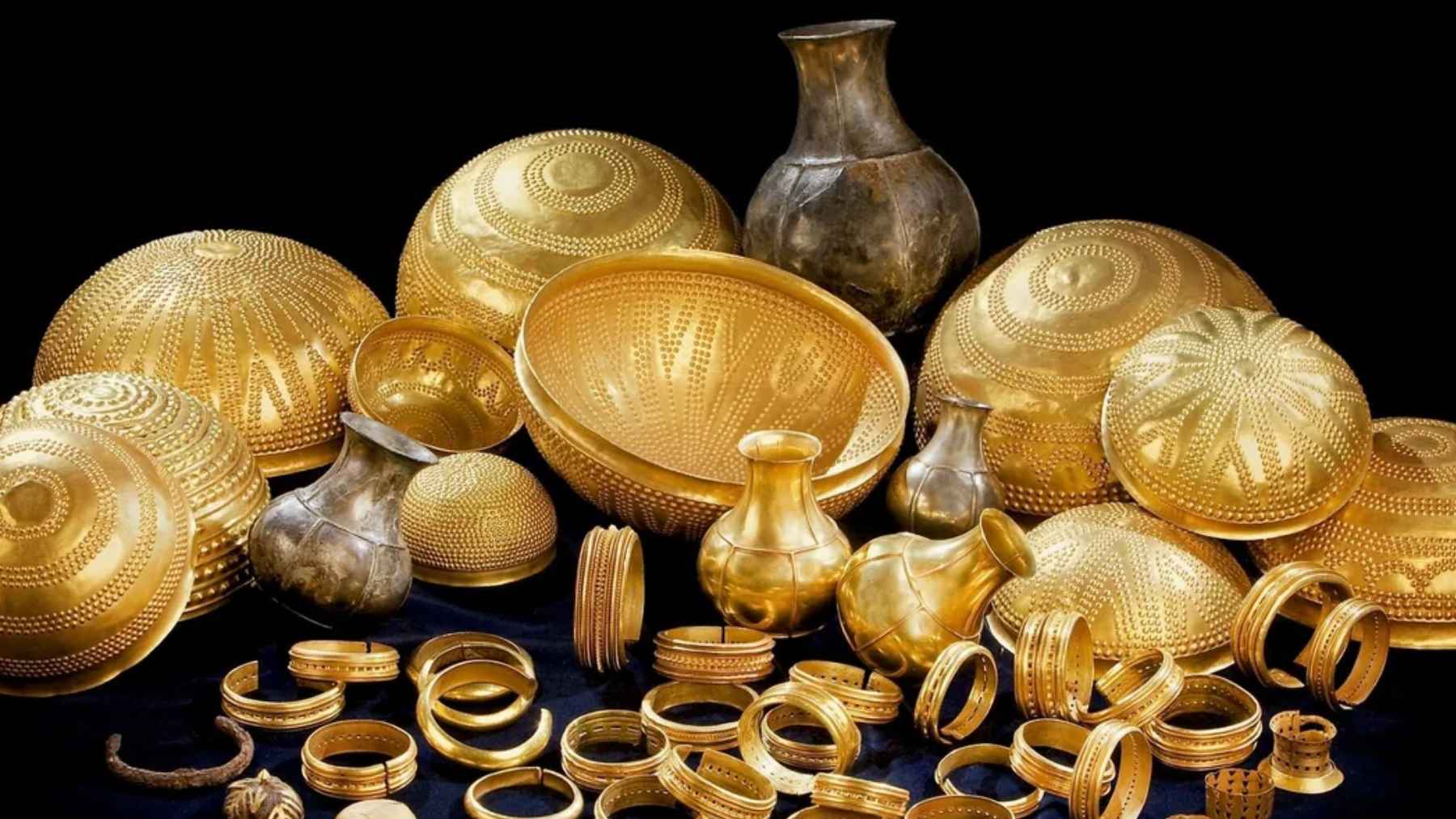
The Treasure of Villena is considered one of Europe’s most important prehistoric gold assemblages, with more than sixty objects, most of them made of finely worked gold and carefully stored in a ceramic vessel.
Amid the shine, two pieces always looked out of place, a corroded bracelet and a hollow hemispherical cap decorated with gold. Their “ferrous” appearance did not fit comfortably with the Bronze Age dating of the rest of the hoard, and for decades archaeologists were unsure how to explain them.
After all, large-scale use of terrestrial iron in the region only takes off much later. So what were these iron-looking ornaments doing in a Bronze Age treasure?
Reading the nickel fingerprint
To solve the mystery, a team led by museum conservator Salvador Rovira Llorens obtained tiny samples from both pieces and analyzed them with mass spectrometry, a technique that reveals the elemental fingerprint of a material.
Despite heavy corrosion, the tests showed a high nickel content, a hallmark of meteoritic iron rather than iron smelted from earthly ores. The authors conclude that the bracelet and cap are very likely made from meteorite iron and can be dated to the same Late Bronze Age horizon as the rest of the treasure.
In the words of co-author Ignacio Montero Ruiz, “iron was as valuable as gold or silver, and in this case [it was] used for ornaments or decorative purposes,” a sign that this rare “raw material” was reserved for high-status objects.
Ancient communities and metal from the sky
Researchers note that these may be the first confirmed examples of meteoritic iron objects in the Iberian Peninsula, placing Villena alongside better known cases such as the famous dagger of Tutankhamun and other Bronze Age “star metal” artifacts.
For the most part, such finds point to communities that watched the sky closely, collected fallen meteorites and learned, through trial and error, how to hammer this stubborn material into bracelets and weapon fittings.
There is still some uncertainty because corrosion can blur the chemical signal, and the team itself calls for newer non-invasive tests to firm up the picture.
Even so, the Villena hoard now looks a little different, not only as a masterpiece of prehistoric goldsmithing but also as quiet evidence that ancient craftspeople were already working with what we might call recycled stardust.