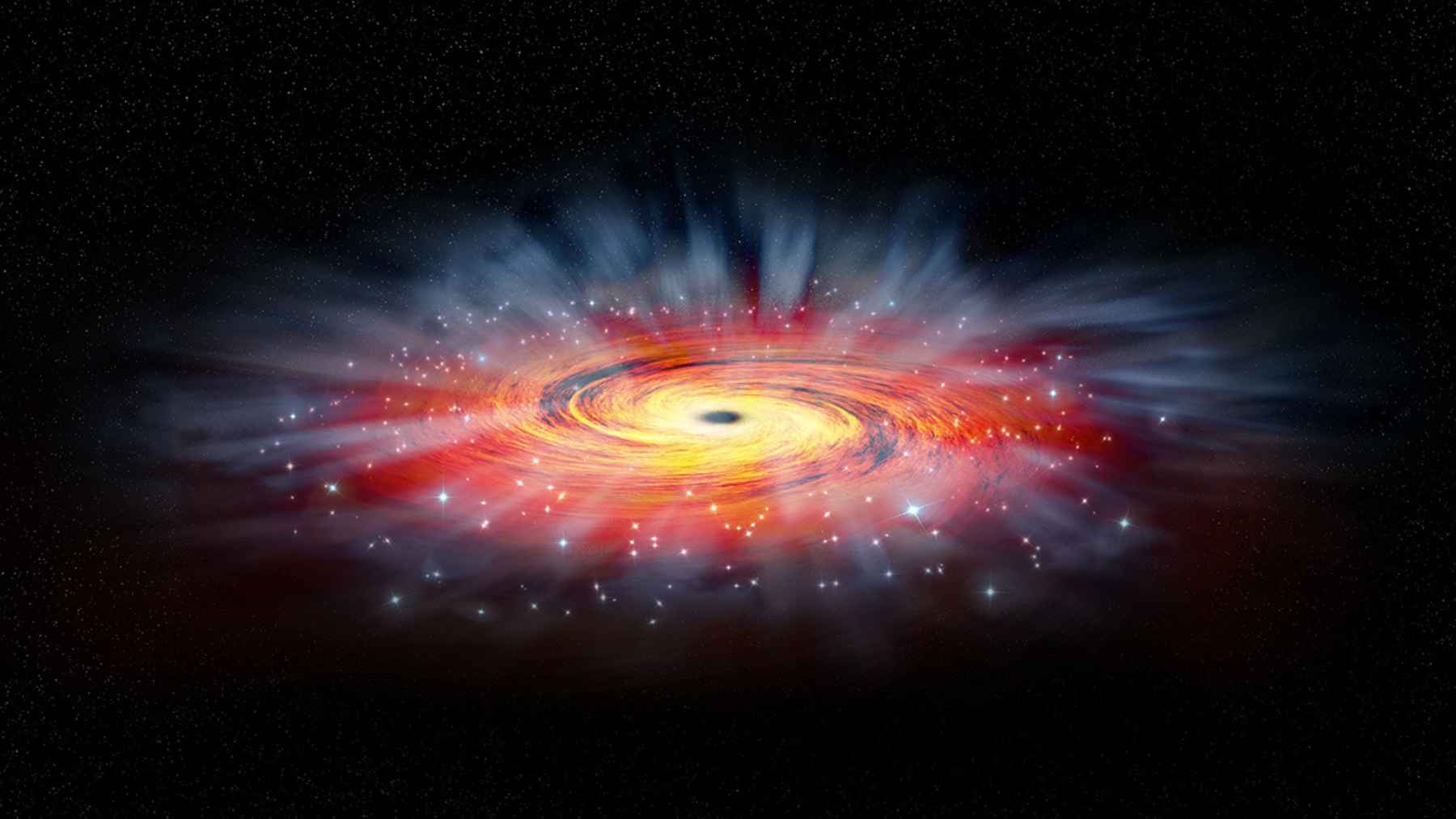
For more than fifty years, astronomy textbooks have treated the center of the Milky Way as the home of a supermassive black hole. It is the invisible heavyweight that keeps nearby stars whipping around at incredible speeds and, in a way, anchors our entire galaxy.
A new study suggests something even stranger might sit there instead. Rather than a classic black hole, the team proposes a compact clump of dark matter that behaves almost the same way from the outside.
A dark heart without a traditional black hole
At the center of our galaxy lies the bright radio source known as Sagittarius A*. Observations of the so-called S stars, which loop around this object at up to a few thousand kilometers per second, have long been treated as some of the clearest evidence for a black hole about four million times the mass of the Sun.
The new work, led by Valentina Crespi of the Institute of Astrophysics La Plata, argues that those same orbits can be explained if the central mass is made of “fermionic” dark matter. In this scenario, countless lightweight particles crowd together under their own gravity to form a super dense core that still tugs on nearby stars the way a black hole would.
The twist is that this core does not sit alone. The study describes a single structure with a compact center and a more diffuse halo of the same dark material stretching far into the galaxy. According to the authors, that unified object can handle two jobs at once: guiding the frantic motions near the galactic center and shaping the slower rotation of stars far out in the disk.
Gaia’s slow down clue
Here is where a European space mission quietly enters the story. Data from Gaia have mapped how stars and gas orbit in the outer regions of the Milky Way. Instead of staying at roughly constant speed, their motion shows a gentle decline with distance, a pattern known as Keplerian decline.
Traditional cold dark matter models often struggle with this detail. They tend to produce halos that extend with long smooth tails and do not naturally match the measured slowdown. The fermionic dark matter model predicts a more compact halo.
When the researchers combine that halo with the mass of the galactic disk and bulge, the resulting rotation curve lines up better with what Gaia sees.
Study co-author Carlos Argüelles notes that this is, to a large extent, the first time a single dark matter model connects the fast inner stars, the dust shrouded “G sources,” and the behavior of the outer galaxy in one consistent framework.
Can dark matter cast a shadow?
There is still the now famous image from the Event Horizon Telescope that appears to show a black hole shadow at the Milky Way’s center. At first glance, that seems like a problem for any alternative.
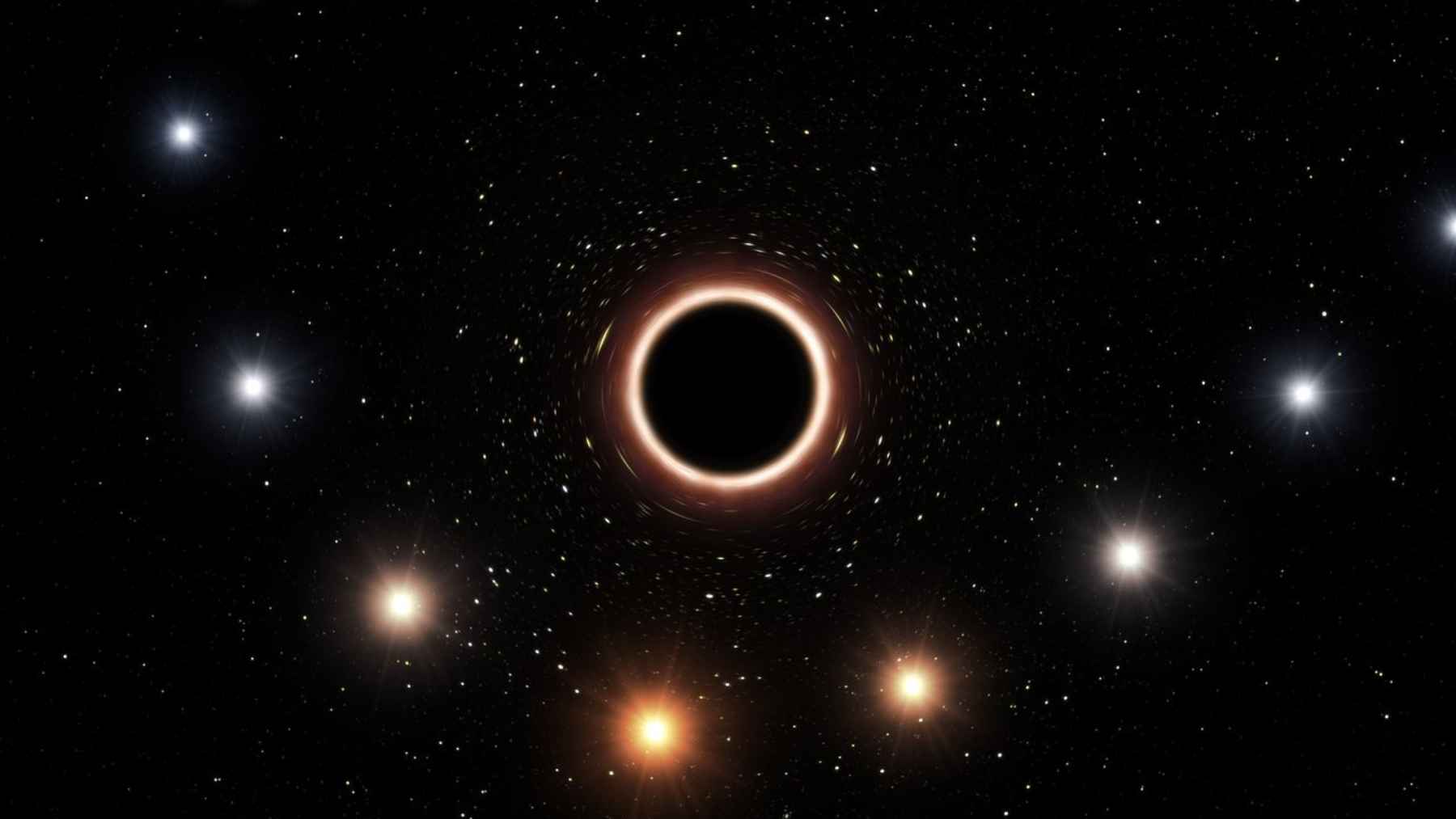
Earlier work, cited by the new study, simulated what happens when an accretion disk of hot gas lights up a dense dark matter core. The result is a central dark region surrounded by a bright ring that looks remarkably similar to the Sagittarius A* image released in 2022.
In other words, a sufficiently-compact dark core can bend light so strongly that it mimics a black hole style shadow even though it has no true point of no return called an event horizon. So from the perspective of telescopes, both ideas are still on the table.
How astronomers hope to tell the difference
Right now, the motions of the inner stars can be fitted by a classic black hole model or by the new fermionic dark matter core. Statistically, neither wins by a knockout.
The next tests will rely on ultra-precise instruments such as the GRAVITY interferometer on the Very Large Telescope in Chile. Astronomers are looking for very subtle signatures that separate a true black hole from any other compact object.
One key target is a set of nested “photon rings”, delicate patterns of light that theory predicts only for black holes. The new dark matter model does not produce such rings, so their confirmed presence or clear absence would be a strong clue.
What this means for black holes and for us
If future observations confirm a dark matter core at the center of the Milky Way, it would not erase the work of pioneers such as Stephen Hawking, who explored how black holes behave and even how they might emit radiation. It would instead tell us that not every extreme object we label as a black hole is necessarily one in the strict sense.
For everyday life on Earth, nothing changes. The night sky still shows the hazy band of our galaxy on clear summer evenings. No new threat suddenly appears on the “space weather” forecast. What shifts is our mental picture of what sits at the heart of that band of light.
At the end of the day, this study reminds us that even long standing assumptions in astrophysics are testable. The Milky Way’s central giant might be a classic black hole, or it might be something even more exotic built from invisible matter that also shapes the rest of the cosmos. Either way, the coming years of observations will tell us more.
The study was published by the Royal Astronomical Society.