Rivers can feel timeless when you stand on a bridge and watch the water slide by. Yet they are born, reshaped, and sometimes vanish altogether. By current evidence, the oldest river still following its ancient course is the Finke River in central Australia, known as Larapinta in the Indigenous Arrernte language, and it is estimated to be between 300 million and 400 million years old, which makes it older than the dinosaurs.
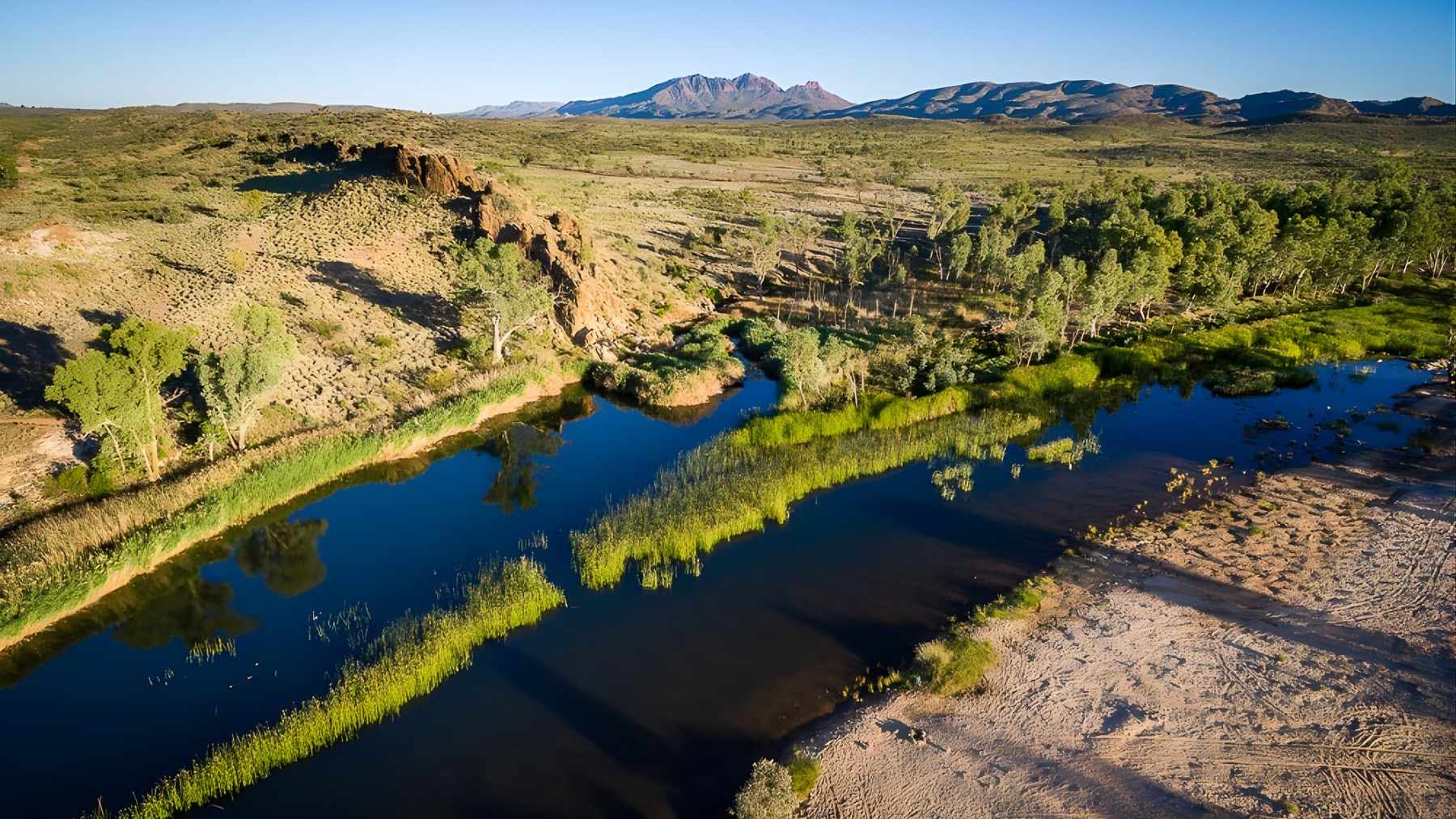
Today, this record-holding river does not look like a mighty Amazon. It stretches for more than 400 miles (about 640 kilometers) across Australia’s Northern Territory and South Australia, but in such an arid landscape that for most of the year it survives as a chain of muddy waterholes. When rare floods do arrive, they briefly stitch those pools together into a flowing ribbon, then retreat again. So how do scientists know that this intermittent river is so incredibly old?
One key clue is hidden in how the river ignores the rules of common sense. Typically, flowing water will wind its way around hard rock, taking the path of least resistance. The Finke does the opposite. As it crosses the MacDonnell Ranges in central Australia, it cuts straight through tough quartzite ridges instead of curving around them. Geomorphologists call this pattern cross-axial drainage, and it strongly suggests that the river was already in place before those mountains rose.
That idea is backed up by the region’s tectonic history. The MacDonnell Ranges, also known as Tjoritja, formed during a mountain building event called the Alice Springs Orogeny, which unfolded roughly 300 million to 400 million years ago.
If the river was cutting down while the mountains were being pushed up, as researchers argue, then the Finke is at least as old as those ranges and possibly older. In other words, it is what scientists call an antecedent river, one that holds its course even as the landscape around it buckles and lifts.
Rock chemistry adds another layer of evidence. Over millions of years, exposure to air and water leaves a subtle chemical fingerprint in surface rocks and sediments. Researchers studying the Finke region combine these weathering profiles with measurements of radionuclides, the radioactive isotopes that decay at predictable rates.
By comparing how much of each isotope remains, they can estimate when rocks formed or were last brought to the surface and match those ages to the Devonian and Carboniferous periods, when the river system appears to have taken shape.
If rivers can fade away, why has this one lasted so long when so many others have been erased by glaciers, faults, or sediment from violent eruptions? Part of the answer lies in Australia’s unusually quiet geologic setting. The continent sits near the center of the Australian Plate and has avoided major tectonic disruption for hundreds of millions of years.
That stability helped protect the Finke from being diverted or buried. As geologist Ellen Wohl notes, long-lived rivers tend to be found where the ground has remained relatively steady and where ice sheets did not repeatedly grind the landscape during the Pleistocene.
Of course, stability is never the whole story. Wohl also points out that rivers can cease to flow when climate dries or when humans pull too much water from their channels. That warning lands hard in a place like central Australia, where climate change is expected to make heat waves more intense and dry spells longer. You can picture what that means in everyday terms. More demand on groundwater, more pressure to keep farms and towns supplied, and more temptation to squeeze every last drop out of systems like the Finke that already spend much of the year as stranded pools.
From an ecological point of view, that string of pools is more than a geological curiosity. Each one can act as a refuge for plants, fish, and invertebrates that are adapted to boom and bust cycles in desert rivers. Ancient channels like the Finke preserve not only the memory of past climates in their rocks but also living biodiversity that has learned to cope with extremes.
Protecting such systems fits squarely into broader efforts on water conservation and climate resilience, especially in drylands where every perennial water source counts.
Globally, there is a shortlist of other very old rivers. In the United States, the New River, which flows through Virginia, West Virginia, and North Carolina, is thought to be about 300 million years old, making it a runner up in the age rankings. To a large extent, that comparison is academic. The real takeaway is that some rivers have survived through mass extinctions, shifting continents, and wild climate swings, yet could still be pushed past a breaking point by modern water use and warming.
So the next time you open the tap or cross a dry creek bed on a road trip, it is worth remembering places like the Finke River. This ancient waterway has outlived dinosaurs and ice ages, but its future now depends on choices made in a much shorter human timeframe.