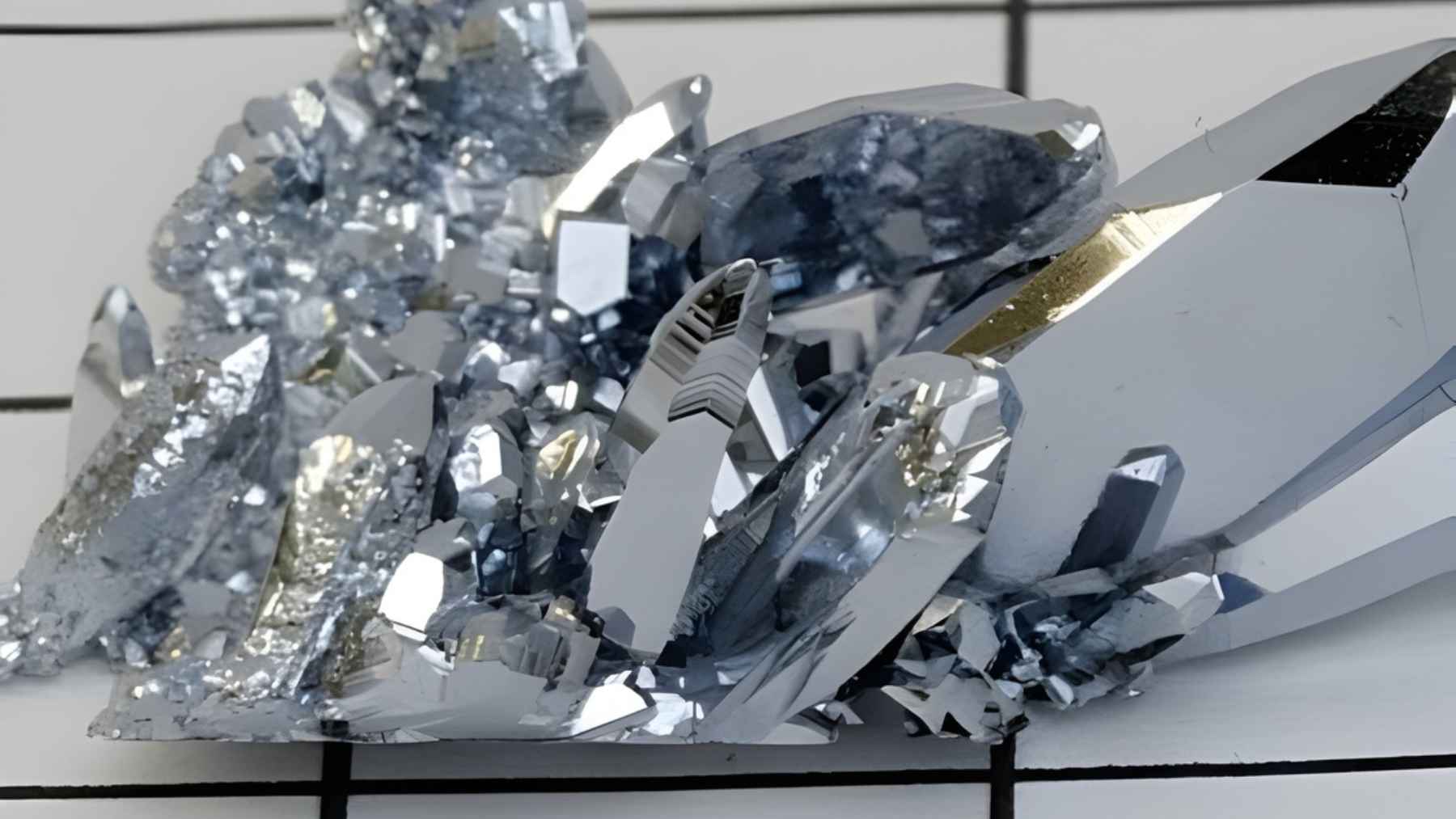
Forget gold and diamonds. Right now the most expensive material available for industrial use is a synthetic metal most people have never heard of, called californium 252. Industry estimates put its price at around $27 million per gram, roughly €23 million.
That microscopic pinch powers nuclear tools used in cancer treatment, reactor technology, and advanced analysis of fuels and building materials.
How californium 252 is made in specialized nuclear reactors
Californium 252 belongs to the actinide family and does not occur in nature. It is made in a few specialized nuclear reactors by bombarding curium targets with neutrons for years, then chemically separating out tiny amounts of the isotope.
At Oak Ridge National Laboratory this work is part of the United States Department of Energy Isotope Program. Its half life is about 2.645 years, so neutron output falls quickly and fresh material is always needed.
So what makes this obscure metal worth more than a luxury apartment in a big city? The answer lies in its neutrons. A single microgram of californium 252 can emit on the order of hundreds of millions of neutrons every minute, an intense source in a package small enough to fit inside the tip of a finger. For many tasks there is simply no other compact neutron source that comes close.
Nuclear energy and industrial uses of californium 252
Those neutrons are incredibly useful in energy and industry. Californium sources help start up nuclear reactors by providing a steady trickle of neutrons while the main fuel is still cold.
They are used to analyze coal and cement in real time, to assess the geology of oil and gas wells, and to calibrate detectors that scan cargo for hidden radioactive material and explosives. The isotope hides behind everyday things like the power in your home, the concrete under your feet, and the fuel that gets you through traffic.
In medicine, californium 252 appears in specialized cancer treatments known as neutron therapy and brachytherapy. Small sealed sources can sit close to a tumor so that high-energy neutrons damage cancer cells that resist conventional X-ray or gamma ray treatments.
Scientists, including teams at NASA, have also tested californium 252 as a way to probe planetary rocks and to measure trace elements and pollutants in soil and industrial materials.
Radiation safety and handling requirements for californium 252
Because the isotope is so radioactive, every step of its life is wrapped in protection. Sources are encapsulated in metal, shipped inside heavy shielding containers, and handled remotely in hot cells to keep workers away from direct exposure. Companies invest heavily in transport logistics and security, which also shows up in the final price.
Researchers are now studying how to produce californium 252 more efficiently at high flux reactors, squeezing more useful atoms from each campaign while keeping waste and worker doses under control.
At the end of the day this little known metal quietly reminds us that some of the most powerful tools shaping a low-carbon and health-focused future are also the rarest and most carefully managed.
A detailed technical review of californium 252 production and applications was published on ScienceDirect.
Image credit: YouTube/@Nigeriahvacnigeriahvac