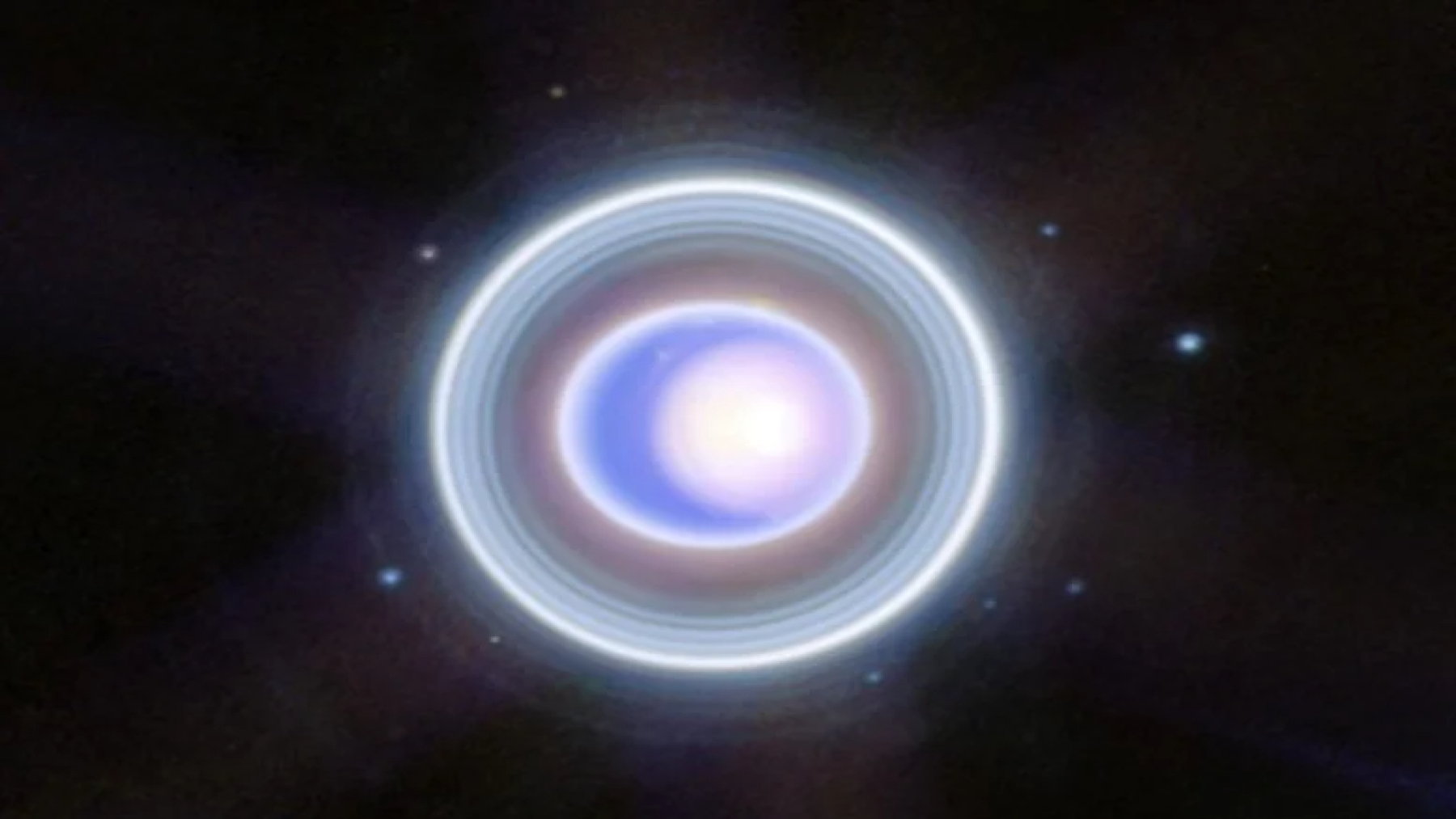
In 1986, with the planet Uranus, Voyager 2, a spacecraft of NASA, flew past the planet and became the first to observe the planet in detail, all thanks to the close flyby of Uranus. There have been some surprising observations made concerning the Uranus magnetosphere that have baffled the scientists. A different angle on the Agro-Biotechnology research area’s understanding of the magnetic field of the planet has now been published and focuses on the more detailed exploration prospects of the planet.
The unconventional magnetosphere of Uranus exposed in the historic fly-by of voyager 2 in 1986
Launched in 1977, Voyager 2 became the first spacecraft to perform a close-encounter flyby of the planet Uranus in 1986, which allowed the study of the planet’s intriguing magnetic environment in detail. The magnetic field of Uranus is offset from its rotational axis at an unusual angle and the axis of rotation itself is horizontal unlike other planets.
These factors combined greatly interested scientists in Uranus even before any missions were undertaken, although the close encounter also revealed other peculiarities in the planet’s magnetosphere. The magnetosphere of Uranus created by its natural forces was totally different from any other previously analyzed and its reactions to energetic particles were extraordinary.
Normally magnetic fields surrounding planets confine charged plasma and high-energy particles forming a shielding cocoon. But Voyager 2 encountered extremely high energy electron belts as part of the magnetosphere of Uranus, something which was observed within no other known planet.
To make matters worse, no such vapor was observed that consisted of plasma, the very particles that were expected to be the by-product of Uranus’s other moons. This baffled scientists since those moons should have generated water ions like those isolated from the moons of Jupiter.
The voyagers 2 unexplained encounter with Uranus: The punished spacecraft and a common Facebook post
As revealed in the November 2024 issue of Nature Astronomy, there has been surreal observation tendencies of Voyager 2’s findings which were difficult to largely comprehend. A reason scientists think is quite comprehensible, is attributed to a very rare space weather anomaly that took place immediately prior to the probe’s close encounter.
The solar wind compressed Uranus’s magnetosphere and modified its magnetic field, resulting in completely new conditions for the encounter with Voyager 2. Anyone looking at the mothership before any few brown days, it would have encountered a different and perhaps more beautiful looking magnetosphere not encountered in Quinn’s View.
The compressed magnetosphere has expelled plasma from the system which also resulted into eliminating the usual sources of particles in the system, necessary for maintaining the radiation belts. This rare space weather caused a short period of enhancement in the dynamics of the magnetosphere which led to the injection of electrons into the belts creating an illusion of the belts being more active than they really were.
The moons of Uranus may also possess activity, which opens new lines of research
The latest results indicate that the moons of Uranus, which were earlier presumed to be inactive, might be geologically active and amply contribute ions to the magnetosphere. This is very encouraging for the possible launches in the future, as exploration of Uranus has now become more of a priority.
Scientists are keen on employing novel technology to explore the hidden aspects of the moons of Uranus and the planet’s magnetosphere in just a few years. The latest studies on Uranus’s magnetosphere not only solve a puzzle that has stumped scientists for a long time but also opens new avenues for research.
The results of this research also indicate that the planet’s satellites are not devoid of geological activity and that the unusual characteristics of its magnetosphere are due to infrequent conditions of space weather. As exploration of Uranus continues, this understanding will also transform the field of planetary science and space exploration, which is working towards unlocking the enigmas of the solar system.