Mars has begun to collect its own museum pieces. One of the most poignant exhibits is NASA’s InSight lander, now a silent shape on the flat equatorial plains of Elysium Planitia, slowly disappearing under a steady fall of reddish dust.
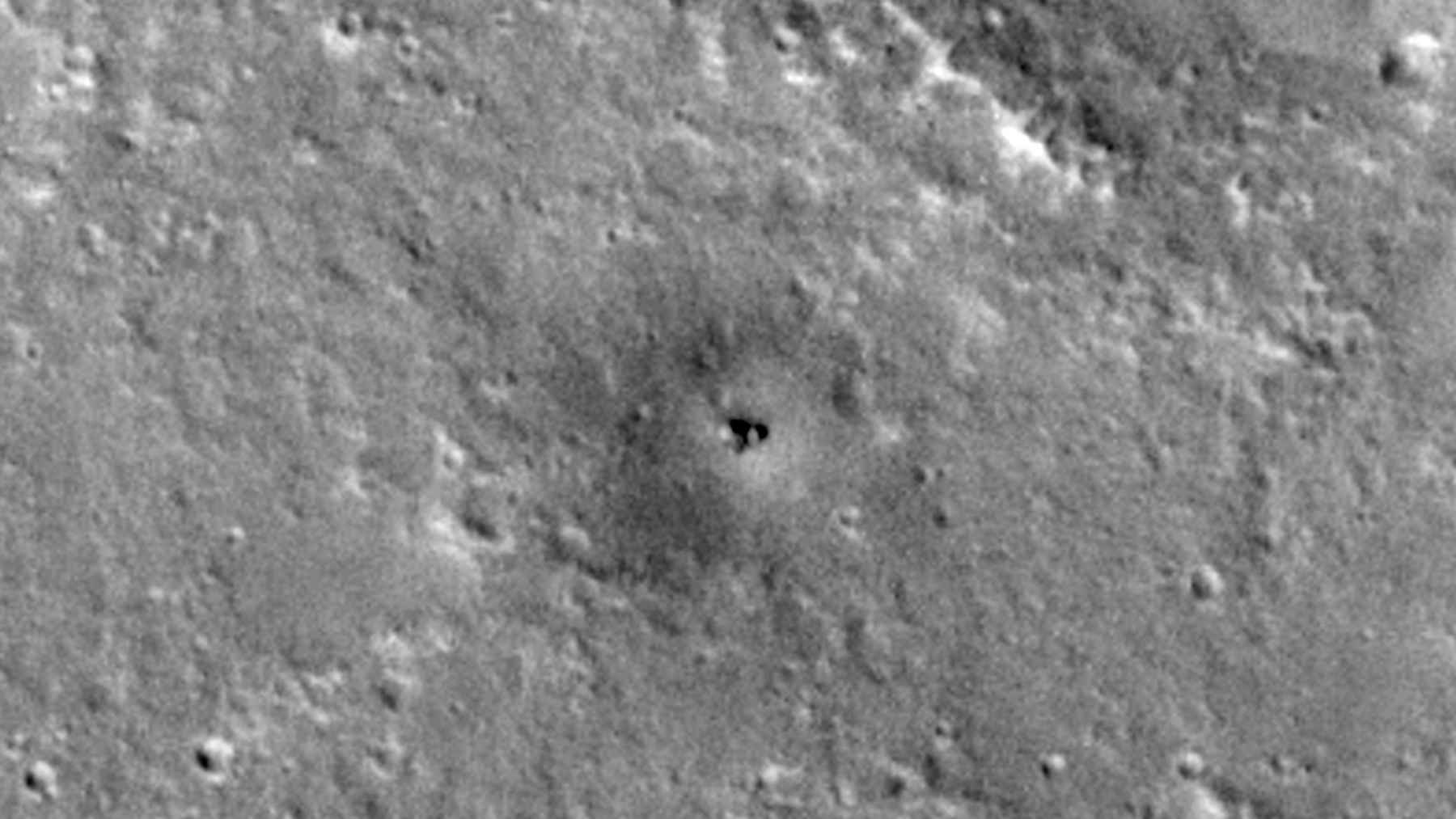
A recent image from NASA’s Mars Reconnaissance Orbiter shows the retired lander almost the same color as the surrounding ground. The orbiter used its High Resolution Imaging Science Experiment camera to photograph the site on October 23 2024, revealing solar panels that once gleamed in sunlight now coated in the same rusty hue that defines the Red Planet.
Solar panels and Martian dust explain why the InSight mission went silent
From an engineering point of view, the lander failed in exactly the way its designers expected. InSight relied on solar energy rather than nuclear power. Over time, fine dust particles settled on its circular solar panels, cutting the amount of light that could reach them.
By December 2022 the accumulation was so thick that the spacecraft could no longer generate enough electricity to run its instruments or communicate with Earth. NASA declared the mission complete when the signal went silent.
Scientifically, the mission was anything but a failure. InSight touched down in November 2018 and spent four productive years listening to the planet’s interior. Its seismometer recorded more than one thousand three hundred marsquakes, including a “monster” event, and those vibrations helped scientists infer the structure of the Martian crust, mantle and core. The lander also returned daily weather data from its place near the equator.
NASA listening campaign ends as InSight becomes a long-term Mars experiment
Even after the last transmission, mission teams were not quite ready to say goodbye. Engineers continued to listen for radio signals in case a lucky gust of wind brushed the panels clean. After two years with no response, NASA is preparing to end that listening campaign. The new orbital image serves as a visual farewell and a scientific reference point at the same time.
Science team member Ingrid Daubar of Brown University summed up that mixed feeling. “Even though we’re no longer hearing from InSight, it’s still teaching us about Mars,” she explained. For researchers, the dusty outline of the lander has become a long term experiment in how Mars reshapes its own surface.
Mars dust devils and seasonal winds tracked with orbital images and lander sensors
Mars is a planet where dust is not just a nuisance but a driving force that influences both atmosphere and landscape. By comparing images of InSight’s site taken over several years, scientists can see how fast dust settles, how often winds clear patches, and how tracks from passing dust devils appear and fade.
During the active phase of the mission, teams matched those dark, twisting tracks seen from orbit with wind measurements from InSight’s sensors. They found that dust devil activity weakened in the Martian winter and strengthened again in summer.
InSight landing halo shows how fast Mars erases fresh surface markings
The landing itself left a clear signature. When InSight arrived, its retrorockets blasted the surface and created a dark halo of disturbed ground around the spacecraft. In the earliest images that ring stood out sharply against the paler surroundings.
In the latest view that same ring is fading back toward the normal red brown color. Watching that change helps scientists estimate how quickly fresh markings on Mars become hidden.
That matters for more than sentimental reasons. New meteoroid impacts also carve bright blast patterns into the Martian surface. The number and size of impact craters in a region are key clues to its age. If researchers can tell how fast dust buries those marks, they can better estimate how long ago a crater formed and how old that piece of crust might be.
The dusty InSight site is also a lesson for future missions that depend on solar power. Fine grains can infiltrate hinges, covers and other moving parts, and they can steadily choke off energy production.
By tracking how quickly the lander and its surroundings change color, engineers gain real numbers to feed back into the design of new landers and rovers.
InSight mission partners at NASA JPL, Lockheed Martin, and European space agencies
InSight itself was a global effort. NASA’s Jet Propulsion Laboratory managed the mission, Lockheed Martin built the spacecraft, and European partners supplied key instruments. France’s space agency provided the main seismometer, Germany’s aerospace center contributed the heat flow probe, and Spain’s astrobiology center delivered temperature and wind sensors, with additional support from institutions in Switzerland, Germany and the United Kingdom.
The Mars Reconnaissance Orbiter and its camera are likewise the product of collaboration among NASA, the University of Arizona and industry partners.
Mars lander relics like Phoenix and opportunity show how the planet reshapes artifacts
Other explorers have already joined InSight as quiet artifacts on Mars, including the Phoenix lander and the Opportunity rover. From orbit, they appear as tiny shapes and fading scars on a vast desert world. Together they show that Mars is not a static graveyard of metal.
It is an active environment where wind, dust devils and time steadily erase even our most dramatic arrivals, turning cutting edge technology into tools for reading the planet’s changing face.
The official statement was published on NASA’s site.