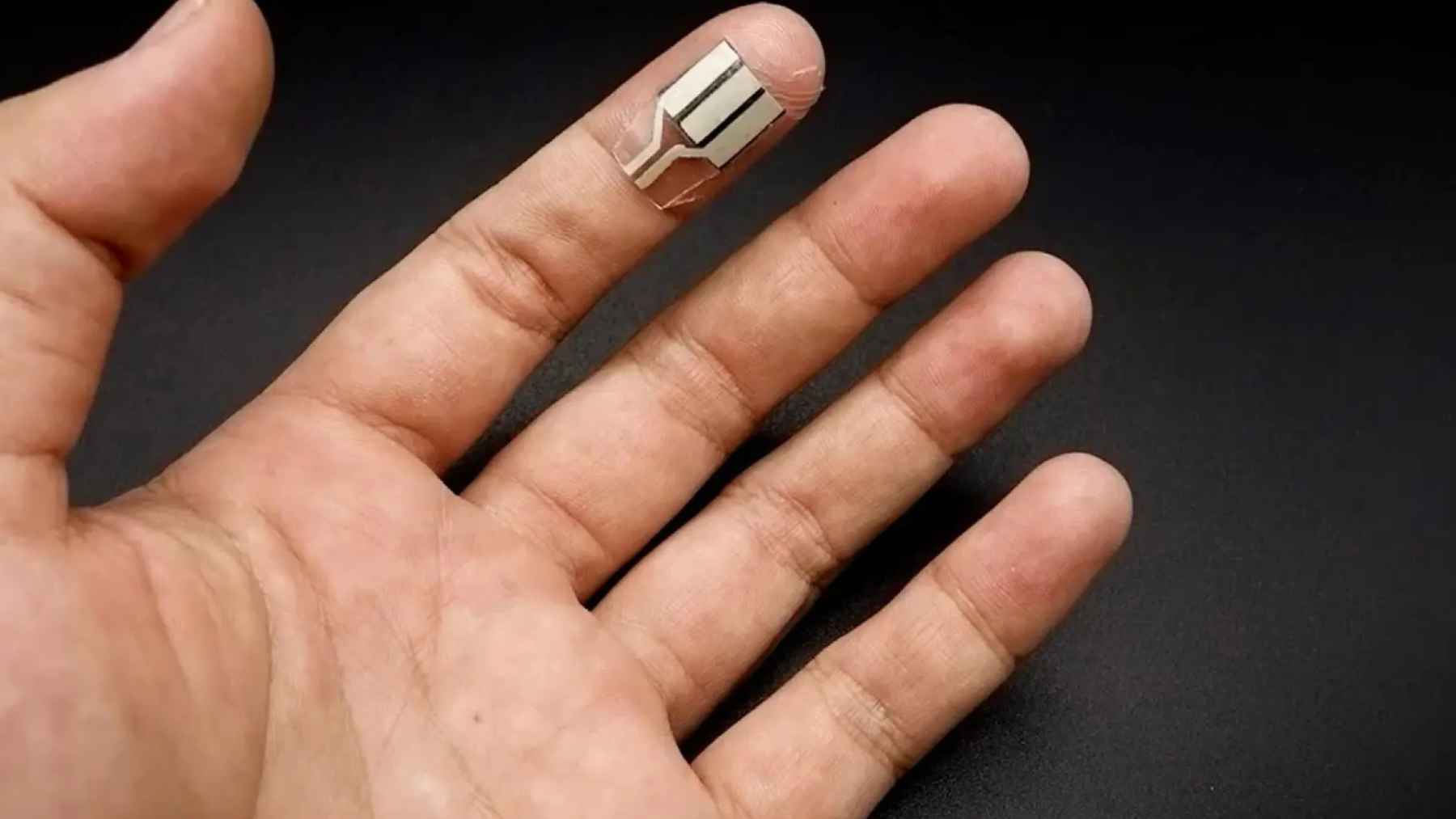
You know that mini panic when a fitness tracker dies right as you start a workout. What if the patch on your skin could power itself the moment you begin to sweat, with no rechargeable battery and no charging cable to misplace.
Researchers in Japan now say they have a cleaner way to manufacture that kind of self-powered sensor using a water-based “enzyme ink” printed onto paper in a single step. The team reports a peak power density of about 165 microwatts per square centimeter (around 1,065 microwatts per square inch) at 0.63 volts, a result published online on February 6, 2026 in ACS Applied Engineering Materials.
How sweat becomes a power source
The devices are called enzymatic biofuel cells, or EBFCs, and they generate electricity by using enzymes to drive chemical reactions in body fluids. In this study, the main fuel is lactate in sweat, and the researchers say their system can measure lactate across roughly 1 to 25 millimolar, a range tied to real exercise conditions.
The basic flow is straightforward. Enzymes help pull electrons from lactate at one electrode, those electrons move through a circuit, and oxygen is reduced at the other electrode to complete the reaction and deliver power for sensing.
The printing breakthrough
For years, EBFCs have looked promising in the lab, but manufacturing has been the headache. Conventional methods often involve printing a carbon layer, then drip-casting enzyme and mediator solutions, then drying, which can introduce device-to-device variability that is hard to control in mass production.
The Japanese team tackled that by putting the active chemistry directly into a printable formulation so the electrodes can be made in one pass. Associate Professor Isao Shitanda summed up the goal by saying they need an enzyme ink that prints “uniformly” and is “suitable for mass production.”
What is inside the enzyme ink
Screen printing is already widely used in manufacturing, and the researchers designed their ink to work with those industrial conditions on a thin paper substrate. Their recipe premixes enzymes, porous carbon materials, electron-shuttling mediators, and water-based binders, including a polymer emulsion called POLYSOL, plus carboxymethyl cellulose to get the right thickness for printing.
Going water-based is not just a convenience. The team notes that avoiding organic solvents helps preserve enzyme activity, and their electrochemical tests found the printed electrodes delivered higher catalytic currents and showed minimal decay compared with traditional drop-cast coatings.
What the numbers mean for real devices
The full lactate oxygen cell reached a maximum power density of 165 microwatts per square centimeter (about 1.06 milliwatts per square inch) with an operating voltage of 0.63 volts. The researchers also highlight that this exceeds a previously reported value of 96 microwatts per square centimeter (about 619 microwatts per square inch) in similar systems.
This is micro power, not phone power. But it is in the range that can support low-power sensing and small wireless transmissions, and the team says earlier work indicates the output can run Bluetooth Low Energy for sending sweat lactate readings.
Reliability is part of the story too. The researchers report that drop-cast electrodes can degrade to less than half their initial activity within minutes to hours, while the enzyme ink electrodes held steadier during longer tests.
The sustainability angle hiding in plain sight
Every wearable looks small, but the pile of devices and chargers we cycle through adds up. The world generated about 68.3 million tons of electronic waste in 2022 (62 million metric tonnes), and only about 22 percent was documented as properly collected and recycled.
Battery-free patches will not fix e-waste on their own, especially if they are designed for single use, but they could reduce demand for miniature batteries and simplify designs. At the end of the day, making sensors that run on the chemistry we already produce could be one way to shrink the battery footprint of health tech.
What has to be proven next
A paper-based sensor still has to survive the real world. Can it handle sweat, bending, and daily movement without losing performance, and can the enzymes stay active long enough for practical wear times.
The team has already shown the idea can scale on printing equipment, including a roll-to-roll demo that continuously printed about 1,312 feet of substrate (400 meters). They also say practical implementation may come closer to 2030 after further optimization, long-term validation, and integration with wearable platforms.
If it gets there, the use cases are easy to picture. Real-time lactate tracking could help athletes fine tune effort, and continuous metabolic monitoring could support care settings and even heat illness prevention when hot weather turns a simple walk into a sweaty challenge.
The official press release was published on Tokyo University of Science.