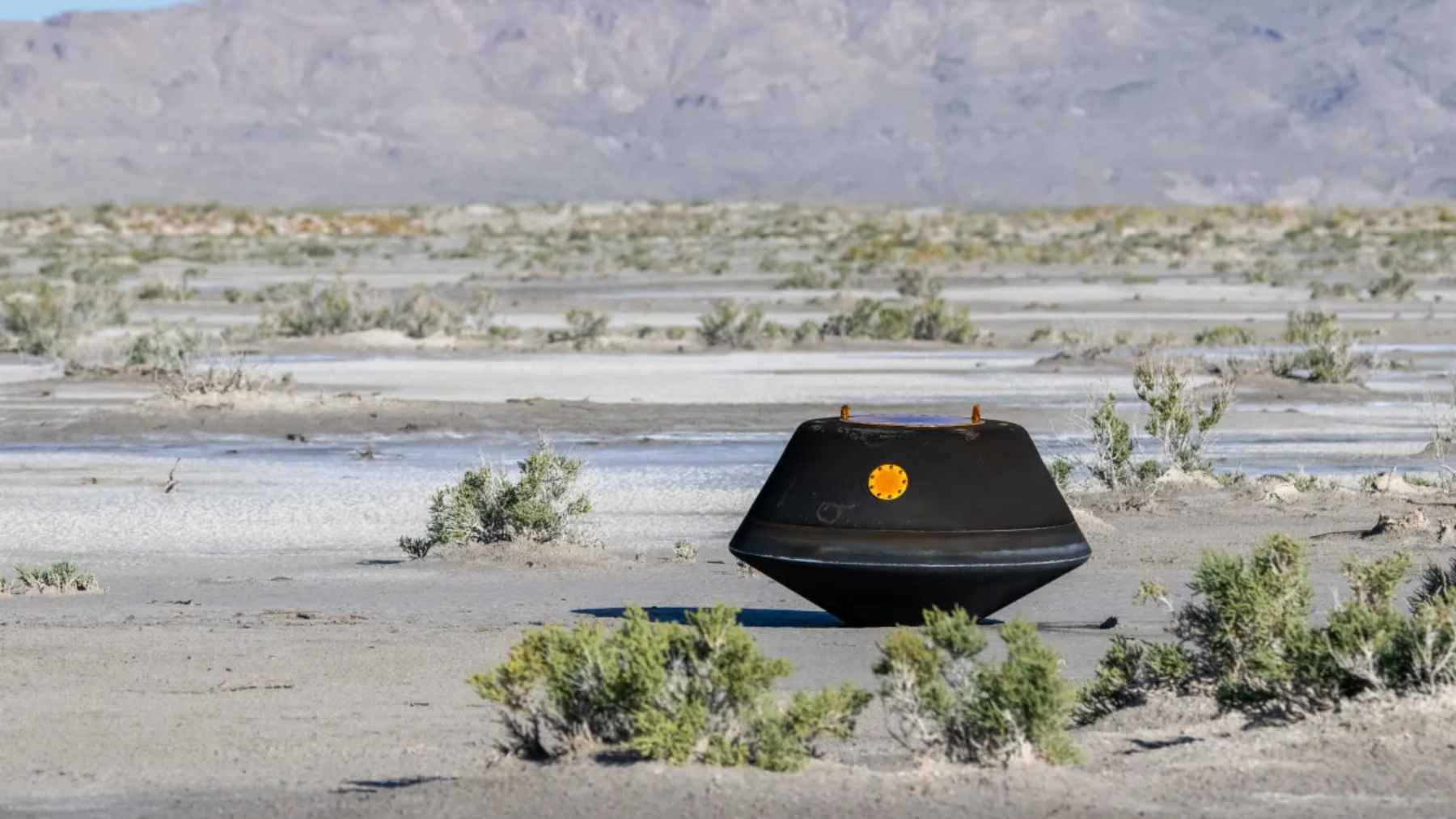
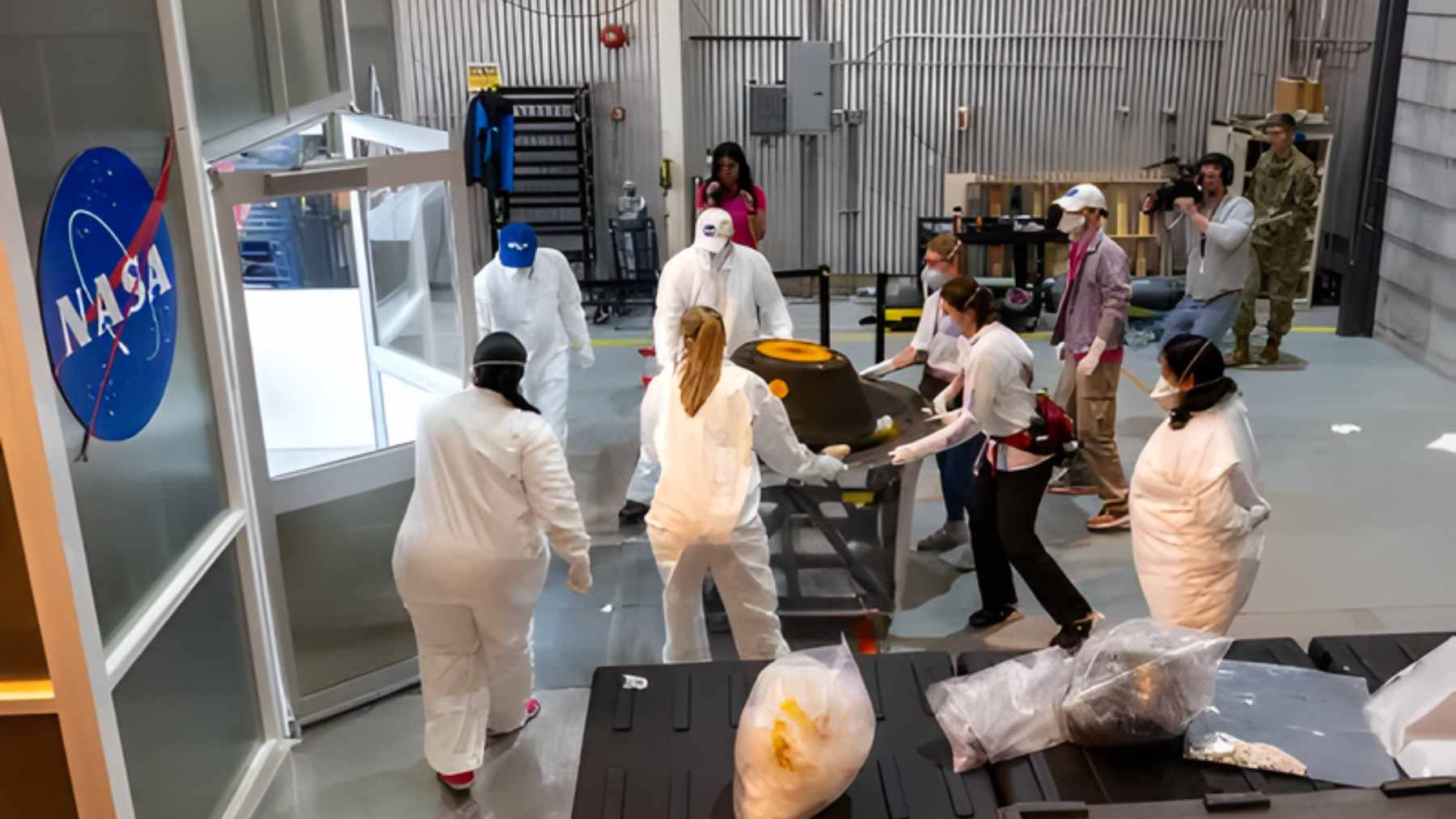
When NASA’s OSIRIS‑REx spacecraft dropped a capsule of asteroid dust over the Utah desert in 2023, scientists hoped it would clarify how life began on Earth.
Now, a new analysis of that material from the near‑Earth asteroid Bennu suggests that key amino acids may have formed in frozen, radiation‑soaked regions far from the young Sun instead of only in warm pools of liquid water.
Bennu is a dark, carbon-rich rubble pile about 500 meters across, thought to preserve material from roughly 4.6 billion years ago.
It already stood out because earlier work on the returned samples found that they are rich in carbon, nitrogen and ammonia, along with amino acids and even the nucleobases that build DNA and RNA.
Those results came from coordinated studies including a NASA analysis of the Bennu sample and a Nature Astronomy paper on Bennu’s volatile-rich chemistry.
At the same time, Bennu is not just a quiet museum piece drifting in space. It is a near‑Earth asteroid Bennu that periodically swings past our planet and has been modeled as a potential long-term impact risk, even if the odds are low.
That dual role as both a threat and a time capsule is part of what makes it so compelling.
A colder birthplace for amino acids than scientists expected
For decades, textbooks treated one pathway as the standard way to build simple amino acids in space. In that picture, known as Strecker synthesis, ingredients such as hydrogen cyanide and ammonia react with other carbon-containing molecules in liquid water at mild temperatures.
It is an idea that fits nicely with a young Earth full of hydrothermal systems and with meteorites altered by water. But what if some of life’s building blocks took shape much farther from the warmth of any planet?
The new study, led by geoscientist Allison Baczynski at Penn State, zoomed in on the isotopes inside Bennu’s amino acids. Working with grains of dust no bigger than a pinch of salt, the team measured subtle differences in the ratios of carbon and nitrogen isotopes in individual molecules, especially glycine, the simplest amino acid.
Their results suggest that Bennu’s glycine did not form in a lukewarm liquid ocean inside a rock but inside extremely cold ice that was later bathed in radiation in the outer regions of the early solar system.
To check that conclusion, the group compared Bennu’s chemistry with the famous Murchison meteorite, which fell in Australia in 1969 and has long served as a benchmark for prebiotic organics.
Murchison’s amino acids carry isotopic fingerprints that match formation in watery environments at moderate temperatures. Bennu’s amino acids look different, which points to a chemically distinct birthplace for its parent body.
The bigger picture for life, and the puzzles that remain
Those comparisons build on other work showing just how complex Bennu’s organic inventory really is. A separate team recently reported prebiotic organic compounds in samples of asteroid Bennu, including at least 14 of the 20 amino acids life uses on Earth and a diverse suite of other carbon-based molecules.
Another study at the Advanced Light Source in California identified nitrogen-rich polymers in the asteroid’s rocks, early “gum like” material that could have acted as precursors to amino acids and nucleobases, as described in an Ancient Asteroid Provides Evidence of Amino Acid Precursors highlight.
Put together, these findings strengthen ideas that small bodies can deliver a kind of formula for life to young planets. If amino acids, sugars and related molecules can form in cold cosmic ices as well as in warmer, watery environments, then the potential habitats for the chemistry that precedes biology widen dramatically. Earth becomes one possible stage, not the only one.
Bennu also keeps surprising chemists with details that do not yet fit neatly into any theory. In the new work, the two mirror image forms of the amino acid glutamic acid showed strikingly different nitrogen isotope values, even though they are chemically identical except for their handedness. Researchers expected those twins to match.
They did not. That mystery hints that we still lack key pieces of the puzzle connecting simple space chemistry with the specific handedness that life on Earth prefers.
Why this matters beyond Bennu
While scientists dissect Bennu grain by grain, other teams are busy tracking fresh objects that rush past our planet. Research on near‑Earth asteroids helps refine how often rocks like Bennu cross our path and how dangerous they might be.
In parallel, missions and telescopes that follow another potentially dangerous asteroid show how the same data can serve planetary defense as well as basic science. Bennu has even featured in work that probes a possible strange new force in the universe, showing how one small world can influence questions that range from gravity to biology.
At the end of the day, this little rubble pile is turning into a kind of reference library for the early solar system. It records cold molecular clouds, icy outer regions, watery alteration inside an ancient parent body and the long journey into a near‑Earth orbit where a sample return mission could reach it.
The study was published in Proceedings of the National Academy of Sciences.