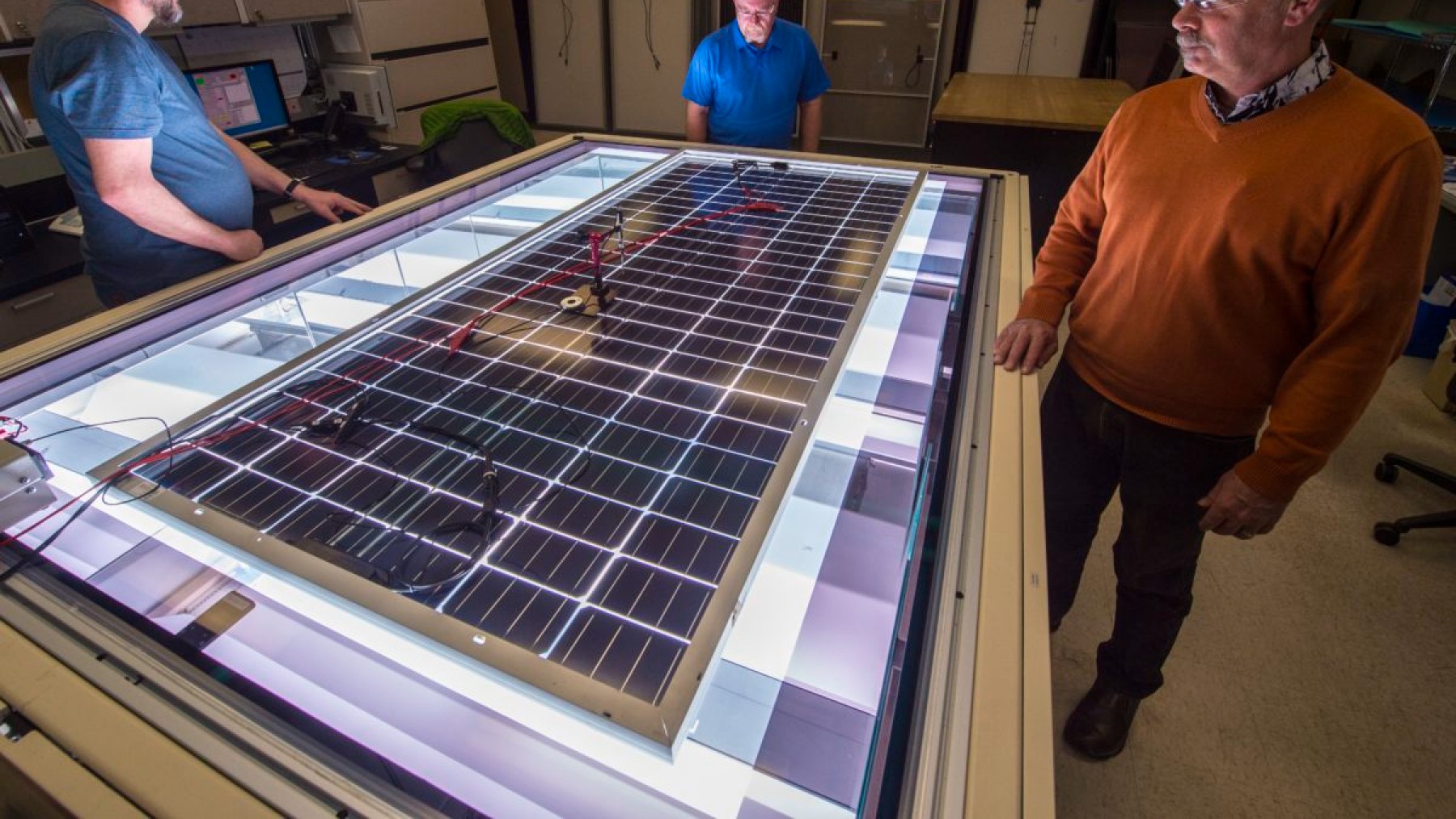
A solar panel appears that should not exist. It is 190% efficient and breaks the laws of the universe. The futuristic ‘solar panel N’ was a revolution, something that is about to happen again. The fight against climate change has already become one of the most important challenges for mankind. It is for this reason that decarbonization is one of the most sought-after goals for different nations.
After years of using fossil fuels, there is an urgent need to replace them with renewable energies, a process known as energy transition. This concept encompasses the set of changes in energy production, distribution and consumption models in order to achieve greater sustainability.
In this context, solar panels play a fundamental role as ‘suppliers’ of solar energy. Due to their importance, more and more efficient models are appearing on the market, such as the product we are going to present below. It breaks the laws of the universe and many believe it shouldn’t even exist.
The most amazing solar panel: its efficiency knows no bounds
A key step towards breaking down a limit in solar panels has been taken with a product that demonstrates 190% of extreme quantum efficiency. It represents a break with the laws of the universe because the theoretical limit governed until now was just above 33%.
But with new technologies that push quantum efficiency, it has been shown that a conversion of more than 60% can be obtained. These new solar cells would reach an extreme quantum efficiency level of 190%.
As mentioned earlier, this number far exceeds the previously considered Shockley-Queisser limit. In 1961, physicists William Shockley and Hans Queisser set a theoretical limit on the amount of light energy that could be transformed into electricity. Over the years, this limit was raised to 33.7%, establishing a standard.
According to this theory, out of 1,000 W/m2 incident light, only 337 W/m2 can be converted into electricity. Now this system is only applied to single-layer systems, since new panels and materials that have come out over time have left this figure far behind.
Lehigh University (USA) took a step beyond all previous research. Their findings were reported in the journal Science Advances. They sought to find a technology for next-generation panels and created a quantum material that, integrated as an active layer in a solar cell device, gave 80% absorption and a high rate of photoexcited carriers.
The EQE ranged from 110% to 190% over a wide repertoire of solar waves, including near-infrared and visible light spectrum. Another goal in improving conversion efficiency is to take advantage of all possible bands.
The super solar panel that breaks the laws: Experts could have reached a record efficiency
Along with this discovery, the team observed that by adjusting the thickness of this active layer, higher optical activity and higher EQE is achieved at wavelengths from 600 to 1,200 nm. The theoretical result is a conversion efficiency of up to 63%. This is how an impressive result was achieved.
The university team is aware that there is still a lot of work ahead. However, there are already several well-established ways to improve the EQE and efficiency of the solar panel. In short, the efficiency of this solar panel (190%) breaks the laws of the universe and is a real milestone in the energy sector, where the solar panel already enjoys a privileged place.