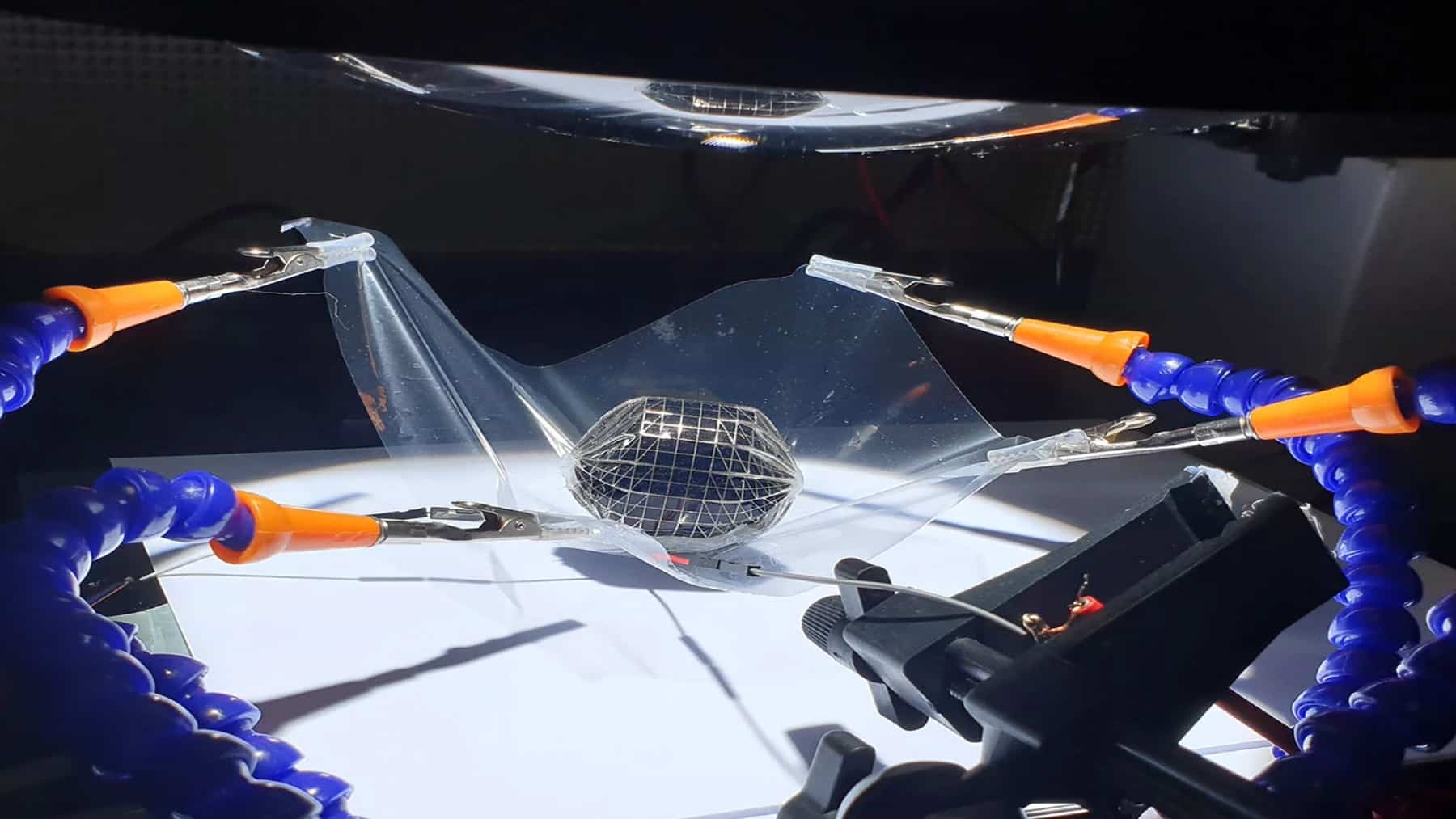
Revolutionary spherical solar cells are revolutionizing energy capture by means of their ability to absorb all direct, diffuse, and reflected solar radiation in every direction without requiring any mechanical systems of tracking sunlight. King Abdullah University of Science and Technology has produced a large-scale spherical silicon solar cell under novel, corrugation methods that bend rigid silicon to be flexible.
The traditional limits on solar panels are revamped by the spherical design
Conventional flat solar panels are severely hampered in capturing scattered and reflected sunbeams, and when necessary, tracking systems are required to keep up with the movement of the sun during the day, and thus incur high expenses. By capturing light at various angles at the same time, including direct sunlight, diffuse atmospheric light, and background reflections, which are not captured by flat panels, spherical solar cells can eliminate these limitations.
The ball-shaped design allows the generation of the maximum amount of energy on a system of cells independent of sun position, and hence these cells are of special importance in a system where mechanical tracking systems are either impractical or prohibitively expensive. This all-purpose light capture feature is one of the radical departures of traditional solar technology, which is based mainly on exposure to direct sunlight.
The silicon transformation is flexible with an advanced corrugation method
Scientists have invented a new method of corrugation, whereby hard monocrystalline silicon can be converted into a soft material, and a flexible material can be made to assume the shape of a sphere. This revolutionary technology incorporated in the manufacturing process retains the high efficiency properties of traditional silicon and allows the creation of 3D formations hitherto unattainable with the existing cell-based technology of solar cells.
Increased power generation by light harvesting in all directions
The findings of the experiment show that there has been a massive increase in performance as compared to conventional flat solar cells with the same ground coverage area. Having tried using sand as the reflective background material, the spherical cells demonstrated a 14.8% increment in the instantaneous power output. More radically, the power output was 39.7 percent higher than in the flat panel designs when white paper was used as the reflective surface.
The ball-shaped architecture uses as many photons as possible since light is utilized in the design as opposed to the flat panel designs, where the light is wasted. This encompasses diffracted atmospheric light, earth reflection, and diffused light, which plays an important role in the generation of energy that is general across weather conditions and daytime.
Less maintenance is needed with dust dust-resistant orientation
Representing spherical cells installed facing downwards gives it an automatic edge in terms of resistance to dust collection over the conventional flat panels. This cleansing property lowers the maintenance levels and gives it greater consistency of operation in the long run, especially important in a dusty environment where conventional panels need to be cleaned on a regular basis.
The uses of practical applications are not limited to conventional installations
Solar cell spheres represent a new technology that opens up the potential of solar integration in small-sized devices, wearable electronics, and space challenges in the use of overly large flat panels in space. The fact that the technology can turn sunlight that is scattered inside a building into power is what makes it particularly viable in indoor settings, cities with little direct sunlight, and devices that need a constant energy supply.
Spherical solar cells are a breakthrough in the technology of photovoltaic technology as they break the restrictions of the flat panel design to harness the untapped light energy. The new practice shows that in improved ways in which traditional materials can be innovated to become practical and efficient to generate greater power, consume less maintenance, and find more uses.
Disclaimer: Our coverage of events affecting companies is purely informative and descriptive. Under no circumstances does it seek to promote an opinion or create a trend, nor can it be taken as investment advice or a recommendation of any kind.