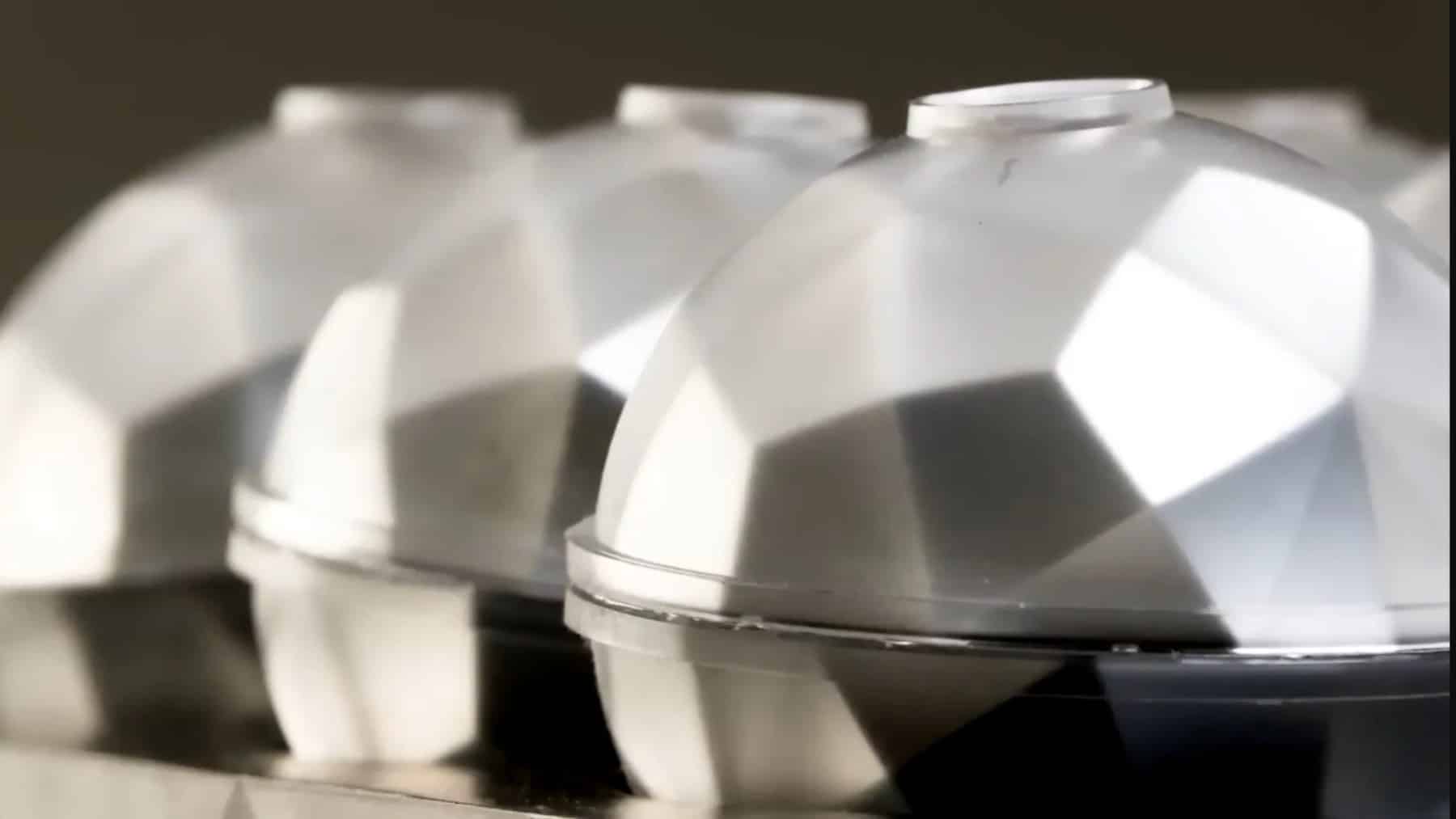
For several years now, solar panels have always followed somewhat of a blueprint. Flat solar panels that are rigidly structured and designed to face the sun is what everyone has come to know solar panels to be. With the increasing demand for renewable energy, Japan unveils the first photovoltaic sphere.
Japan’s Kyosemi Corporation is challenging the whole idea of what solar cells should look like with their spherical solar cells. Known as Sphelar, these photovoltaic spheres unveiled by Japan are set to revolutionize not only the appearance of panels but how we gain energy from the sun. Gone are the days of sticking to flat solar panels.
Why are we still making flat panels?
The entire premise of flat panels is being questioned as it is believed that flat solar panels were created in controlled labs where the light source was static. Research and real-life observation indicate that the sun floats across the sky throughout the day and changes position with the seasons. The observation of the sun’s positioning during the day and throughout the different seasons indicates that flat panels may be flawed. Flat solar panels are able to capture the sun’s energy at its peak efficiency for a limited time of day only.
Kyosemi’s founder, Mr. Nakata, saw this limitation as a way to question, why are solar panels flat when sunlight is always moving? The question further led to experiments in Japan’s JAMIC microgravity research tunnel. Research and experimentation led to Kyosemi melting and crystallizing silicon in near-weightlessness to form perfectly round silicon crystals considered to be the building blocks of Sphelar.
These sphere-shaped panels are capable of absorbing sun from all directions, harnessing energy from direct sunlight, reflected rays and ambient lights. This allows solar panels to be effective throughout the day and during the different seasons. These solar panels indicate a shift from solar panels developed in labs to that of panels that are able to capture nature’s complexity.
The unique edge of Sphelar solar cells
Sphelar’s sphere-shape is a neat and quite an impressive development in solar engineering. Every micro-sphere has been specifically designed to capture sunlight omnidirectionally without the panel needing to be tilted or tracked to follow the sun’s path.
A noteworthy feature of the Sphelar cell is its versatility that shines through this space-saving panel that is aesthetically pleasing and well-suited to urban environments. Sphelar solar cells also enable an energy-producing window or smartphone to gain charge from ambient indoor light making these cells quite the advancement in mobile tech too.
With competitive efficiency of about 20% in comparison to flat panels, the Kyosemi’s method minimizes waste by using molten silicon droplets to reduce the material losses typical in slicing flat wafers. As silicon prices escalate globally, the efficient use of this resource becomes even more valuable.
Prospects, potential and promise on the road ahead
Much like Korea’s first invisible solar panel in history, the prospects, potential and promise of Sphelar is apparent, however, this solar panel experiences a few hurdles that it needs to overcome before it can compete with flatter solar panels on a global platform. Thus far, scalability is an issue. Manufacturing these spherical cells with precise P-N junctions on curved surfaces is technically demanding and not as yet cost effective in comparison to flat cell solar panels. Kyosemi, however, is currently investing in automation to reduce costs and produce more panels.
The future is not flat or round, but sphere-shaped
Kyosemi’s Sphelar cells deviate from traditional panels and as such do not look conventional but plays according to the sun’s terms similar to the record-breaking leaf panel. Japan’s spherical panel is a shift towards a more sustainable and decentralized energy future, reminding us that out-of-the-box thinking is best.