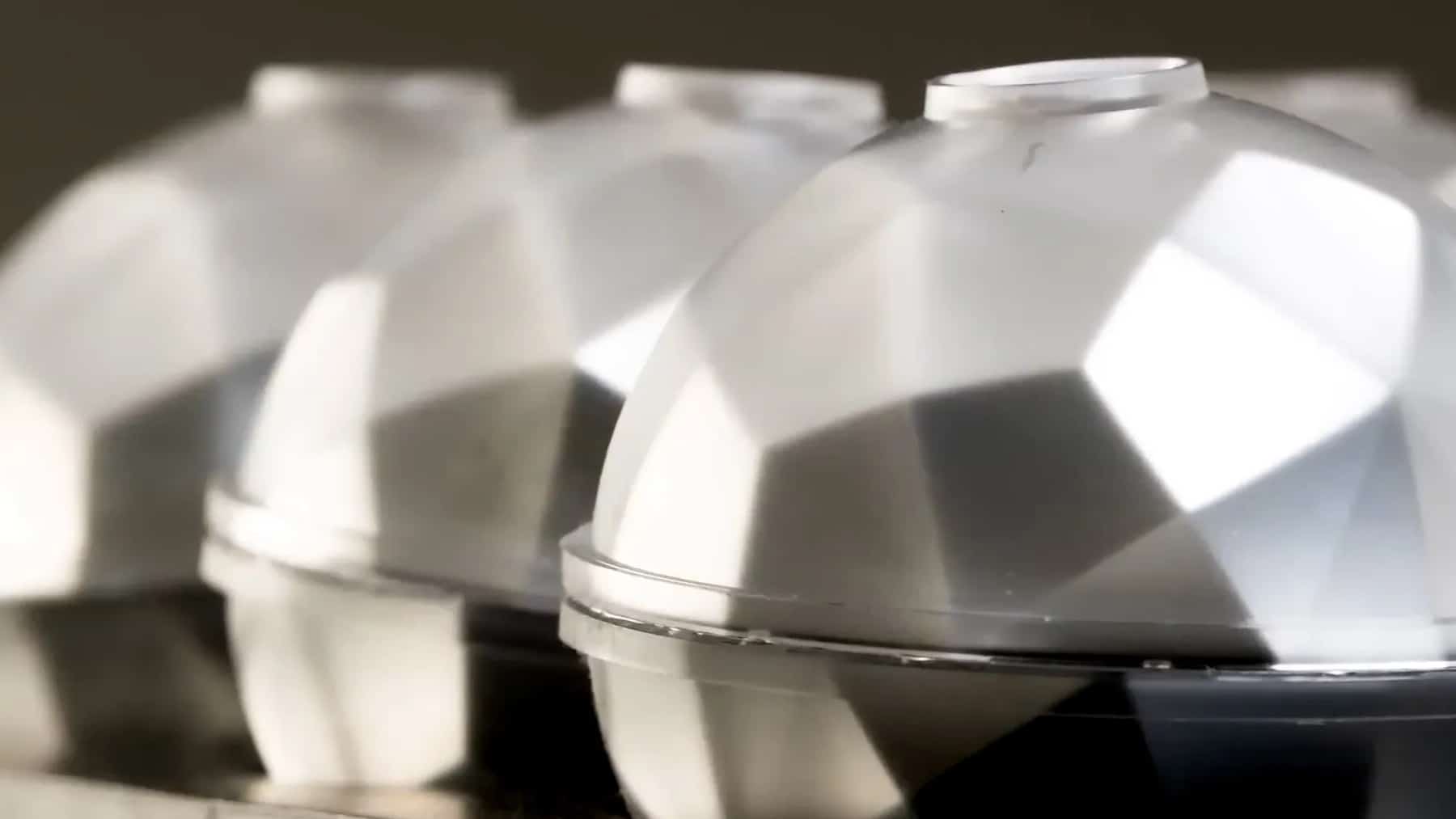
When we think about the global race for energy transition, we always think of the United States as the leader when it comes to installed solar power capacity. But recently, Japan seems to have just taken the next evolutionary leap. And why? Well, while the rest of the world continues to rely on flat panels, the Japanese have unveiled something radically new: photovoltaic spheres. This new technology could change everything we know about capturing sunlight, especially in urban environments and where space is limited.
Have you ever stopped to wonder why solar panels are flat?
The most curious thing is to think that all this innovation began with a simple question asked by a Japanese engineer named Shuji Nakata, founder of Kyosemi. How so? Well, while working on flat solar panel projects at Mitsubishi Electric, he began to wonder why the entire industry continued to insist on flat surfaces, even though they knew that the Sun is always moving.
Of course, in laboratory environments, the light source is fixed. However, in real life, sunlight arrives from different angles throughout the day and seasons. In addition, we must remember that in addition to direct light, there are also reflections, shadows and atmospheric diffusion. And all this made Nakata wonder: “what if the cell were spherical?” And that was how the concept of spherical micro solar cells was born, which would be able to capture light at 360°, regardless of the position of the Sun.
It all started in a coal town, with microgravity experiments and a silicon sphere
To better understand this, we need to go back to the 1980s, when Kyosemi was looking to expand its production in Hokkaido, northern Japan. With this in mind, they chose the city of Kamisunagawa, a former coal mining company that was looking to reinvent itself, as their base. It was there that the company found the ideal partner: the recently opened Japan Microgravity Center (JAMIC), which used an old mine tunnel to create a 710-meter-deep vertical laboratory.
Then came Nakata’s bold new idea: to form silicon spheres in microgravity by dropping capsules of molten silicon down a 490-meter vertical shaft (a far cry from these wind spheres). It would be the temporary absence of gravity during the fall that would allow the material to naturally solidify into a spherical shape. It was through trial and error that the team finally managed to generate crystallized grains in the shape of a ball.
However, it didn’t stop there. They had to face a technical challenge: creating P-N junctions on curved surfaces, something much more complex than on flat panels. It was in this scenario that they applied their knowledge of optoelectronics, and the team then created the first functional spherical cells, which, when exposed to light, successfully generated electricity.
But are these photovoltaic spheres really applicable?
After many tests, the first promising results appeared. It was then that Kyosemi created its own Microgravity Laboratory in 1998. In 2004, they registered the Sphelar brand. And from then on, they began distributing samples and seeking practical applications for the new technology.
Of course, as with all new technologies, the market reception was initially cautious, after all, no one knew for sure where and how these spheres could be applied. But versatility soon proved to be one of their advantages, as Sphelar cells can be integrated into windows, clothing, backpacks, mobile devices, electric cars and even curved building surfaces. Not stopping there, they work better than flat panels in low light conditions, partial shade and indoor environments, surprising everyone, just like Aeroleafs, which deliver free energy through a tree planted in your