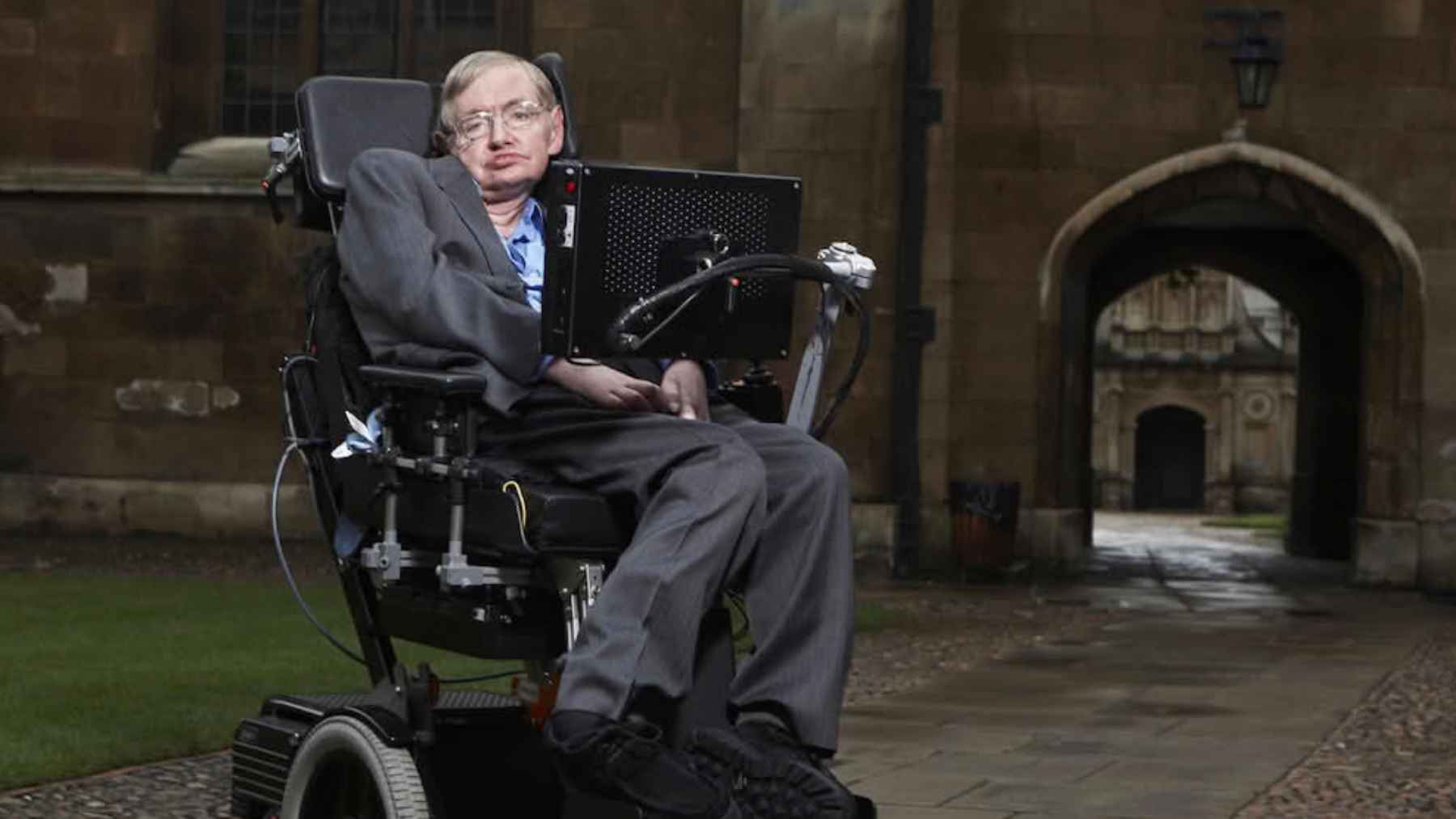
How does a scientist end up reshaping black hole physics and becoming a household name at the same time? Stephen Hawking did exactly that. His work helped rewrite modern cosmology, and his books made ideas about time, gravity, and the universe feel less like distant classroom jargon and more like questions anyone could ask.
His story carried extra force because it unfolded under severe physical limits. Diagnosed at 21 with ALS, a disease that slowly damages nerve cells, Hawking lost much of his movement and natural speech. Even so, he stayed active in research and public life for more than five decades, turning a computerized voice into one of the most recognizable sounds in science.
From Oxford to Cambridge
At University College Oxford, Hawking studied natural science and finished with first-class honors in physics. He then moved to Trinity Hall, Cambridge, where his doctoral research on expanding universes launched the work that would define his career.
His rise was fast, and it was not ordinary. In 1979, he became Lucasian Professor of Mathematics, one of Cambridge’s most celebrated posts and one previously held by Isaac Newton. He remained in that role until 2009.
The black hole idea that changed physics
A black hole is a place in space where gravity is so strong that even light cannot escape once it crosses the boundary around it. In 1974, Hawking argued that black holes are not completely black after all because quantum effects near that boundary can make them leak energy over time.
That proposal became known as Hawking radiation. In practical terms, it pushed two major areas of physics toward each other: Einstein’s theory of gravity and the strange rules of the quantum world. The work appeared in Nature and also helped ignite the still unresolved information paradox.
Why the wider public never forgot him
Hawking did not leave those ideas trapped in specialist journals. His 1988 book “A Brief History of Time” became a global bestseller, stayed on the Sunday Times list for 237 weeks, and helped make theoretical physics the kind of subject people talked about at kitchen tables, in school hallways, and on long commutes.
Recognition followed almost everywhere. He was elected to the Royal Society, later received its Copley Medal, was awarded the Presidential Medal of Freedom in the United States, appeared in The Simpsons and Star Trek, and saw his life retold in the 2014 film The Theory of Everything, which earned Eddie Redmayne an Oscar for playing him.
That mix of deep science and public reach is why Hawking still stands apart. Plenty of researchers change a field, but very few also change the way teenagers, parents, and casual skywatchers talk about black holes.
The main official materials referenced for this article were published by the Stephen Hawking Estate and the University of Cambridge, with supporting official records from the Royal Society, Nature, StarTrek.com, and the White House.