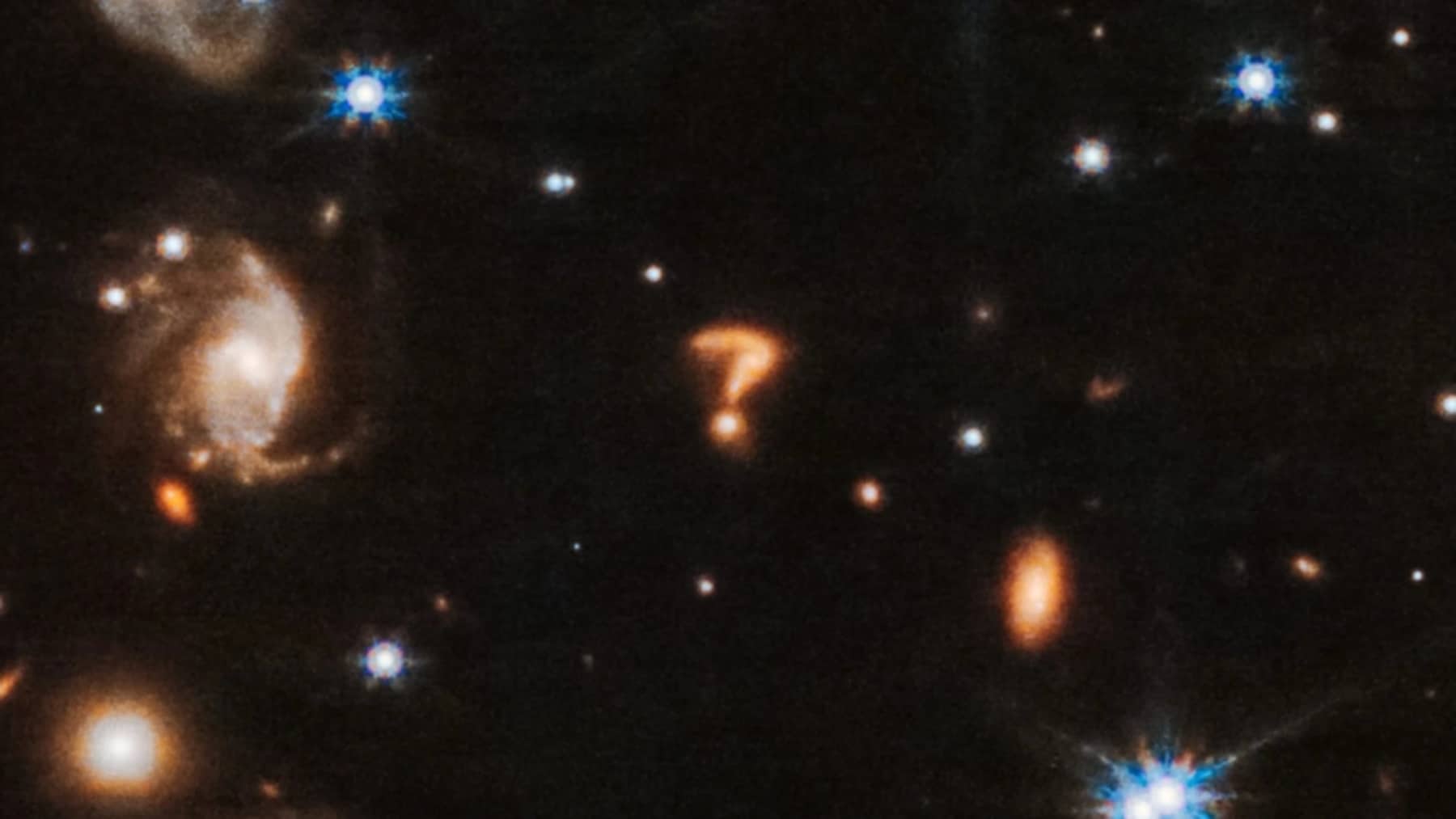
NASA thrives off having new hurdles and obstacles to overcome with the aim of gaining more profound and deeper insights into the universe. This time, the reputable government agency was on a quest to uncover the details of what the Milky Way galaxy might have looked like 7 billion years ago when they captured an enigmatic question mark.
The Integral role fulfilled by NASA’s James Webb Space Telescope
The James Webb Space Telescope is an essential addition to NASA’s abundance of resources, as it allows astronomers to capture photographic evidence in its highest quality. The telescope was launched in 2021 and, since then, has helped NASA to present to the world exclusive images that display the findings made by scientists. What actually makes the James Webb Space Telescope unique?
As per reports, the telescope is the largest in space, possessing high-resolution and sensitivity features that make it capable of capturing images from different kinds of ranges. Its design is representative of modern astronomy because it perfectly regulates infrared astronomy. In a solar system filled with confusion and various objects, the Webb Space Telescope brilliantly simplifies the universe in a manner that humans can fathom.
It is therefore not a surprise that the telescope was at the center of an enigmatic question mark captured by NASA. Owing to the Webb Space Telescope, astronomers have the ability to analyse photographs and make sense of what it means in the context of the universe.
What is the enigmatic question mark that NASA captured in a distant galaxy?
NASA spotted a question mark whilst conducting a study on the galaxy cluster MACS-J0417.5-1154 using the now infamous Webb Space Telescope, which has the ability to capture objects within a galaxy billions of light-years away. An astronomer who was in awe of the image described it as “cool looking”. The cluster is apparently so monstrous that it twists the fabric of space-time, giving astronomers access to see the other distant galaxies that are located behind the cluster.
Delving deep into the apparent illusion: An analysis of why it’s not real
In the instance where NASA spotted a question mark shape, a red galaxy, and a spiral galaxy were interconnected, leading to them becoming strangely magnified and distorted. The galaxy cluster MACS-J0417.5-1154 is said to act like a funhouse mirror, which twists the light through gravitational lensing and can produce numerous photographs of the same thing. Additionally, gravitational lensing is what happens when a massive phenomenon like this particular galaxy cluster contorts the fabric of space-time, causing the magnification of galaxies that are located behind it. Although space is filled with miraculous occurrences, it is still impossible for the same object to be found in two different places, hence ‘it’s not real’.
What is the relevance of NASA discovering an enigmatic question mark?
When NASA makes interesting discoveries, humans instinctively seek to make connections between the solar system and the Earth. However, sometimes there is no identifiable connection. In this particular case, the question mark image and the findings made by NASA are beneficial to astronomers as they continue to conduct further investigations. The scientists are able to gain a deeper insight into the specific details of star formation in galaxies. Reports also predicted that the two interconnected galaxies forming the question mark shape are likely to be in their preliminary stage of development, meaning more images can be captured in the future as they fully develop.
If it were not for the technological innovation that led to the launch of the James Webb Space Telescope, astronomers might not have been able to spot the enigmatic question mark in the universe. The cluster MACS-J0417.5-1154 effectively deceives people into believing that galaxies are bigger than they actually are. Still, NASA’s telescope provides a clearer visual for astronomers to fathom star formation in the universe accurately.