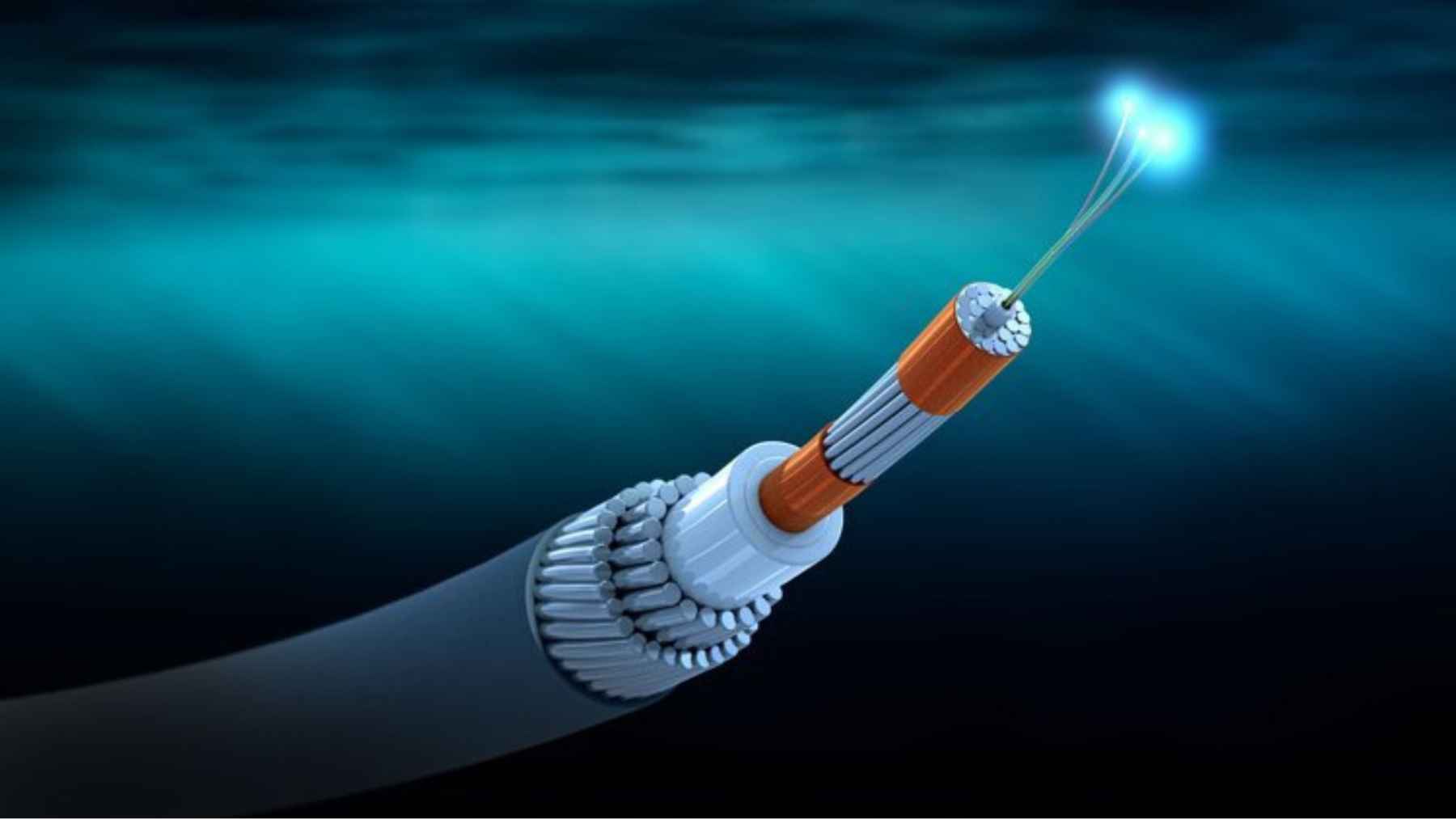
Every time you hit play on a movie or join a morning video call, you are leaning on a massive infrastructure that most of us never see. Thin glass strands on the seafloor carry almost all international data traffic. Those same strands are now being reimagined as a kind of planetary nervous system that can listen for earthquakes, tsunamis and even whales in near real time.
According to the International Telecommunication Union, submarine telecommunication cables carry roughly 99% of international data exchanges and span more than 1.7 million kilometers worldwide. Instead of serving only as digital highways, scientists are turning sections of these cables into long, ultra-sensitive sensors that run along the seabed.
The idea is simple to describe, even if the engineering is complex. Use what the world already built for the internet to watch over the ocean.
Distributed Acoustic Sensing (DAS) explained
A key technique behind this shift is called Distributed Acoustic Sensing, or DAS. In plain terms, DAS lets researchers use the fiber itself as a continuous line of tiny vibration meters.
Short laser pulses are sent through the cable, and tiny stretches and squeezes in the glass change how the light bounces back to shore stations. By tracking those changes, software can reconstruct vibrations, pressure variations and some kinds of sound all along the cable path.
That turns a single cable into thousands of virtual instruments. Instead of placing a few seismometers or hydrophones here and there in the ocean, the cable behaves like a dense array, with “listening points” spaced every few meters. For earthquake and tsunami monitoring, that continuous coverage matters a lot, especially offshore where instruments are rare and access is expensive.
SMART subsea cables and UN ocean monitoring
This is where a United Nations-backed effort comes in. The Intergovernmental Oceanographic Commission of UNESCO, the World Meteorological Organization and the ITU created a Joint Task Force on SMART subsea cables. SMART stands for Science Monitoring And Reliable Telecommunications.
The concept is to build new commercial telecom cables with environmental sensors integrated into their repeaters on the seafloor, measuring pressure, temperature and salinity, along with seismic and acoustic signals.
In practical terms, that means every time a country lays a new transoceanic link to make streaming faster or cut its cloud costs, it could also be adding a permanent deep ocean observatory.
SMART cables are designed to feed data into global climate and hazard systems, including sea level and ocean heat monitoring and tsunami early warning for coastal communities.
Earthquake early warning using fiber optic cables
We are not talking about theory only. In Monterey Bay, California, researchers have already tested how DAS can plug straight into earthquake early warning networks.
A recent study described the dEPIC framework, which uses DAS data from a submarine cable to act like a dense offshore seismic array that can work on its own or together with the existing ShakeAlert system in the United States.
Because the cable sits closer to offshore epicenters than many land stations, it can pick up the first vibrations earlier and help refine estimates of where a quake started and how big it might be. In an early warning system, even a few extra seconds can mean more time to stop trains or shut off industrial processes.
Whale monitoring and underwater noise detection
The same sensing power can also “hear” living things. In the Salish Sea, in the Pacific Northwest, scientists unspooled more than a mile of fiber optic cable to test whether DAS can track endangered Southern Resident orcas.
Their bet is that hair-thin strands carrying internet traffic can double as a continuous underwater microphone, capturing the clicks and calls of whales as they move through busy shipping lanes.
Unlike traditional hydrophones that listen from a single point, DAS treats the entire cable as a chain of listening posts. That can help pinpoint where animals are and how they respond to ship noise.
For an orca population of roughly seventy five animals that already struggles with lack of salmon, underwater noise and pollution, knowing in real time where the pods are swimming could guide “slow down” alerts for ferries or rerouting of noisy activities. It is a small but very practical way ocean tech could touch everyday operations.
Submarine cable resilience and disaster risk reduction
All of this is happening while cable owners and regulators worry more about resilience. The ITU has highlighted that hundreds of active and planned cable systems report around 150 to 200 faults each year, from fishing gear, anchors, landslides and other hazards.
For the telecom industry, that is a risk to cloud services and international finance. For coastal communities, it overlaps with a different concern, which is how to prepare for tsunamis, seafloor earthquakes and rising seas in a warming climate.
Experts stress that fiber-based sensing will not replace buoys, tide gauges and traditional seismometers. It is more likely to become an extra piece of the puzzle.
There are also open questions about cost, long-term sensor reliability, data sharing and the security of critical infrastructure. To a large extent, the future of “listening cables” depends on whether governments, network operators and scientists can agree on who runs what and who gets the data.
Still, the direction of travel is clear. The cables that already carry our calls, texts, memes and remote meetings are being asked to do one more job; listen quietly to the planet under our feet.
At the end of the day, turning that invisible infrastructure into a permanent ocean observatory could be one of the most efficient environmental upgrades humanity has built without fully realizing it.
The study was published in Nature Scientific Reports.