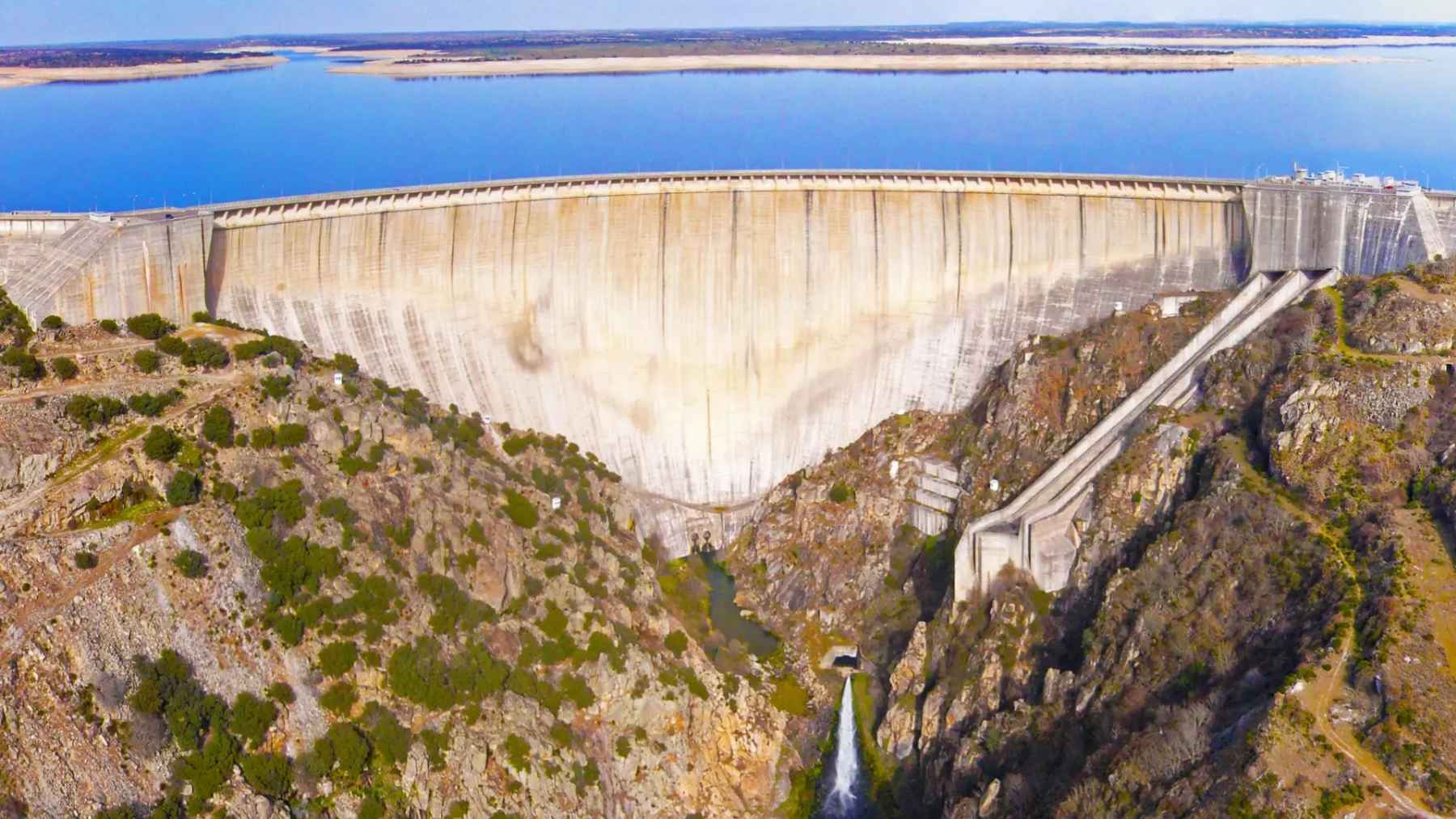
After weeks of heavy rain, reservoirs across Spain are finally looking blue again instead of worryingly brown. Near the border with Portugal, Almendra Dam in western Castilla y León is close to brim level, its concrete wall rising more than two hundred meters over the gorge like something out of a fantasy series.
According to recent figures from MITECO, peninsular reservoirs are now close to 77 percent of their total capacity, compared with about 58 percent at the same time last year. In that overflowing map, Almendra stands out.
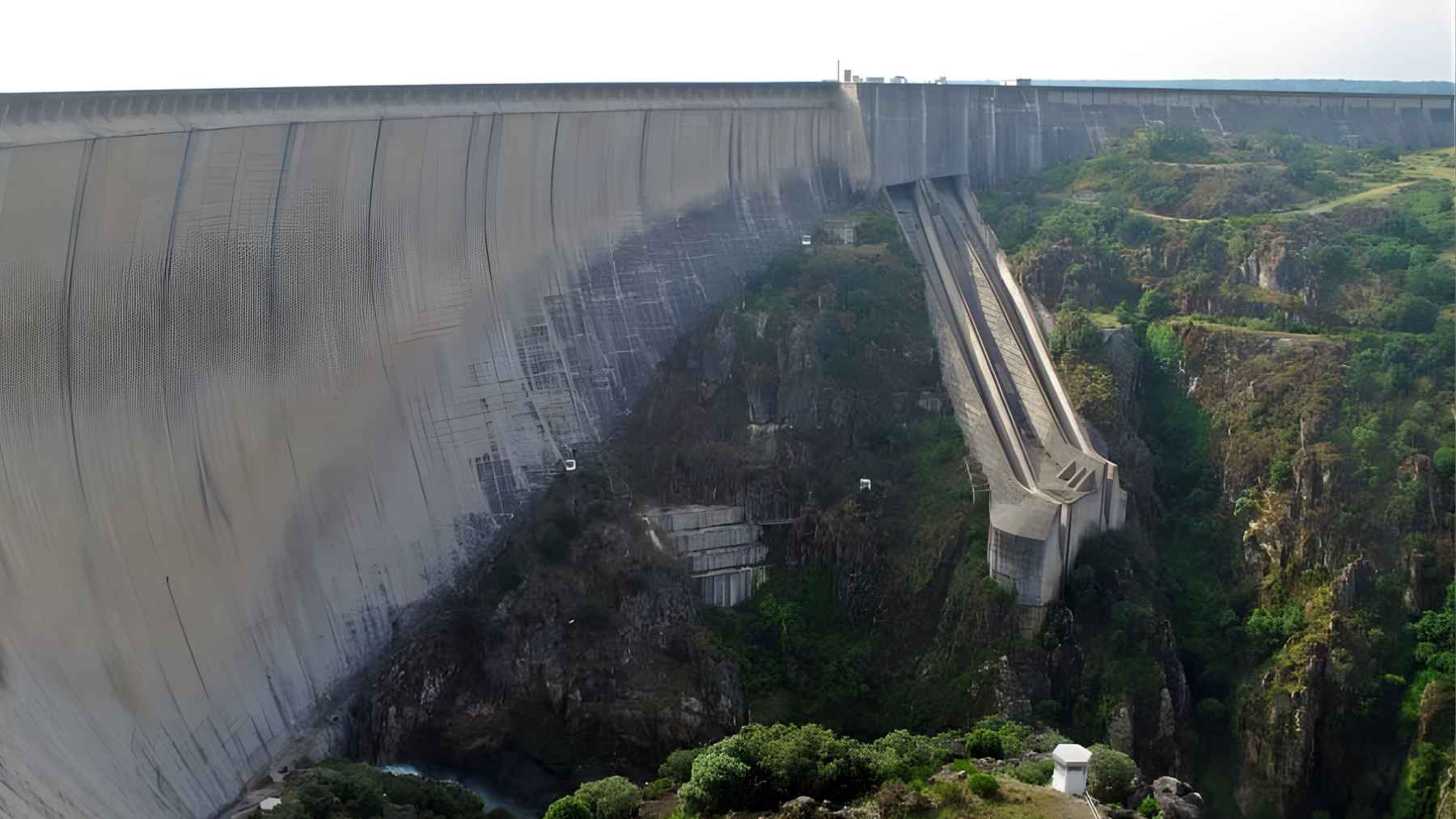
Built in the 1960s on the lower reach of the Tormes River, its arch wall rises about 202 meters and holds a reservoir that can store around 2,650 cubic hectometers of water, the third largest capacity in the country.
In simple terms, this single basin can keep enough water behind it to support one of the most powerful hydro plants in the Spanish grid while also smoothing floods on the way to the Duero River.
A concrete giant that works like a battery
What is all that water really doing for everyday life and for the electric bill? Almendra is not only a dam. Through a fifteen-kilometer tunnel carved into bedrock, water travels to the underground Villarino hydropower plant, where six reversible turbines can generate electricity or pump water back up to the reservoir. At full operation, those turbines can move roughly 232,000 liters every second, enough to send a small river uphill.
By combining generation and pumping, the Almendra Villarino pair behaves like a giant rechargeable battery. When there is plenty of wind and solar power and prices drop, water is pushed uphill and stored.
When demand spikes in the evening or during a heat wave when air conditioners roar to life, operators let the water fall again and recover that energy in minutes.
For a grid that is trying to run on more renewables, that flexibility is gold. It helps keep lights on when clouds roll in and wind farms slow, without relying as much on gas plants.
Landscape, tourism and a wall that looks unreal
The reservoir behind Almendra spreads across roughly 8,600 hectares of plateau, a surface locals call the sea of Castilla. The dam and its lake sit inside Arribes del Duero Natural Park, a protected landscape of canyons, vineyards on terraces and small livestock farms.
For years, visitors could walk along the crest road and stop at informal viewpoints to take in the dizzying drop to the river. New European safety rules tightened access and local mayors complained that closing the crown of the dam hurt rural tourism in a region already losing people and jobs.
In response, regional authorities and Iberdrola are now developing a dedicated viewpoint that will join the network of singular overlooks in Castilla y León. The structure is designed to channel visitors toward a safe platform while still showcasing birds, cliffs and the enormous curve of concrete that many compare to a fantasy fortress.
A village under the water line
The story of Almendra also has a quieter chapter that does not appear in tourist brochures. Beneath the reservoir lies Argusino, a village of around four hundred residents that was expropriated and demolished in the 1960s before the dam gates closed.
On 17 September 1967, the first waters from the Tormes flooded houses, farmland and the cemetery. Families were compensated and relocated, but their home disappeared in barely more than a day. In years of drought, stone walls and church foundations sometimes reappear at the edge of the shrinking lake and former neighbors gather for memorial events.
Almendra is far from the only case. By 2023, Spain had more than 2,450registered dams, over one thousand of them classified as large structures. Many helped secure drinking water, irrigation and electricity. Many also erased valleys and reshaped rivers, a trade off that is still sparking debates between engineers, local communities and environmental groups.
What Almendra tells us about future water and energy
At the end of the day, Almendra is a snapshot of the tensions inside the energy transition. On one hand, its reversible turbines provide low-carbon power and storage that can back up wind and solar for decades to come. On the other, its wall and reservoir are a permanent reminder that even renewable infrastructure comes with social and ecological costs.
Climate models suggest that the Iberian Peninsula will face longer dry periods mixed with more intense downpours. Large reservoirs like Almendra can help capture part of that erratic rainfall and release it slowly, but only if they are managed with safety, ecosystems and local voices in mind.
The official statement was published on MITECO.