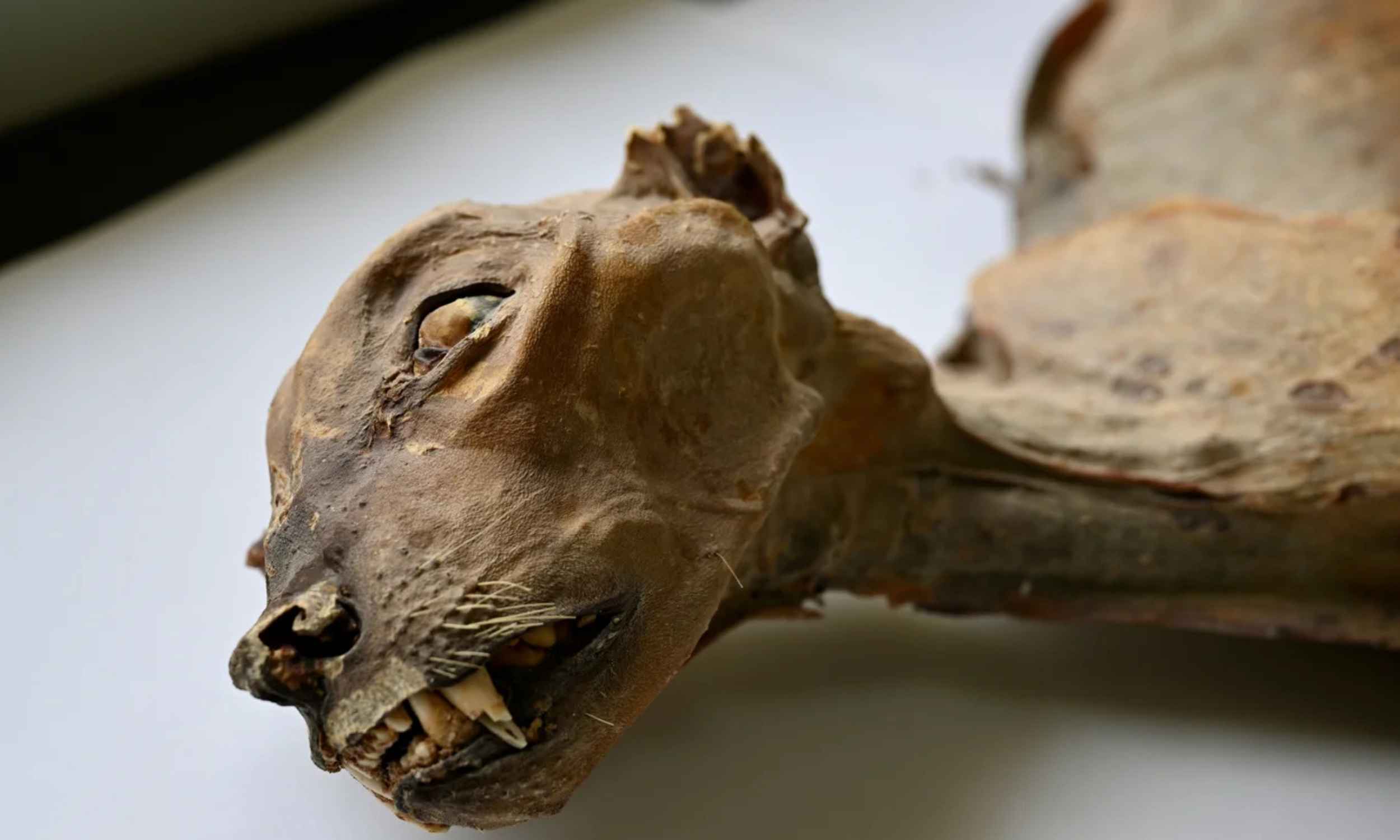
Seven naturally mummified cheetahs discovered in caves in northern Saudi Arabia are offering an unexpected gift from the past. Their bodies and DNA show that at least two cheetah subspecies once lived on the Arabian Peninsula, a finding that could change how conservationists plan to bring the big cats back.
The new study reports seven mummified cheetahs and the skeletal remains of 54 more, all found in the Lauga cave network near the city of Arar. Radiocarbon dating shows the remains span roughly four thousand years, from about 4,223 years before present to around 127 years before present, so from ancient history to only about a century and a half ago.
For a species already in deep trouble worldwide, that timeline matters. Cheetahs have vanished from about 90% of their historical range and are believed to have disappeared from the Arabian Peninsula since the 1970s. Most of us now know them only from wildlife documentaries or zoo visits, not as neighbors in desert landscapes.
A desert cave that works like a time capsule
The discovery began as a broad wildlife survey. In 2022 and 2023, researchers checked 134 underground caves across about 1,200 square kilometers of northern Saudi Arabia. Only five caves held cheetah remains, but those few caves turned out to be remarkable archives.
Inside, the air is dry, the temperature steady, and the light minimal. That sort of environment slows decay and lets bodies dry out rather than rot. The result is natural mummification. In this case, the cheetahs still have shrunken muscles, cloudy eyes, and skin that clings to bone like a husk.
Large mammals almost never preserve this well. Scavengers, insects, and heat usually win. So finding multiple cheetahs, including adults and cubs, in such good condition is almost like opening a door straight into their world.
So what can a handful of dried cats really tell us about modern conservation?
Ancient DNA reveals two lost lineages
Because the soft tissue and bone were so well preserved, scientists could do something that had never been achieved for naturally mummified big cats. They extracted and sequenced complete genomes from three individuals.
The youngest mummy was genetically closest to the Asiatic cheetah, Acinonyx jubatus venaticus, the critically endangered subspecies that survives today only in a small population in Iran.
The two older samples grouped more closely with the Northwest African cheetah, Acinonyx jubatus hecki, a subspecies that now hangs on in scattered parts of the Sahara and Sahel.
For decades, many experts assumed that Arabia had hosted only the Asiatic cheetah. The new genetic evidence shows that the peninsula once held a more mixed cheetah community than expected, with lineages linked to both Asia and Northwest Africa.
In practical terms, that means the historic picture just became richer. It also means managers have a wider reference point when they ask which cheetahs, if any, should return.
How cave mummies could guide rewilding
Saudi Arabia has expanded its protected area network, restored native ungulates such as Arabian oryx and sand gazelles, and invested in habitat recovery over recent decades. As prey species rebound, the idea of reintroducing apex predators has moved from theory to serious planning. Cheetahs are often at the top of that list.
Yet the choice of subspecies has been a sticking point. The Asiatic cheetah is down to only a few dozen animals in the wild, by most estimates. Pulling individuals from that population for reintroduction elsewhere could add risk to a subspecies already on the edge.
By showing that ancient cheetahs in Arabia were genetically closest to the Northwest African subspecies for much of the record, with a more recent link to Asiatic cheetahs, the study suggests that future rewilding could be based on the closest available lineages without relying only on Iran’s tiny population.
It does not hand policymakers a simple yes or no. Instead, it gives them a scientifically grounded menu of options and a reminder that the region once supported more genetic diversity than it does today.
Caves as quiet partners in conservation
Beyond cheetahs, the work hints at something bigger. Arid cave systems in Saudi Arabia and other dry regions may still hide similar biological archives, from wolves to smaller carnivores and even their prey.
Every well-preserved skeleton or mummy can help rebuild missing baselines about where species lived, how diverse they were, and how ecosystems functioned before modern pressures took hold.
For people living far from the desert, that might sound distant compared with daily worries like traffic or the weekly grocery bill.
Yet healthy predator populations often signal healthier landscapes overall, with more stable food webs and more resilient habitats in a warming climate. At the end of the day, those are the systems that support everything from grazing livelihoods to migratory birds.
The study was published in Communications Earth & Environment.