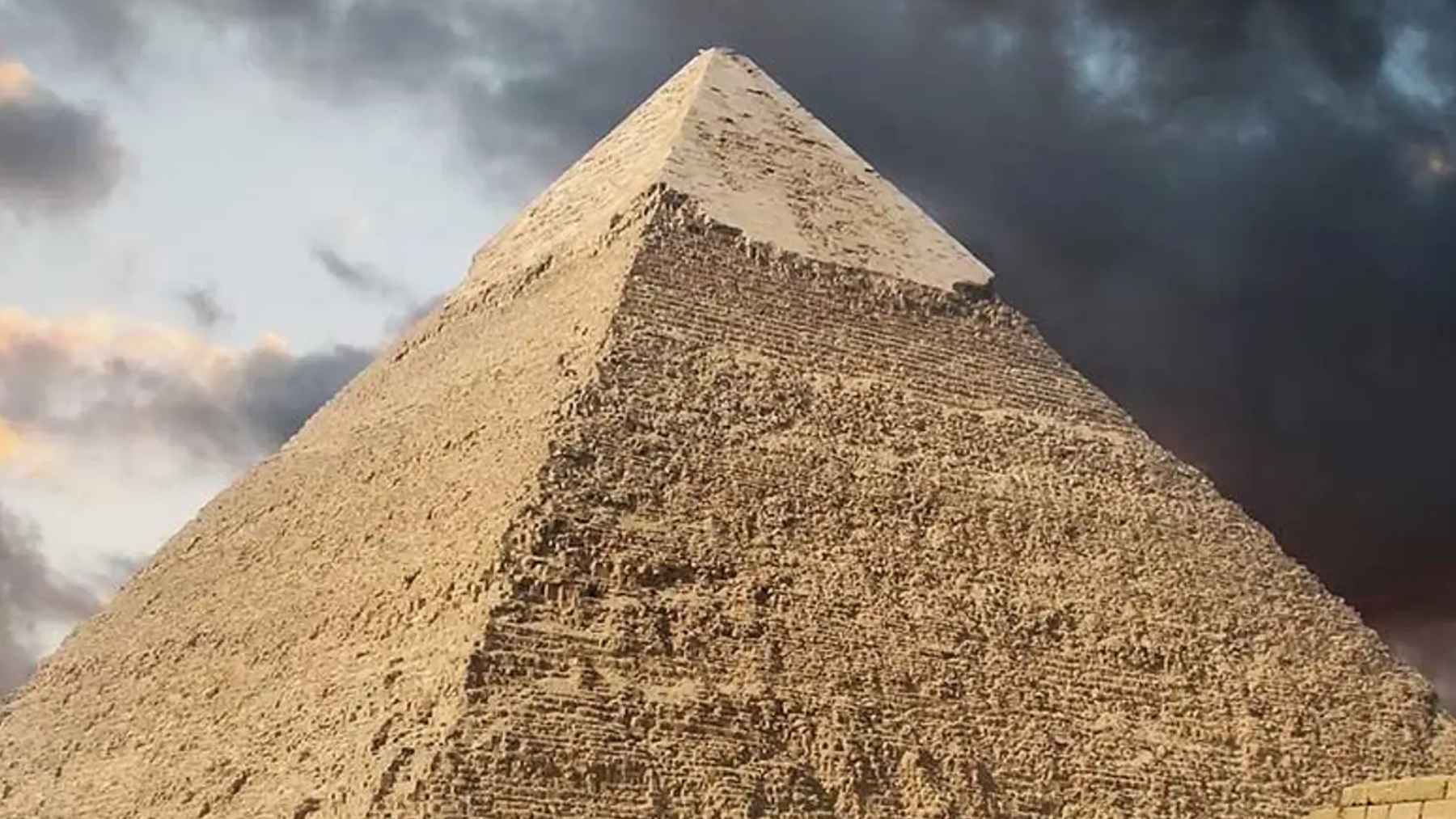
Did the ancient Egyptians really build the Great Pyramid when your school textbook says they did, or could the monument be a survivor from the Stone Age instead? A new preliminary study is pushing that question back into the spotlight, suggesting the pyramid could be tens of thousands of years older than the usual dates.
The work comes from engineer Alberto Donini at the University of Bologna and is available as a non-peer-reviewed report on open repositories. Using a technique called the Relative Erosion Method, he argues that the erosion seen on stone blocks around the base of the Great Pyramid may point to a construction date centered around 23,000 years before the present rather than the familiar Fourth Dynasty timeline.
An engineer’s challenge to the pyramid timeline
In his report, Donini applies the Relative Erosion Method to the two largest pyramids on the Giza Plateau and to several smaller structures, but the attention has focused on the Great Pyramid. He proposes that differences in wear between stones that were long protected and stones exposed for much longer can be used to back calculate when the monument was built.
According to summaries of the work and to the report itself, his statistical model produces an average construction date of roughly 22,900 years before the present and a probability band that stretches from about 8,954 to 36,878 years before Christ with a confidence level of 68.2%. That range would place the project deep in the Paleolithic period, long before any known Egyptian kingdom or writing system.
Reading age in the scars on stone
The core idea behind the Relative Erosion Method sounds simple enough. Stone that has been exposed to wind, rain and temperature changes for longer should be more worn than stone made of the same material that was shielded until recently. At Giza, some limestone blocks were hidden behind smooth casing stones until those outer layers were stripped off in the Middle Ages after a major earthquake.
Donini selected twelve measurement points around the base and compared surfaces that had been exposed since construction with neighboring surfaces that only became visible after the casing stones were removed. He then measured pitting and uniform wear, and converted those measurements into estimates of how long each surface has been exposed. Some points suggested a few thousand years of exposure, while others pointed to more than 50,000 years.
What the Relative Erosion Method leaves out
From these very different numbers, the engineer averaged the results and used a basic probability curve to argue that the most likely age is in the low twenty thousands before Christ. In the report and in secondary coverage, he writes that “the volume of disintegrated material must be proportional to the duration of exposure to erosion processes” and that comparing the two types of wear can yield a plausible construction date.
Even he acknowledges that reality is messier. Climate in Egypt has not been constant over tens of thousands of years, modern pollution and acid rain can speed up erosion, and shifting sand might have protected some blocks for long stretches. On top of that, today the base of the pyramid sees constant tourist foot traffic rather than the occasional ancient work crew, which means the wear pattern near ground level may tell a story more about selfie spots than about the Stone Age.
Archaeological evidence still points to the Fourth Dynasty
That is why many specialists see the new dates as an outlier rather than a revolution. Decades of excavation and analysis already tie the Great Pyramid to the reign of Khufu in Egypt’s Fourth Dynasty of the Old Kingdom, around 2580 to 2560 years before Christ, based on inscriptions, surrounding tombs, pottery and tools.
Egyptologist Mark Lehner explained on the science series NOVA that researchers “primarily date the pyramids by their position in the development of Egyptian architecture and material culture over the broad sweep of 3,000 years”. In other words, the style of the tombs, the way the stone is cut and the objects buried around the complex all fit neatly into one well-studied chapter of Egyptian history.
Radiocarbon dating backs that conventional picture
Beyond style and inscriptions, radiocarbon dating has also been used directly on the Giza monuments. A project reported in the journal Archaeology used small bits of charcoal and other organic material trapped in the mortar of several pyramids and found that the Great Pyramid belongs to the same Old Kingdom era indicated by historical chronologies, even if some samples came out a century or two older because of recycled wood.
In 2010, an international team led by researchers at the Oxford Radiocarbon Accelerator Unit at the University of Oxford published a radiocarbon based chronology for Dynastic Egypt in the journal Science using hundreds of short-lived plant remains such as seeds and stems. Coverage of that work quoted archaeologist Thomas Higham saying that “the analysis of seeds and plant remains from well-dated contexts confirms the traditional dates” for Egypt’s main kingdoms, including the time of the pyramid builders.
Why this controversy keeps coming back
So could the Great Pyramid really be a secret survivor from a forgotten civilization twenty thousand years ago? For most Egyptologists, that scenario remains extremely unlikely, because it would require reinterpreting not just one monument but the entire web of evidence that surrounds it, from workers’ villages to royal records.
At the same time, new methods like the Relative Erosion Method highlight how scientists keep looking for fresh ways to test old assumptions, even about landmarks you see on every classroom wall chart. For now, the erosion study is an interesting experiment in dating stone rather than a new timeline that will replace what you read in history class, and its bold claims will need independent checks before anyone redraws the pharaohs’ family tree.
The main study has been published on Zenodo.