For decades, Hallucigenia has been the poster child for how weird life became during the Cambrian seas. Now a roughly 500 million year old fossil from Canada finally shows what this tiny creature was eating and hints at the quiet cleanup crews that kept those ancient oceans running.
Burgess Shale specimen and the new analysis
The new study, led by paleontologist Javier Ortega Hernández at Harvard University, reexamines a classic specimen from the Burgess Shale in western Canada.
The slab preserves the flattened body of a soft, jelly-like animal about three and a half centimeters long, surrounded by loose spines from at least seven Hallucigenia.
Evidence of scavenging behavior on the seafloor
According to the team, the jelly-like animal died and sank to the seafloor. Small Hallucigenia then gathered to feed on the carcass, probably by suction, leaving their spines scattered over the decaying mass.
Paleontologist Allison Daley of the University of Lausanne calls the fossil “a moment captured in the fossil record”.
Other specialists, including Jean Bernard Caron at the Royal Ontario Museum, note that rock movements can sometimes mix fossils from different animals, so the scene is still under debate.
What Hallucigenia was and why it still matters
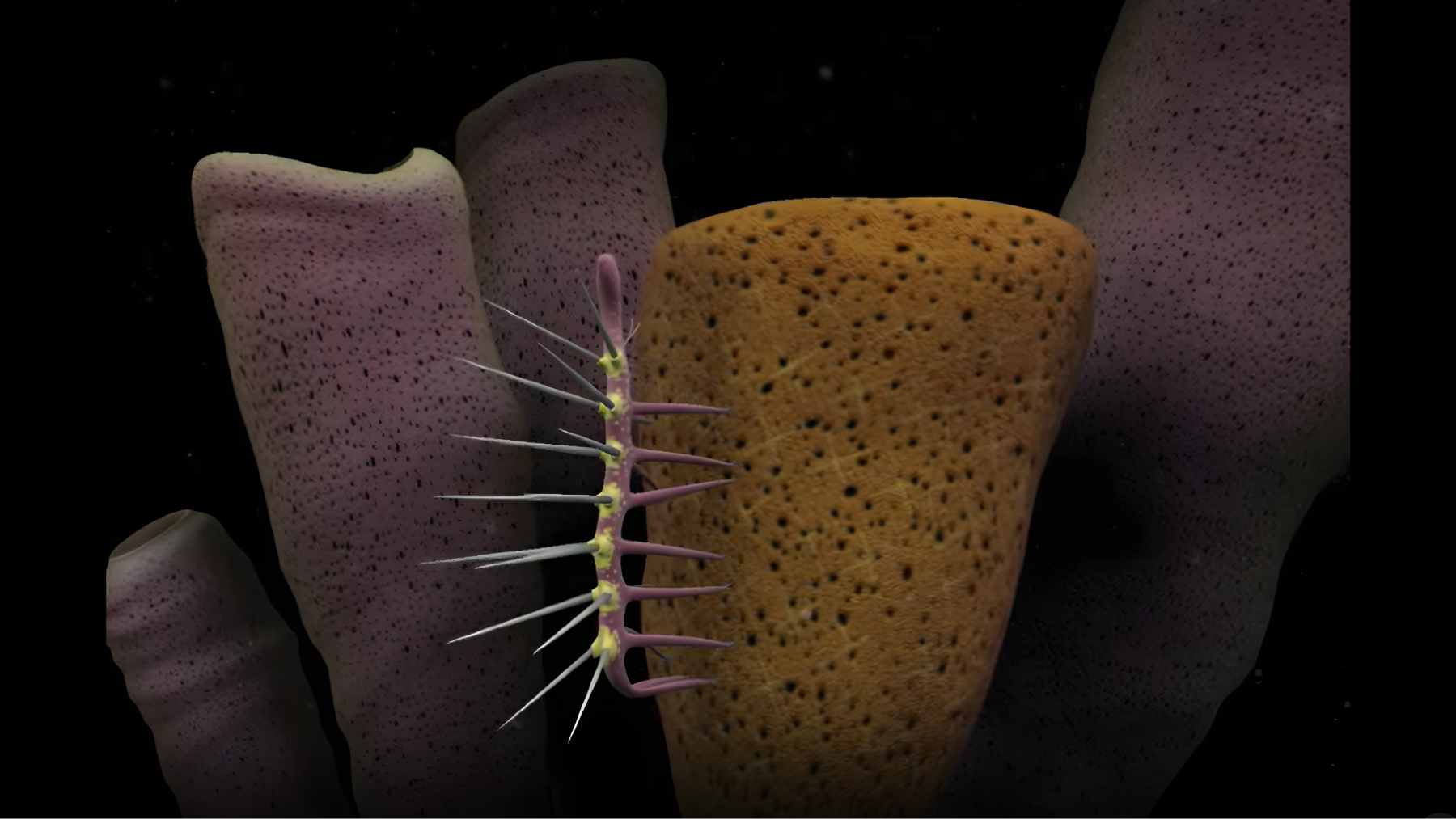
Hallucigenia itself was only about five centimeters long, with a thin tubular body, soft legs below and a row of rigid spikes along its back, distant kin of modern velvet worms, tardigrades and arthropods.
It was so strange that the first reconstructions literally turned it upside down until better fossils showed that the spikes were armor, not legs.
The preprint also revisits the head and throat. By comparing the long front end and an internal ring of tiny hardened denticles with living sea spiders, Ortega Hernández argues that Hallucigenia fed by suction on soft gelatinous prey.
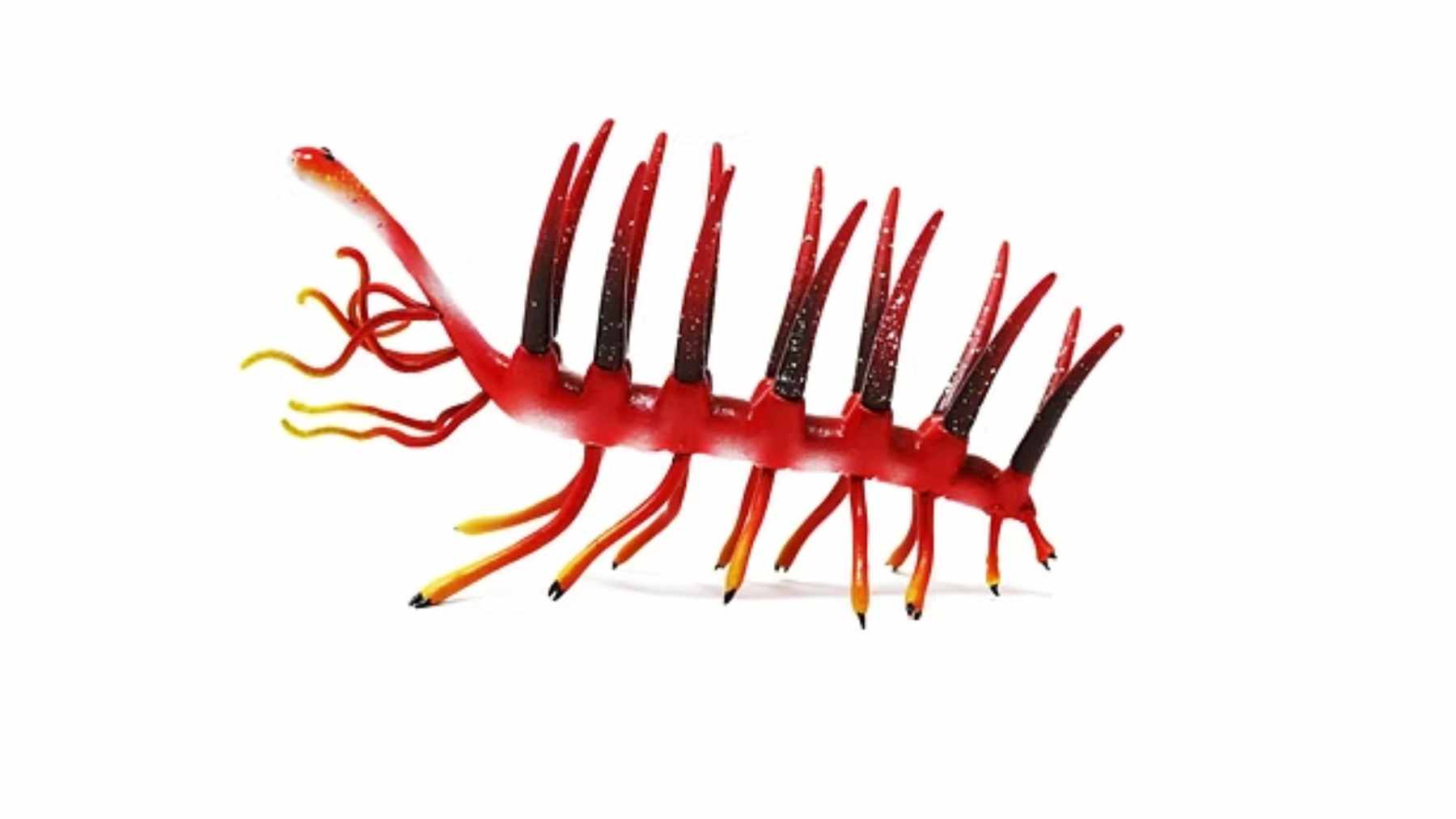
In the new fossil the likely victim is a comb jelly similar to the Cambrian ctenophore Xanioascus from the same rocks, and the authors describe “swarm like behaviour” of several small Hallucigenia scavenging on the carcass.
Why should we care what a thumb-sized worm ate half a billion years ago? Because diet is a key part of any ecosystem.
If Hallucigenia and its relatives specialized in cleaning up sinking jelly-like carcasses, they were probably important recyclers on the Cambrian seafloor, similar to modern scavenging worms and crustaceans that quietly stop today’s oceans from filling with dead jellyfish.
That ancient lesson has a modern echo. When we stress marine food webs through overfishing, pollution or climate change, it is often the small recyclers that disappear first.
The fossil does not give direct answers about our own future, but it reminds us that complex food webs and recycling networks already existed long before fish, forests or coral reefs and that breaking those networks today carries risks we still struggle to measure.
For now, the work remains a preprint rather than a peer-reviewed paper, so its conclusions may be refined as other specialists weigh in.
The study was published on bioRxiv.