An entire lake disappears overnight in northern Quebec, and the water travels more than 6.2 miles as if someone had pulled the plug

Published On: March 23, 2026 at 8:45 AM
Follow Us
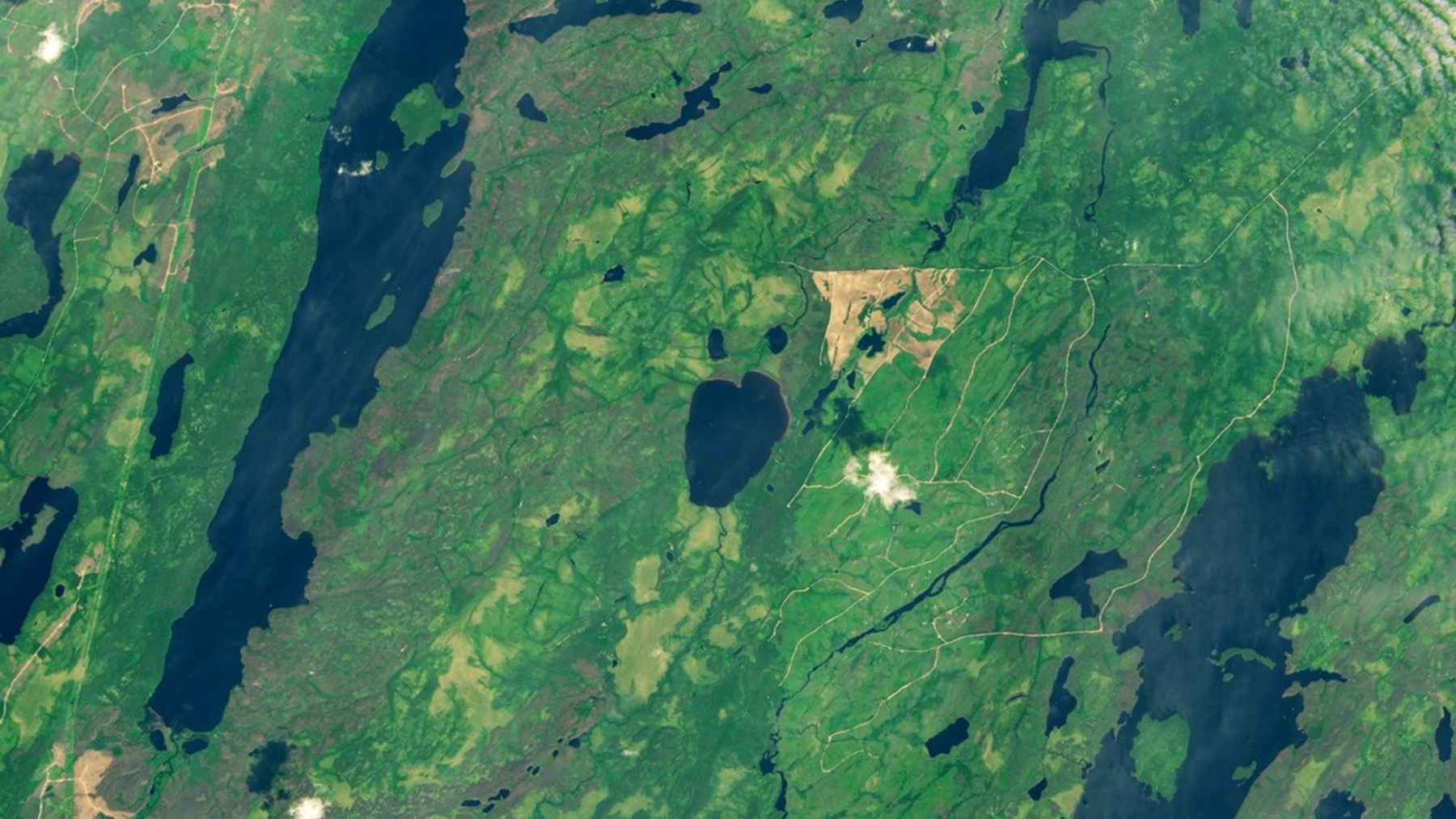
Satellite view of Lac Rouge and the surrounding landscape in northern Quebec before the lake’s sudden drainage event

In spring 2025, people from the Cree community of Waswanipi in northern Quebec woke up to shocking news. Lac Rouge, a favorite fishing lake with sandy shores, had almost completely drained, leaving mud, dead fish, and stunned residents. The missing water carved a fresh channel through the forest and poured into a larger lake about 10 kilometers away.

Satellite images later released by NASA Earth Observatory confirmed how dramatic the change was. From orbit, the dark heart-shaped lake seen in 2024 had become in 2025 a pale basin with a tan sediment streak, a classic sign of a sudden lake drainage called an outburst flood.

A lake that emptied almost overnight

The first alarm came from a washed-out logging road northwest of Waswanipi in early May. When community members checked the area, they saw that Lac Rouge’s banks had collapsed along one side and that the lakebed was nearly dry except for a few shallow pools.

Landsat 9 images show the breach opened in the lake’s eastern bank and water flowed northeast, punching through a string of ponds before reaching Lac Doda about 10 kilometers away. For hunters and trappers, it felt like the map of their territory had been quietly rewritten.

An outburst flood scientists rarely see

Geomorphologists classify the event as a sudden lake drainage or outburst flood, a term usually reserved for glacial lakes or man-made reservoirs when ice or dams fail. Experts say they have almost never seen a natural, non-glacial lake drain by cutting its own new outlet. 

Diana Vieira at the Joint Research Centre within the European Commission described Lac Rouge as an “absolutely amazing” case because the water ignored its normal outflow and opened a brand new exit through soft shoreline sediments. That suggests the lake was already perched near a tipping point, just waiting for the last push.

Fire, logging, and what it means for other lakes

So what pushed this quiet northern lake over the edge? Scientists point to a mix of natural and human-driven factors, from an elevated basin with soft banks to a snowy winter followed by rapid spring melt that poured extra water into soils already close to saturation.

Around Lac Rouge, two recent wildfire seasons and decades of logging have stripped away much of the mature forest that once shaded snow and helped anchor the ground. Younes Alila at the University of British Columbia notes that when land is disturbed by fire or clearcutting, the soil tends to stay saturated longer, which weakens lake and river banks over time.

Indigenous leaders in the Cree First Nation of Waswanipi now want nearby lakes with similar conditions mapped for risk, since no one wants to see a favorite dock backed by cracked mud.

The main press release has been published by the NASA Earth Observatory.
Adrian Villellas

Adrián Villellas is a computer engineer and entrepreneur in the fields of digital marketing and advertising technology. He has led projects in data analysis, sustainable advertising, and solutions for new audiences. He also contributes to scientific initiatives related to astronomy and space observation. He writes for science, technology, and environmental media outlets, where he makes complex topics and innovative advances accessible to a broad audience.

Related Post

Bowhead whale surfacing among sea ice in the Arctic

Bowhead whales can live for more than 200 years despite weighing up to 200,000 pounds, and scientists found their cells repair dangerous DNA breaks unusually well, with one protein even improving DNA repair in human cells and extending lifespan in fruit flies

September 22, 2026 at 6:26 PM
Angsana trees shading red curved benches on a Singapore street

Singapore plans to plant 1 million additional trees by 2030, and research suggests well-placed shade could cut outdoor heat stress by 3°C to 5°C while models show trees may reduce summer air-conditioning energy use by 6% to 9% in humid cities

September 21, 2026 at 4:56 PM
Children using tablet computers in a classroom

Researchers followed 260 Finnish children for eight years expecting more screen time to signal weaker thinking skills, but by age 15 those reporting greater use actually showed better overall cognitive performance, although the study could not prove screens caused the difference

September 20, 2026 at 6:00 PM
Australian magpie perched on a branch in Sydney

Researchers fitted five Australian magpies with GPS trackers to map their movements, but within an hour the birds began helping one another remove the harnesses, turning a failed tracking experiment into an unexpected observation of cooperation and problem-solving

September 20, 2026 at 2:30 PM
People cycling along a canal street in Amsterdam, Netherlands

Dutch men went from averaging about 5 feet 5 inches in the mid-1800s to nearly 6 feet today, gaining almost 8 inches in roughly 150 years, but researchers found natural selection may explain less than 2% of that extraordinary national growth spurt

September 20, 2026 at 11:48 AM
Three tall men walking together on a street in Amsterdam with Dutch canal houses behind them

Dutch men grew about 20 centimeters in 150 years, going from among Europe’s shortest to its tallest, and a simulation shows natural selection explains less than half a centimeter of that change

September 20, 2026 at 6:33 AM

Leave a Comment