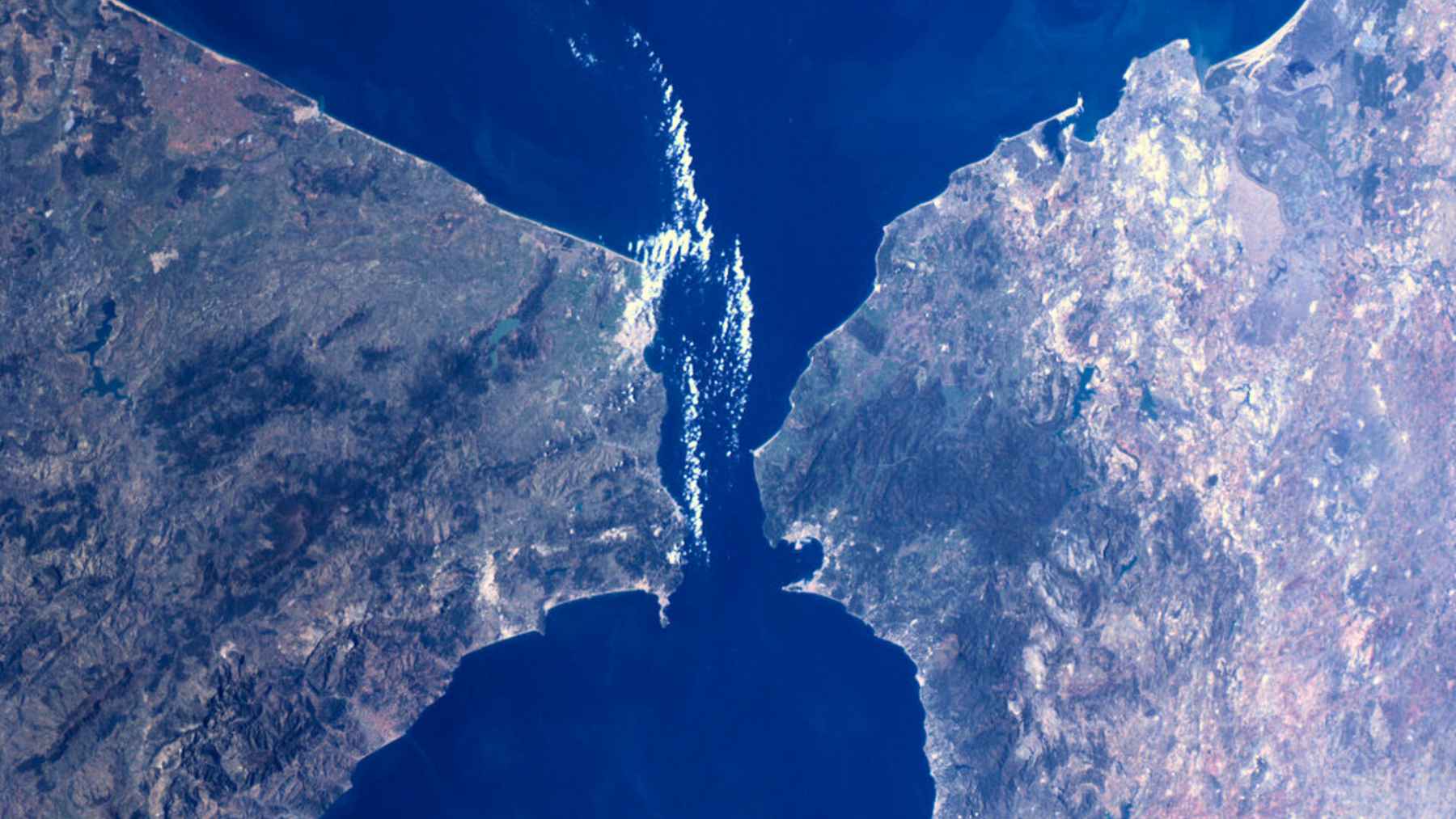
Headlines keep claiming the Strait of Gibraltar is “about to disappear.” A new computer-model study agrees the geology is shifting, but the schedule is measured in millions of years, not decades.
The bottom line is straightforward. The channel is not closing anytime soon, but the rocks below it may be setting up a process that could eventually reshape the eastern Atlantic.
A famous gap between continents
The Strait of Gibraltar is a narrow, 36-mile-long waterway that separates Spain from Morocco. It links the Mediterranean Sea with the Atlantic Ocean, and it is a busy route for ships and ferries.
But on a geological map, it is more than water. It sits near a boundary where the African and Eurasian tectonic plates push and slide, building stress that can be released as earthquakes.
What subduction means
Earth’s outer shell is broken into huge slabs of rock called tectonic plates. They move slowly, but when they collide, one can be forced downward.
Subduction happens when one plate bends and sinks under another and slides down into Earth’s interior. That sinking edge can trigger earthquakes, feed volcanoes, and recycle old seafloor back into deeper layers.
Most of the Atlantic today is not built around subduction. Instead, it is a spreading ocean, where new crust is created along the Mid-Atlantic Ridge, and its edges are mostly quiet compared with the Pacific.
Inside the new computer model
The new research used 3D computer simulations that try to recreate how rock moves deep underground over long periods. The team spans the University of Lisbon Faculty of Sciences, the Instituto Dom Luiz, and Johannes Gutenberg University Mainz.
Their simulations are “gravity-driven,” meaning dense slabs can sink and pull on the rest of the plate, a bit like a heavy curtain sliding off a table. In practical terms, that helps test whether Gibraltar’s sluggish subduction could wake up again after a long pause.
It also ties into the “Wilson cycle,” the idea that oceans can open, widen, and later begin to close. Subduction initiation matters because it is the turning point when an ocean stops expanding and starts being recycled back into the mantle.
A long countdown, not a near-term collapse
So why do some descriptions make it sound like the strait is about to vanish? In geology, “soon” can mean tens of millions of years, and this study’s estimate is about 20 million years before Gibraltar’s subduction pushes farther into the Atlantic.
The researchers describe this jump as “subduction invasion.” Put simply, a subduction zone that formed in a closing ocean, like parts of the Mediterranean, may migrate into a still-growing ocean, like the Atlantic.
There is also a key caveat. The authors stress that it is hard to create new subduction zones because oceanic plates are strong and resist snapping and bending, and that is why they built models to test what could overcome that resistance.
Why the Atlantic matters
Subduction zones are where the biggest quakes and many volcanic arcs are born. The Atlantic has far fewer obvious subduction zones than the Pacific, so scientists pay close attention to any place where a new one might be starting.
In the press materials, the lead author called the Atlantic crust here “super strong and rigid.” The model argues that this strength helps explain why the Gibraltar system can get stuck in a slow phase instead of breaking off and stopping.
If the process continues, it could be an early step in the Atlantic entering a new stage of its life. That does not mean the ocean is about to “shut,” but it does suggest the boundary conditions are changing along its eastern edge.
Could an Atlantic Ring of Fire form?
The Pacific Ring of Fire is a horseshoe-shaped belt about 24,900 miles long, marked by frequent earthquakes and volcanoes. The study raises the long-range possibility that a similar chain could eventually develop around parts of the Atlantic.
Still, the word “eventually” is doing a lot of work here. The models described a new subduction system forming over tens of millions of years, which is far beyond any human planning horizon.
A future Atlantic version, if it ever formed, would likely grow piece by piece as new subduction segments turned on and linked up. For now, researchers treat it as a hypothesis worth testing, not a forecast for the next few centuries.
What this means for people living nearby
There is also a more immediate angle. If the Gibraltar subduction is still active, it matters for earthquake risk around southern Spain, Morocco, and Portugal, even if big events are expected to be rare.
One reason scientists keep pointing to the region is history. The 1755 Lisbon earthquake and tsunami killed tens of thousands of people, and waves were reported at roughly 20 feet in Lisbon and about 65 feet in Cádiz.
Modern monitoring cannot prevent an earthquake, but it can improve warning and preparedness. That can translate into stricter building codes, better emergency planning, and clearer public communication, the unglamorous steps that save lives.
What scientists will test next
Models are only as good as the real-world clues they match. Seismic studies track how earthquake waves travel through the mantle, and they can help pin down whether the slab under Gibraltar is still sinking or just sitting there.
Another line of evidence combines earthquake records with satellite-based GPS measurements of how the ground moves. Researchers also compare their simulations with mantle-flow signals inferred from past work in the region.
So the headline-grabbing idea of a “vanishing” strait is best read as a far-future scenario, not a countdown on your calendar. But it is still a reminder that the ground beneath familiar coastlines is never truly still.
The main study has been published in Geology.