What if the leftovers from your breakfast banana ended up in your T‑shirt, your notebook or even a fruit tray at the supermarket? That idea is moving from curiosity to reality as factories learn how to turn banana pseudostems into a standardized raw material for textiles, paper and bio‑based composites.
Studies of circularity in banana farming show that only a small share of the plant becomes food. The rest is biomass that usually stays in the field or is removed as waste. In some production systems the residue can reach around 220 tons per hectare, which helps explain why industry is suddenly very interested in this forgotten trunk.
At the same time, researchers estimate that banana pseudostems generate tens of millions of tons of waste every year in producer countries such as Brazil.
Those stems hold strong cellulosic fibers with tensile strengths that can surpass classic natural fibers like jute and sisal, which makes them attractive for yarns and reinforcement materials.
From craft to factory floor
For years, banana fiber showed up in small artisan projects. The big change now is that companies are organizing the residue as a proper industrial supply chain, with quality standards, traceability and safety routines similar to other natural fibers.
In Brazil, this shift became visible when FIESC highlighted projects at the SENAI Institute of Textile Technology, Apparel and Design that develop fabrics from banana stem fiber specifically for large-scale use.
One of these initiatives, known as Banana Têxtil, took a fabric made from banana stalks all the way to the final of the BRICS Solutions Awards, showing that the material is viable for industrial weaving and not just for craft markets.
Inside a banana fiber plant
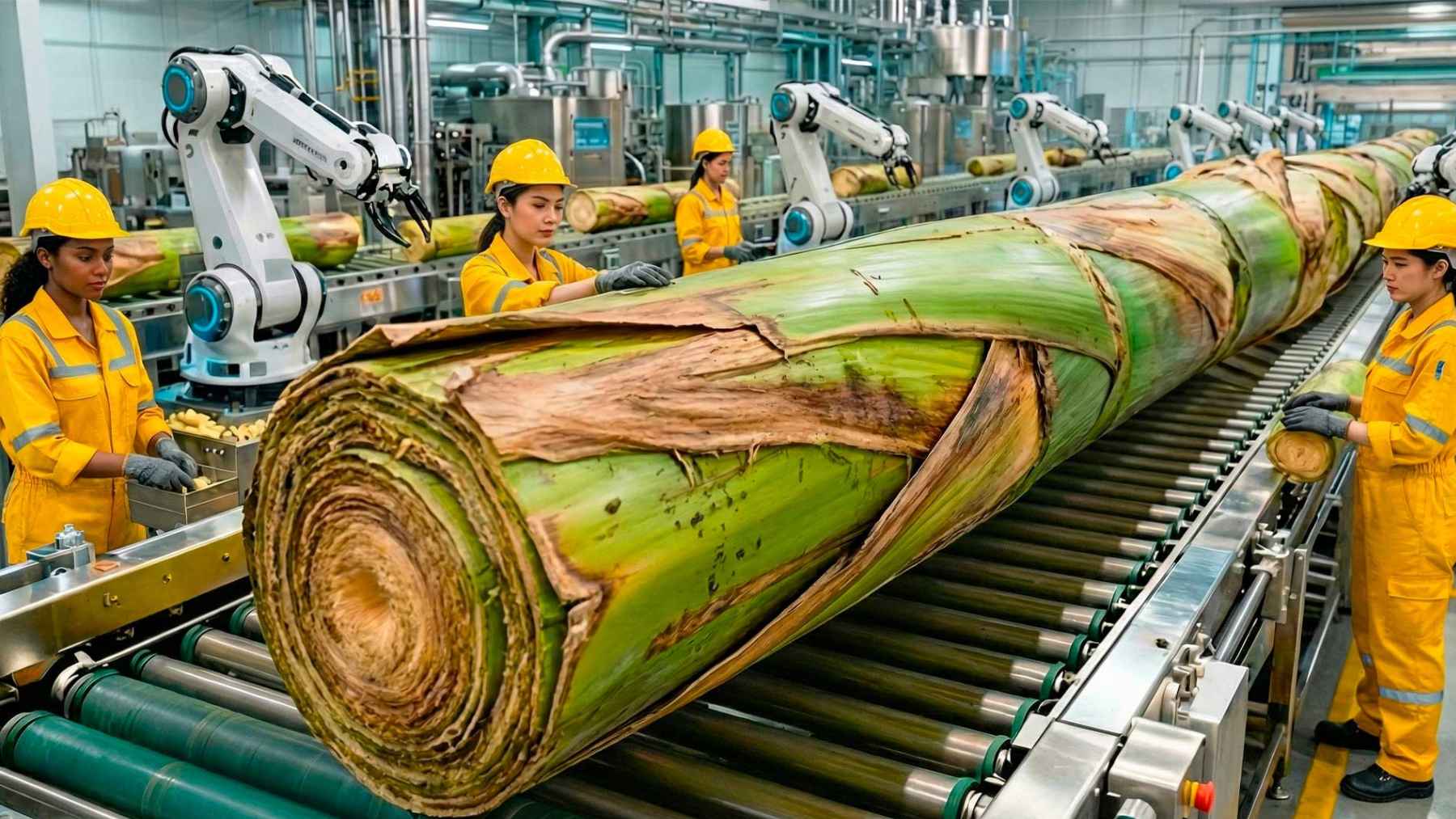
The operation usually starts close to the farms. Fresh pseudostems are heavy and full of water, so hauling them over long distances would kill the business and add truck traffic to rural roads. When the loads arrive at the plant they are sorted by size, moisture and condition.
Degraded stems give shorter fibers with more impurities, so this first check already decides a lot about final quality.
The heart of the factory is mechanical extraction. In a process known as decortication, rollers and blades press and scrape the pseudostem, separating a fibrous fraction from the softer, wetter pulp.
Technical studies identify this mechanical route as the most realistic option for industrial scale because it avoids harsh chemicals and delivers fibers that can be aligned and spun. Laboratory work shows that mechanically-extracted pseudostem fibers can reach tensile strengths around 570 megapascals, higher than many other plant fibers used in textiles and composites.
Right after extraction, the fiber goes through intensive washing. The goal is to remove non‑fibrous residues, reduce odor and improve feel. Here, the environmental trade offs become clear. Washing consumes significant water, so the most advanced plants invest in recirculation systems and wastewater treatment to keep both costs and impacts under control.
Drying, quality control and where the fiber goes
Once clean, the fibers need to dry in a predictable way. Many factories mix ventilated air drying with controlled temperature ovens to avoid mold and keep color stable. Recent research indicates that drying temperature influences the physical and mechanical properties of the fibers, which is why this step is treated as process control instead of just waiting for the sun to do the job.
Opening and alignment equipment similar to what is used for other plant fibers then prepares the material for spinning, nonwovens or composite reinforcements.
Quality teams usually monitor average length, moisture, impurities and, in more structured plants, strength parameters. For the spinning mill or paper machine on the other side of the contract, the key is simple. They want banana fiber that behaves the same way every time.
Most of the attention goes to textiles. Projects in Brazil and other producer countries already spin yarns and weave fabrics that blend banana fiber with cotton or other fibers for clothing and home textiles.
But the value chain does not end there. Alternative paper and pulp trials are moving from lab sheets to pilot lines. A recent open access study tested thermomechanically-extracted pseudostem fiber mixed with gum arabic to mold fruit packaging boards, which performed as well as or better than recycled paper pulp trays in several mechanical tests, although they absorbed more water.
What about the rest of the plant
The fibrous fraction is only part of the story. Pulp and sap that leave the decortication line can be turned into compost, solid fertilizer, biogas or even liquid fertilizers.
Experiments using banana pseudostem as a base for organic liquid fertilizer, combined with microbial mixes, show that this residue can supply nutrients while helping farmers cut their reliance on synthetic inputs.
In practical terms, the factory only closes its environmental and financial accounts if most of this biomass finds a use. Otherwise managers end up paying to dispose of soggy waste and local communities are left with odor and runoff problems they never asked for.
A promising fiber, with work still to do
Banana pseudostem fiber will not replace every synthetic fiber in your closet, and experts are clear that logistics, farmer training and wastewater management remain weak points in many projects.
Still, it offers a way to shift part of the textile, paper and packaging supply away from fossil inputs and toward an agricultural residue that already exists in huge volumes.
At the end of the day, the idea is quite simple. Instead of burning or abandoning banana trunks after harvest, turn them into useful products that can eventually return to the soil.
The study was published in Packaging Technology and Science.