What can a long tube of frozen mud pulled from the bottom of the world tell us about coastal cities, beach houses, and ports thousands of miles away? Quite a lot, as it turns out.
An international team working on the SWAIS2C project, which studies how sensitive the West Antarctic Ice Sheet is to about 2 degrees Celsius of global warming, has drilled the longest sediment core ever recovered from beneath an ice sheet.
The scientists melted through roughly 523 meters of ice, then continued another 228 meters into the rock below, bringing up about 218 meters of ancient mud and stones that appear to record around 23 million years of climate history.
Those layers capture times when this part of Antarctica was not a frozen fortress at all but an open ocean, and they could reshape what we think we know about future sea level rise.
A climate time capsule beneath the ice
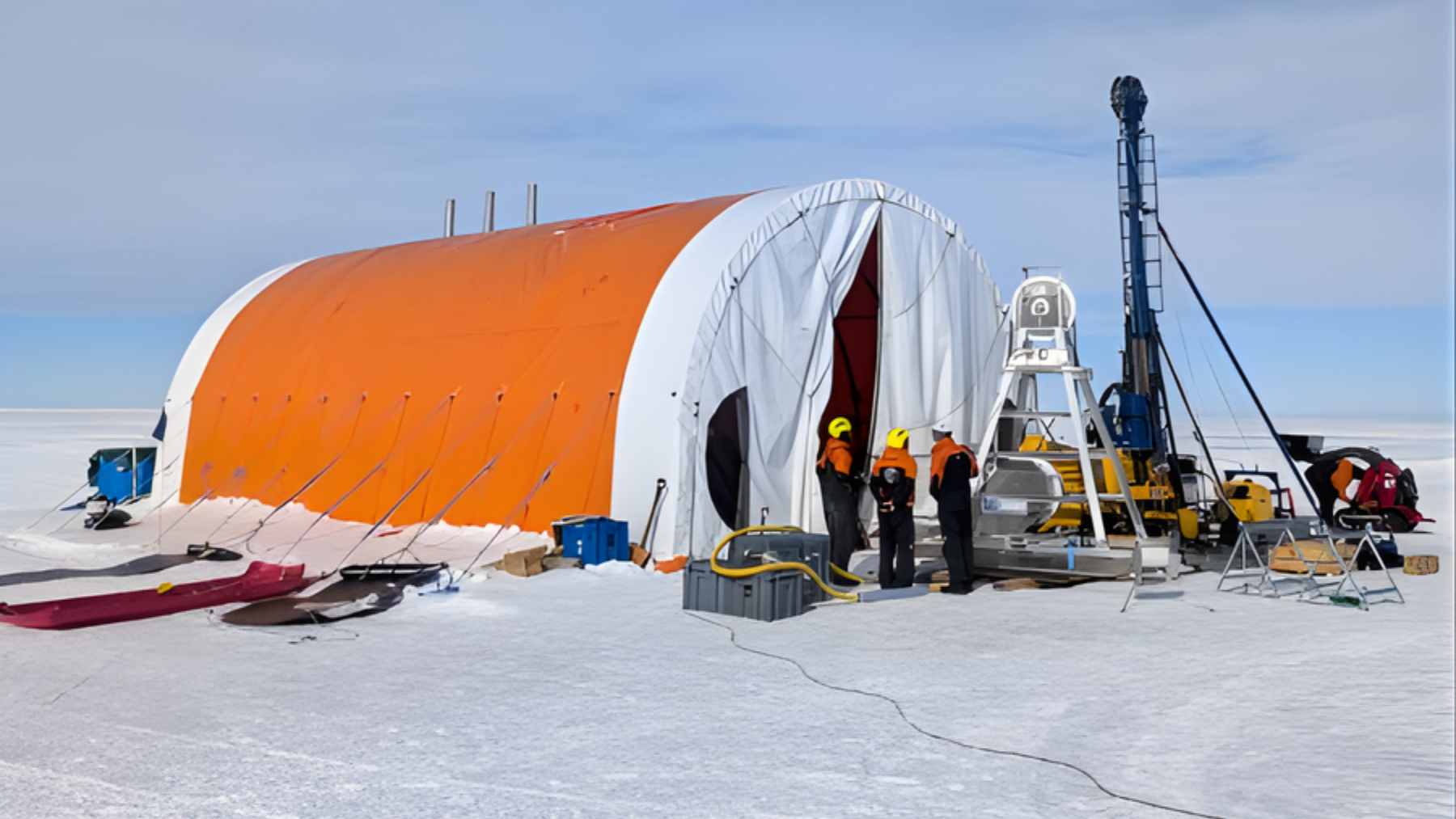
The drill site sits on Crary Ice Rise, a dome of ice that is grounded on bedrock near the inner margin of the Ross Ice Shelf in West Antarctica. It is more than 700 kilometers from the nearest research station, Scott Base, so everything from fuel to food to the custom drill system had to be hauled across the ice on tractor traverses.
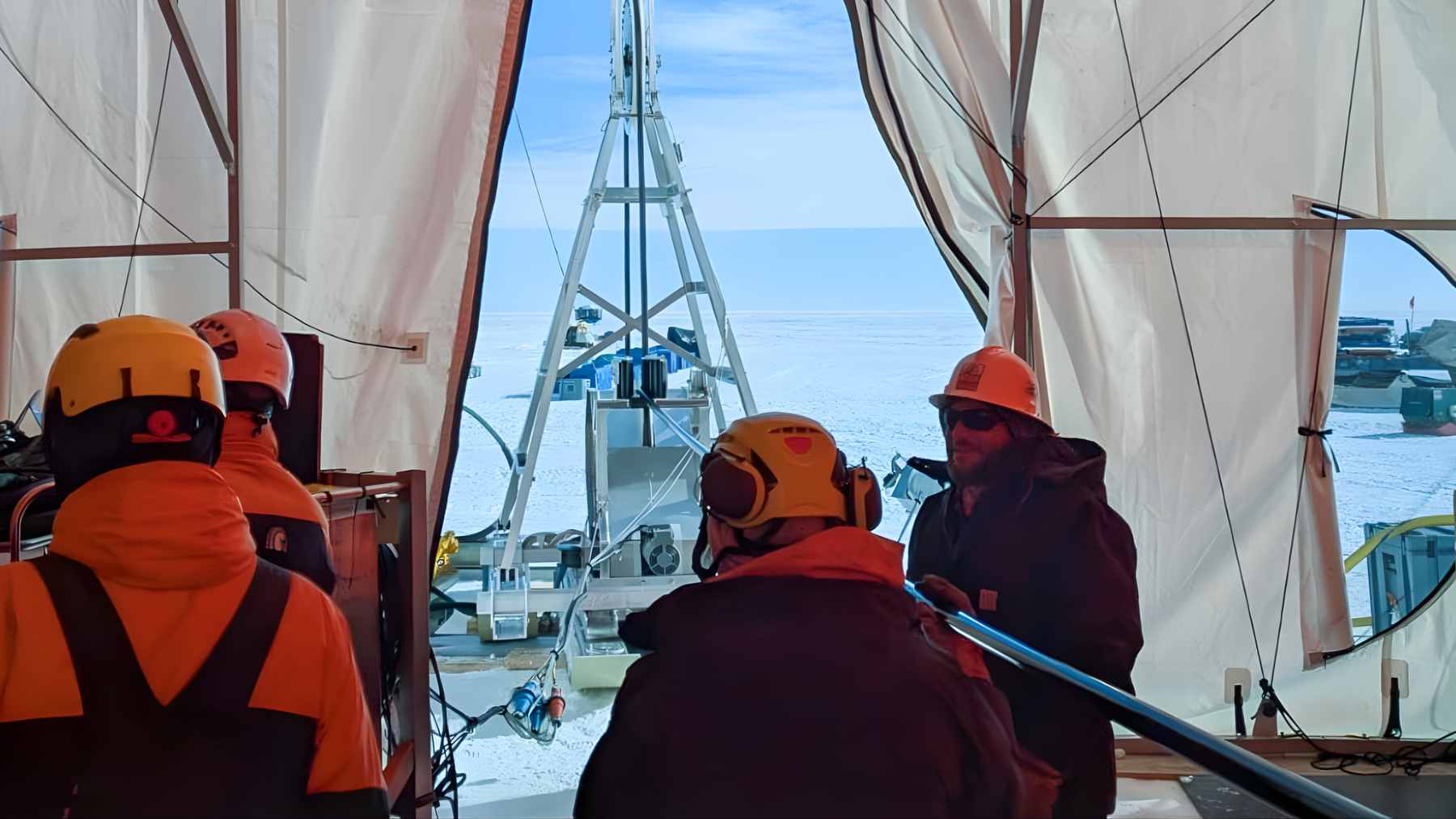
For nearly ten weeks, a camp of 29 people lived in tents on the ice, working in shifts around the clock. First they used a hot water drill to melt a narrow shaft through the floating ice, using water heated to around 75 degrees Celsius.
Then they lowered more than a kilometer of pipes and drilling tools down the hole until they finally reached the sediments that had quietly accumulated over millions of years.
Previous attempts in similar settings had only managed to recover less than ten meters of sediment. Here, the team not only beat that record.
They smashed it. One of the co‑chief scientists, based at Binghamton University, described the whole effort as “Antarctic frontier science,” a fair description when you are camping on moving ice and hoping the weather cooperates long enough to keep the drill running.
Mud, microfossils, and evidence of an ice‑free West Antarctica
What exactly did they find in that stack of cores? As each three meter section came up, the team opened, photographed, and logged the contents right in the field. Some layers looked like you would expect under a modern ice sheet, with compacted, gritty material typical of glaciers grinding over rock. Other layers were very different.
Scientists spotted tiny fossil remains of marine organisms and shell fragments that belong in sunlit seawater, not in perpetual darkness under hundreds of meters of ice.
Some of those organisms need light to survive, which means that when they were alive there could not have been thick ice overhead. In other words, this part of West Antarctica must at times have been open ocean or covered only by a floating ice shelf with open water nearby.
Preliminary dating, based on those microfossils, suggests the core spans roughly the last 23 million years. That time window includes several warm intervals when global average temperatures were more than 2 degrees Celsius above pre‑industrial levels.
To a large extent, this is exactly the period climate scientists are most interested in. Past warm worlds can act as natural experiments, showing how ice sheets behaved when Earth was hotter and atmospheric carbon dioxide was higher, long before humans started burning fossil fuels.
Why two degrees of warming is such a big deal
The SWAIS2C acronym spells out the central question at the heart of this project, which also involves partners at Te Herenga Waka Victoria University of Wellington, ETH Zurich and several other institutions. It stands for Sensitivity of the West Antarctic Ice Sheet to 2 degrees Celsius.
Why that number? International climate agreements treat 1.5 to 2 degrees Celsius of warming as a guardrail. Go much beyond it and sea level rise, extreme heat, and ecosystem losses all become harder to manage. For this part of Antarctica, the stakes are especially high.
The West Antarctic Ice Sheet holds enough ice to raise global sea level by roughly four to five meters if it were to melt completely.
That full melt would not happen overnight. We are talking about centuries, possibly longer. But the tipping points that push parts of the ice sheet into long-term retreat could be triggered at temperature levels not far from where the world is headed on its current emissions path.
Until now, many computer models of West Antarctic ice relied on geological records taken from areas well away from the current ice margin, such as the seafloor in the open Ross Sea. The new core gives scientists a direct record right at the edge of the ice sheet itself.
That helps them test how accurate their models are and whether they might be underestimating or overestimating future sea level rise.
According to the project’s media release, around 680 million people live along coasts that are already exposed to sea level related hazards. At least 30 centimeters of global sea level rise by 2100 is essentially locked in, and on high-emissions pathways the total could reach one to two meters by the end of the century.
For most of us, that does not show up as a graph. It shows up as more frequent coastal flooding, saltwater creeping into drinking water supplies, and storm surges that reach a little farther inland each decade.
From Antarctic mud to everyday life
At first glance, this story sounds very far away. A remote drilling camp on the edge of the world. A long core of mud. A wonky acronym.
In practical terms, though, the work feeds directly into decisions that affect daily life. Better estimates of future sea level rise help cities decide where to build sea walls or whether to retreat from the most exposed land.
They influence flood maps that determine insurance costs and mortgage risks for homes near the coast. Ports, power plants, subway tunnels, and wastewater plants also need to know how often they might find themselves under water in the coming decades.
The same carbon pollution that is quietly raising sea levels is also driving the sticky summer heat that pushes up the electric bill when air conditioners run non‑stop. Keeping warming as close as possible to 1.5 degrees Celsius reduces stress on both fronts.
The new core will not deliver all the answers at once. Experts warn that it will take years of careful laboratory analysis to refine the age of each layer, reconstruct past ocean temperatures, and piece together the exact sequence of ice advance and retreat.
For the most part, though, scientists are already clear on one key message from the field observations. There have been times in the past when open ocean existed where half a kilometer of ice now sits.
What happens next
From Crary Ice Rise, the core has been transported to New Zealand and will then be split and shared among teams in about ten countries. Researchers backed by Earth Sciences New Zealand, Antarctica New Zealand and many international partners will use a suite of techniques to check the initial dating, study the tiny fossils in detail, and measure the chemistry of the sediments.
Their findings will feed into ice sheet and sea level models, which in turn inform national climate risk assessments and long-term planning.
The International Continental Scientific Drilling Project, which helped support the drilling as its first project in Antarctica, is already calling the core a “critical geological record” that captures how this vulnerable ice sheet responded to past warm periods.
At the end of the day, a quiet cylinder of Antarctic mud has become one of the clearest signals yet that the frozen south has not always been frozen, and that our choices about emissions in the coming years will help decide how quickly the ice responds this time.
The press release was published by Antarctica New Zealand.