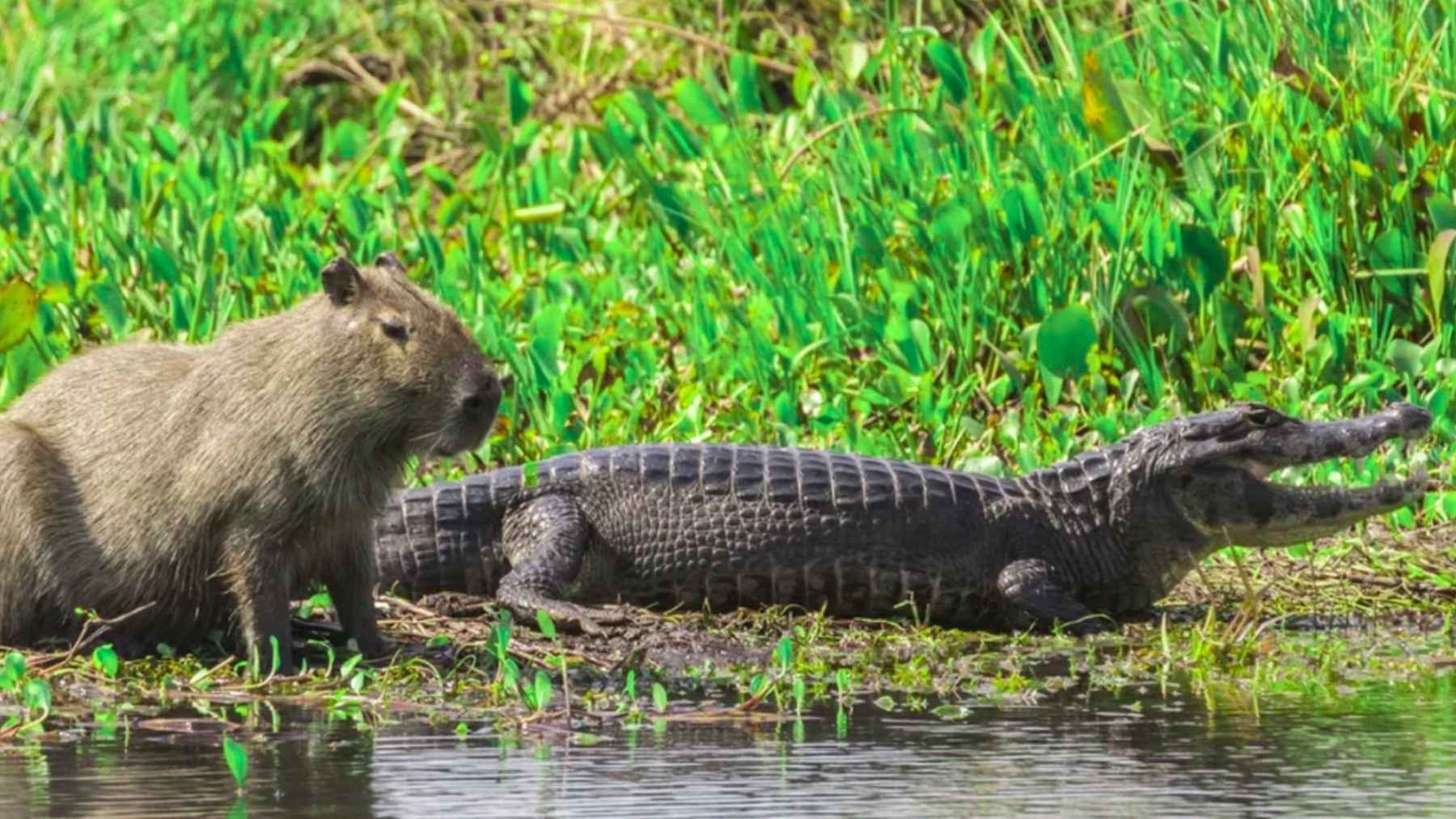
Scroll through your feed and you will probably see it sooner or later. A capybara stretched out on the mud with a caiman just a few inches away, both animals dozing beside the same brown river. No panic. No chase. For a predator with powerful jaws, that calm feels almost unreal.
Yet interviews with capybara specialist Dr Elizabeth Congdon at Bethune-Cookman University suggest that for most crocodilians, adult capybaras are simply not worth the risk.
Capybaras and caimans in South American wetlands
Capybaras are the largest rodents on Earth and live in family groups along rivers, lakes and swamps across much of South America. Their favorite hangouts are the very shorelines where caimans wait. You might expect constant ambushes in those murky shallows.
In reality, Congdon notes that healthy adults rarely show up on a caiman menu, especially when fish and smaller animals offer easier calories.
Why crocodilians avoid adult capybaras
Why would a reptile that can crush turtle shells hesitate in front of a rodent? Size and weaponry. An adult capybara can weigh more than 45 kilograms and carries a set of long, razor-sharp front teeth. Those incisors are built to slice tough grasses, yet they can also tear into flesh if the animal feels cornered.
Congdon explains that when you combine that bite with a heavy body, a capybara becomes a risky meal rather than a convenient snack.
Capybara defenses and wetland survival
Capybaras also play the wetland survival game very well. Their eyes, ears and nostrils sit high on the head and their partially webbed feet help them slip into the water at the first hint of trouble. Conservation groups such as Rainforest Alliance describe how they can stay submerged for several minutes, using the river as a shield while predators search the bank. For a caiman, chasing a vanishing silhouette into deep water simply adds to the risk.
From the predator side, energy matters. Hunting is expensive. Grabbing a struggling, biting capybara can mean injuries that affect a caiman for the rest of its life. Lunging at a fish or smaller mammal usually ends much faster. For the most part, researchers think crocodilians follow a basic calculation that favors low-risk food, and adult capybaras fall on the wrong side of that equation.
Humans, hunting, and capybara farming
Meanwhile, many other animals treat capybaras as relaxed neighbors. Field observations and photos show birds perched on their backs and turtles sunning themselves while the rodents nap beside them. In zoos and wildlife parks, groups often share pools with little drama as long as everyone has space and grass.
Those scenes look almost like a children’s story, yet they reflect a big herbivore that rarely threatens others and quietly anchors busy riverbank communities.
Humans, not crocodilians, remain the main danger. Across their range, communities hunt capybaras for meat and hides, sometimes even where local rules try to restrict the practice. Wildlife sources report that capybaras are now farmed in parts of the region to ease pressure on wild populations, since they adapt well to managed enclosures near water.
Done with care, those farms can give wetlands economic value and encourage landowners to protect them, although regulation and animal welfare standards vary widely.
Their internet fame as chill companions can also blur an important reality. Capybaras stay relaxed most of the time, but they are still powerful wild animals. Congdon and other experts point out that media reports and viral clips have documented bites on pets and people when animals feel harassed or cornered, and medical case reports describe serious wounds from those big incisors.
So that sleepy face beside a river or even in an urban park deserves distance and respect, not a selfie at arm’s length.
In the end, the quiet truce between capybaras and crocodilians is less about friendship and more about simple math. A tough, semi-aquatic herbivore that bites back is rarely worth the effort. For people, the takeaway is straightforward. Enjoy the memes, admire them from afar, and remember that every relaxed capybara carries its own invisible line of defense.