The western Weddell Sea is one of those places that still feels like a blank page. It is remote, ice covered for much of the year, and notoriously hard to study, which is why scientists have long suspected there was plenty happening down there that nobody had actually seen. What do you get when you finally peek under the ice?
New video surveys finally delivered proof. Researchers documented 1,036 maintained fish nests across 277 groups on the seafloor, and many of those nests were organized into tidy shapes that look less like random holes and more like a planned neighborhood.
A new window opened when Larsen C calved
In 2017, the iceberg known as A68 broke away from Antarctica’s Larsen C Ice Shelf, exposing a large patch of ocean that had previously been sealed under ice. That rare opening made it possible to send deep-sea robots into areas that were, for practical purposes, off limits.
During the Weddell Sea Expedition in early 2019, scientists aboard the research ship SA Agulhas II used a remotely operated vehicle called Lassie to film the seabed for about 27 hours across five sites.
The nests showed up between roughly 290 and 411 meters deep, and the team flagged “active” nests because a recent plankton bloom had blanketed the bottom with organic fluff that active fish had cleared out of their nest bowls.
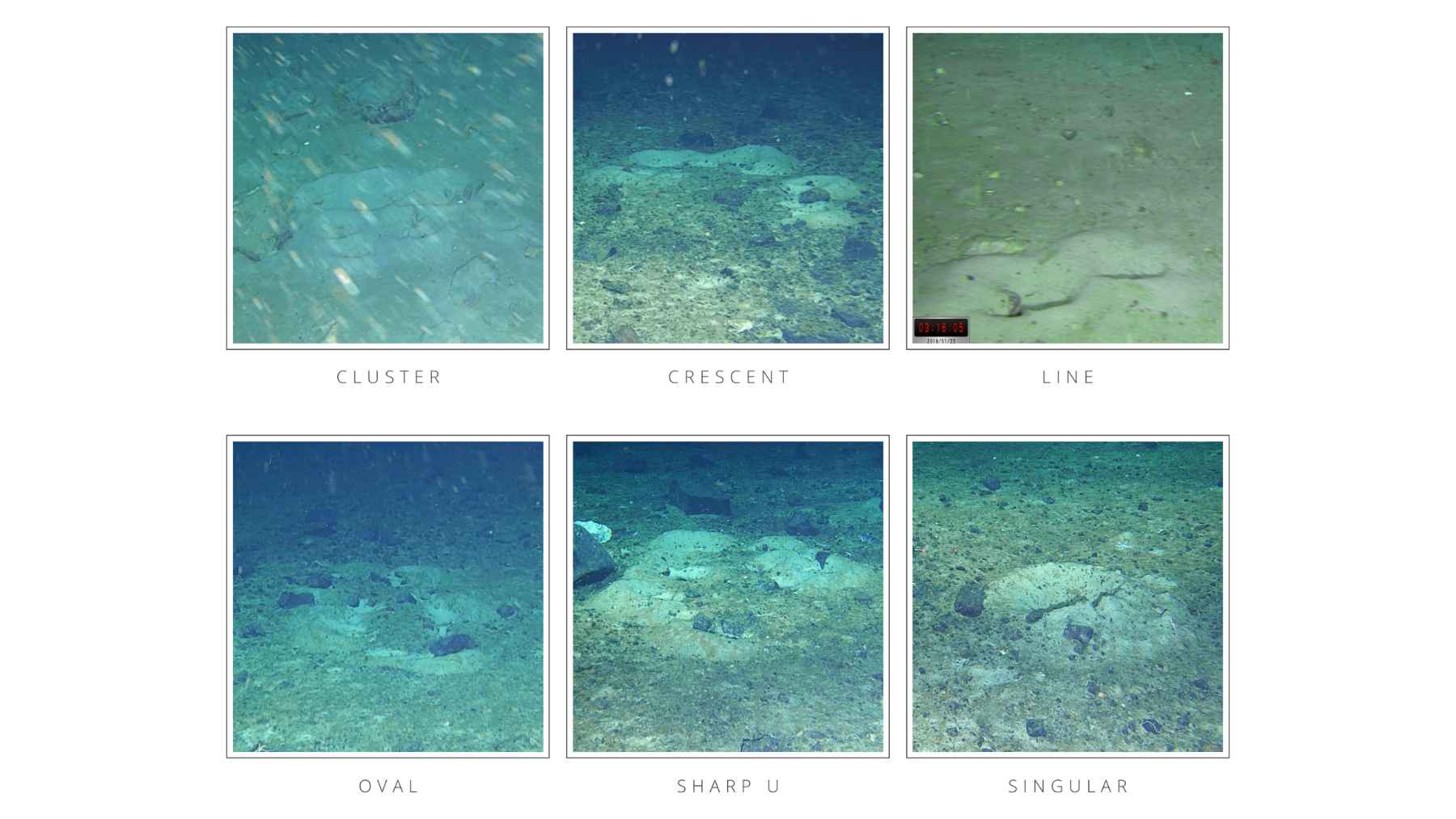
A composite of underwater images reveals distinct fish nest patterns such as clusters, crescents, and lines on the seafloor of the Weddell Sea, suggesting organized behavior in a hidden ecosystem.
A small Antarctic fish that builds and guards its own home
The nest builders were identified as Lindbergichthys nudifrons, also known as the yellowfin notie. Adults live close to the bottom and reach under 20 centimeters long, yet they show parental care that can include nest building, cleaning, and guarding during the long incubation period common in many Antarctic fish.
Across the footage, about 9 percent of nests were classified as inactive and around 7 percent contained larvae in or near the nest. Eggs were not seen, likely because the expedition timing fell after known hatching periods, but the nests averaged around 12 centimeters across and the fish measured from the video averaged just over 10 centimeters.
The nests form patterns that suggest safety in numbers
Instead of scattering nests evenly, the fish often grouped them into repeatable designs. Researchers described six patterns, including dense clusters, crescents, ovals, straight lines, sharp U shapes, and solitary nests, with clusters making up just over 42 percent of all nests.
Solitary nests were the second most common at nearly 19 percent, and they tended to be larger than nests found in groups. That fits a simple idea seen across nature, where bigger or more dominant individuals can sometimes afford to go it alone.
So why the crescents and U shapes? The study suggests the geometry is largely driven by biology, especially predation risk, rather than by a simple physical trigger like a warm patch of water.
In the videos, brittle stars frequently appeared on nest rims and a predatory ribbon worm was also observed nearby, both candidates for egg or larval predation during the months when breeding would normally be underway.
Cold water mattered, but it did not run the show
Temperatures at nesting sites ranged from about minus 2.1 degrees Celsius to minus 1.1 degrees Celsius. For the most part, there were no significant differences between temperatures at nests and temperatures in nearby nest-free areas, except at one site where nesting spots were about 0.2 degrees colder.
That result stands out because another well-known Antarctic breeding colony, reported previously for a different fish, appears tied to a much stronger temperature anomaly.
In that case, bottom water was up to about 2 degrees warmer than surrounding areas and nests were far larger, around 75 centimeters across, while the yellowfin notie nests in the Weddell Sea averaged roughly one-sixth of that size.
Why this discovery matters beyond the polar scientists
Nesting sites are not just a cool biological detail: they are an ecological asset. The researchers say these structured breeding habitats meet key criteria used to identify “Vulnerable Marine Ecosystems,” and their clear video evidence strengthens the case for the proposed Weddell Sea Marine Protected Area under Antarctic conservation discussions.
The numbers suggest this is not a one-time oddity. Nest densities varied sharply by site, reaching an estimated 332 nests per kilometer of robot survey track at one location, which implies a habitat that could be both widespread and easy to damage if disturbed.
There are still open questions about how these nest neighborhoods work, including whether each nest represents one breeding pair and how consistent the patterns are from year to year.
But the Weddell Sea also helps regulate global ocean circulation and gas exchange, so what happens there can echo far beyond the ice, in ways that eventually show up in the weather patterns we all live with.
The study was published in Frontiers in Marine Science.