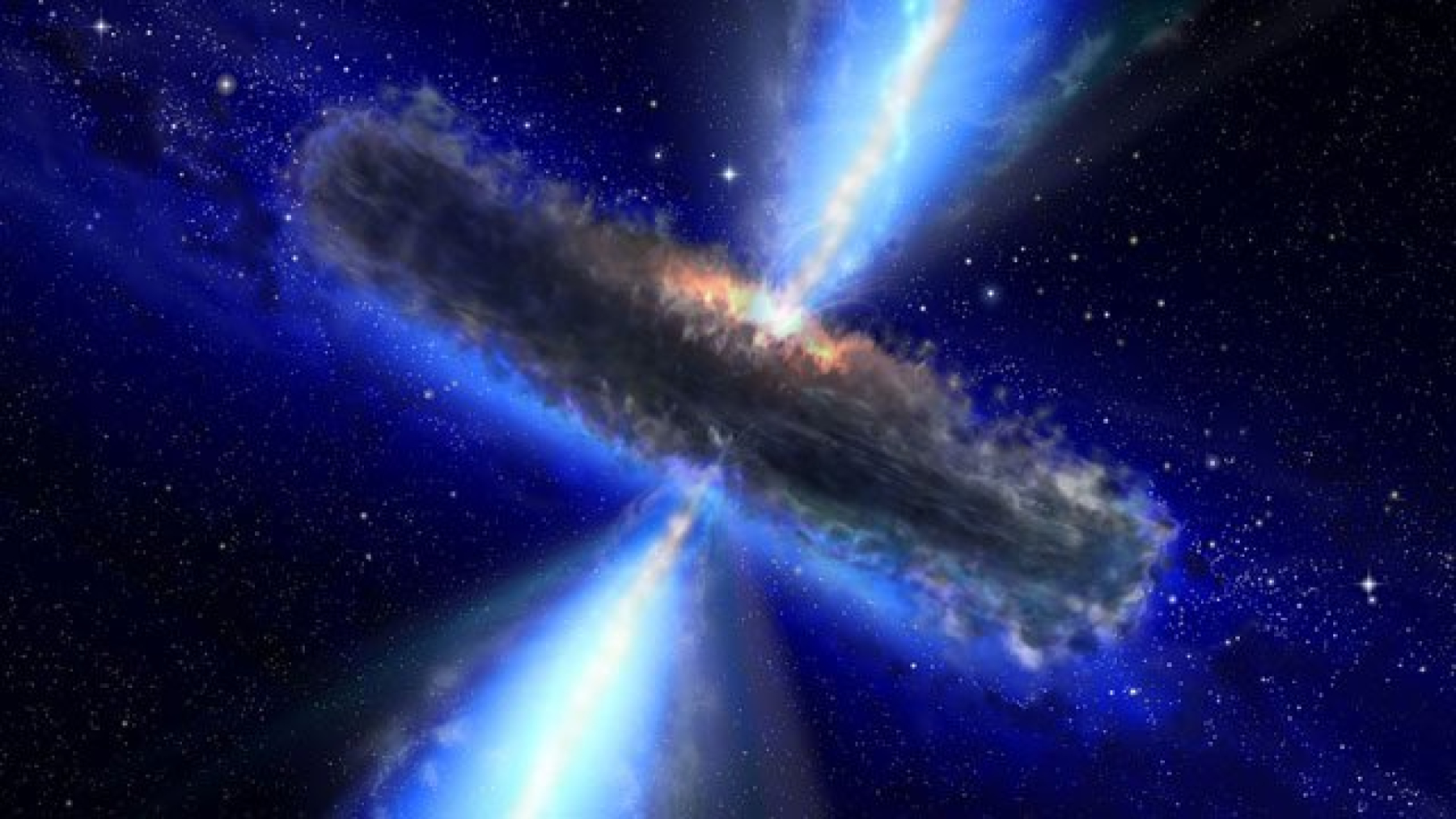
The finding of water across the cosmos brings insights about space and the possibilities of life itself. Among such milestones is the detection of a water reservoir-the greatest ever discovered and the farthest to date-around a quasar more than 12 billion light-years away. This quasar called APM 08279+5255, and others like it with water in their composition, such as interstellar clouds and protoplanetary disks, are examples of the significant role water plays in creating the universe.
Major breakthrough as water vapour flanks farthest quasar yet discovered
Astronomers have announced amazing results of a huge reservoir of water vapor surrounding APM 08279 + 5255 star-feeding or feeding black hole quasar. This is a reservoir holding 140 trillion times as much water as in all the oceans on Earth; it is unmatched for any object at such a large distance.
The black hole powering this quasar is the mass of 20 billion suns and energizes that quasar as bright as a thousand trillion suns, creating a unique environment for the evaporating water. This water vapor spans hundreds of light-years, and the temperatures are around -63°F (-53°C) with densities between 100 and 1,000 times denser than those typical of the galaxy.
The emission from the quasar provides illumination for this unusually warm and dense gas in X-rays and infrared light. These findings make very evident that water is not limited to forms we are familiar with on Earth; it abounds already in those early moments of the evolution of the universe.
How stars and planets are shaped by water: The cosmic water cycle
The occurrence of water accentuates beyond the confines of the quasars up to interstellar clouds and through protoplanetary disks, where it plays a pivotal role in forming both stars and planets. For example, the multiple-ages giant star-forming nebula, the Orion Nebula, also possesses both vapour and ice forms of water. Image taken by the Herschel Space Observatory clears the knowledge of how water vapor surrounds young stars and accounts to reveal the processes involved in spreading this vital molecule across the galaxy.
From such evidence of water-rich protoplanetary disks, PDS 70, which has recently been documented around young stars, indicates that the material that will compose newly emerging planets is being gathered into these disks. The Atacama Large Millimetre/Submillimetre Array (ALMA) has detected such signatures of water vapor fonts evolving with such data.
The Hubble Space Telescope and Rosetta spacecraft: Revealing the secrets of water in space
Comets and asteroids act as reservoirs of water ice in our solar system, which could provide important information about the origins of water on Earth. The Rosetta mission studied the comet 67P/Churyumov-Gerasimenko.
Water vapor released from the nucleus of this comet may help to elucidate the role of comets in the delivery of water to terrestrial planets. NASA’s EPOXI mission also proved to be a significant player by discovering the similarity in the composition of water on Comet Hartley 2 and the oceans on Earth, further enriching the theories of delivery through extraterrestrial water.
Among the exoplanets, K2-18b is one such planet, which is believed to have the presence of water vapors in its atmosphere. Hubble Space Telescope detected this planet, and it is in the habitable zone of its star, where conditions might favor the presence of liquid water.
These findings could help understand where to look for liquid water-and perhaps life-in the universe. Water’s distribution all over the universe fills the entire place that it has taken into the formation and evolution of celestial bodies.
This ranges from the huge reservoir surrounding APM 08279+5255 to those icy trails created by comets and including the atmospheres of distant exoplanets. Water is discovered far beyond the Earth’s surface. While astronomers continue unraveling all the mysteries of space water, they reach further into the areas asking fundamental questions concerning the origins of life and the nature of our universe.