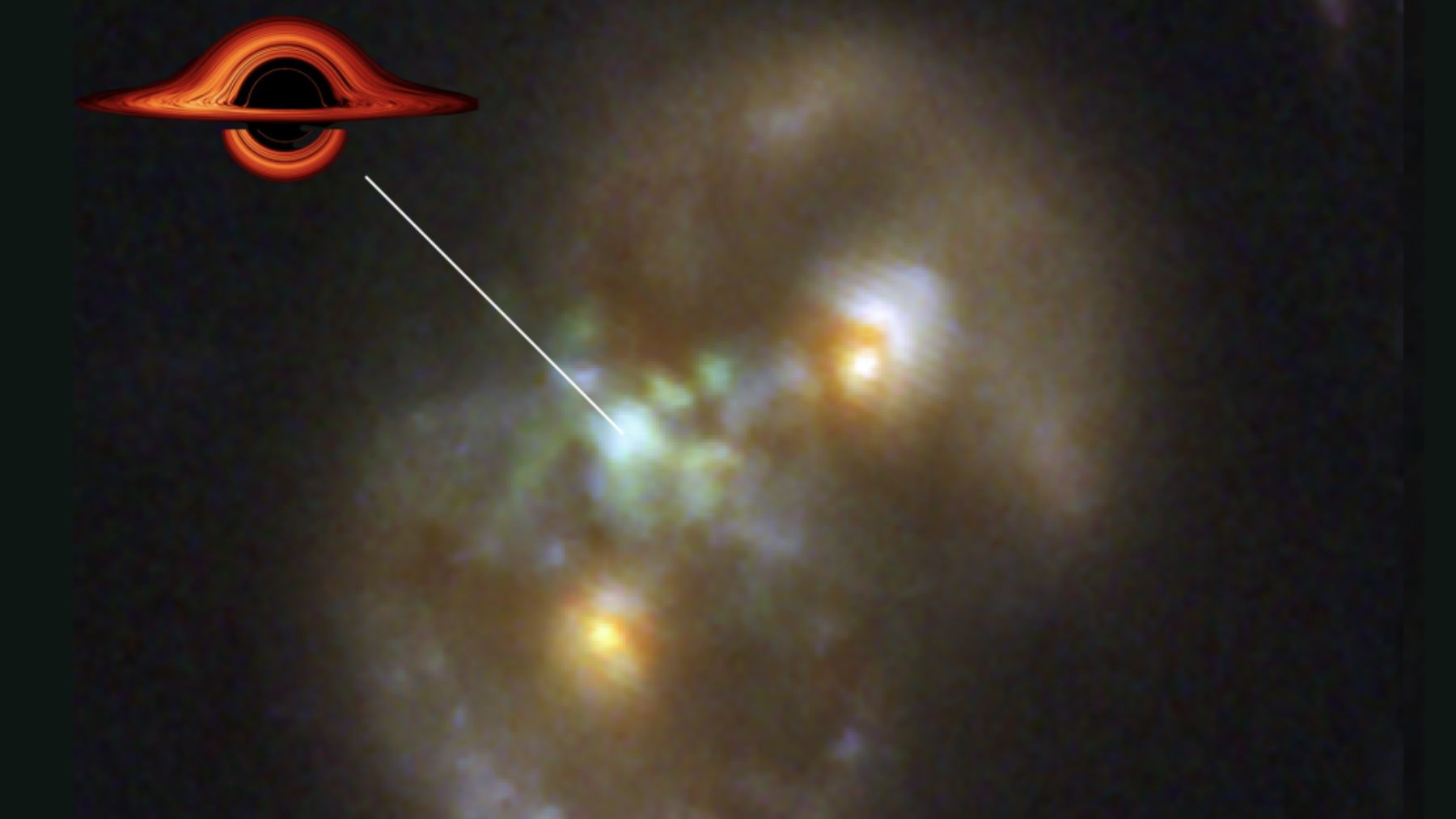
Far out in the constellation Sextans, about 8.3 billion light years from Earth, astronomers have spotted a cosmic figure eight that could rewrite the story of how the biggest black holes are born. The object, nicknamed the Infinity Galaxy, appears to host a supermassive black hole that formed directly inside a cloud of gas rather than from the death of a star.
The discovery came from images taken by NASA’s James Webb Space Telescope as part of the COSMOS Web survey. In those images, two compact red galactic nuclei sit inside bright stellar rings that loop together in the shape of the infinity symbol. Follow up data from NASA’s Chandra X ray Observatory and the Very Large Array revealed a powerful source of X-rays and radio waves glowing not in either nucleus, but right between them, inside a broad region of ionized hydrogen gas.
Pieter van Dokkum of Yale University, who leads the study, summed up the surprise. He explained that “everything is unusual about this galaxy” and added “we think we’re witnessing the birth of a supermassive black hole, something that has never been seen before.”
Two paths for making a cosmic giant
Astronomers have long debated how black holes millions or billions of times the mass of the Sun manage to appear so early in cosmic history. One camp favors so called light seeds, where ordinary massive stars collapse into small black holes that slowly grow and merge over hundreds of millions of years. The trouble is that Webb has already found very massive black holes at times when the universe was still relatively young, which makes that slow growth scenario hard to reconcile.
The second idea, known as the heavy seed or direct collapse scenario, skips the stellar step. In this case, a giant gas cloud collapses under its own gravity straight into a black hole that may already weigh up to a million Suns. That would be fast enough, but there is a catch. As gas clouds collapse they usually fragment and form stars, not a single monster black hole. Proving that direct collapse really happens has been a major challenge.
Infinity Galaxy may offer the clearest real world example so far of that process at work.
A head-on crash that lit the spark
According to the team, the odd shape of the system tells an important part of the story. Two disk galaxies appear to have crashed together nearly face-on, flinging their inner stars outward into twin rings that still circle each surviving nucleus. In the crowded middle, gas from both galaxies slammed together, shocked, and compressed. Van Dokkum notes that this compression “might just be enough to form a dense knot that then collapsed into a black hole.”
Spectra taken with the W M Keck Observatory’s Low Resolution Imaging Spectrometer in Hawaiʻi helped pin down key numbers. The team measured the distance to the system and estimated the mass of the central black hole at roughly one million times that of the Sun, similar to the black hole in the heart of our own Milky Way.
If the object in the middle were simply a runaway black hole flung out of one galaxy, or the hidden center of a separate faint galaxy that happens to sit in the same line of sight, its motion should differ from the gas around it. New Webb observations with the NIRSpec integral field unit instead show that the velocity of the black hole matches that surrounding gas to within about fifty kilometers per second. That close agreement, together with the extended cloud of ionized hydrogen around it, strongly supports the idea that the black hole formed right there inside the gas itself.
As an extra twist, the new data reveal that each of the two bright galactic nuclei also hosts its own active supermassive black hole. That three-black-hole line up rules out scenarios where a single central black hole was kicked out of one nucleus and later came to rest between them.
Why a distant collision matters here at home
At first glance this might feel like remote, abstract physics, far removed from crowded cities, rising seas, and the electric bill on the kitchen table. Yet supermassive black holes help regulate how galaxies grow and how many stars eventually form. They heat and stir their surroundings, shaping the long term “climate” of galaxies that will later seed planets, atmospheres, and maybe life. Understanding how these giants first appeared is part of understanding the wider environment our own Milky Way evolved in.
If direct collapse really can happen when dense gas is violently squeezed, conditions in the early universe may have been far more favorable to quick black hole growth than light seed models assume. Infinity Galaxy then becomes a kind of fossil clue, caught at a moment when two galaxies turned a chaotic crash into the birth of a cosmic heavyweight.
Watching and helping from Earth
The story is still unfolding. Astronomers plan sharper observations with adaptive optics on Keck and more detailed Webb studies to probe the gas motions even closer to the central object. On the theory side, teams are running computer simulations to see whether similar collisions naturally produce heavy-seed black holes.
People at home are not entirely on the sidelines. Through projects such as Galaxy Zoo, volunteers can help classify Webb images of galaxies and may even flag the next strange object hiding in the data.
So while we look up from well-lit streets and glowing phone screens, the universe continues to recycle gas, stars, andentire galaxies on scales that are hard to grasp. Somewhere in that distant infinity-shaped ring, a newborn black hole is still feeding, and quietly telling us how the first giants may have changed the universe we live in today.
The study was published in The Astrophysical Journal Letters.