At first glance, the collapse of Antarctic ice sounds like the worst climate news you could imagine. Yet a new study suggests that in some cases, meltwater from the West Antarctic ice sheet might actually help a crucial Atlantic ocean current avoid a full shutdown.
That current is the Atlantic meridional overturning circulation, or AMOC, which moves warm salty water northward near the surface and returns colder deep water southward.
The research finds that meltwater from West Antarctica can sometimes weaken this circulation yet also make it more resilient to melt from Greenland, even completely preventing a collapse in certain high-emission scenarios.
A climate tipping point that shapes daily weather
Scientists describe the AMOC and big ice sheets as climate “tipping elements”, meaning systems that can flip into a new state that is very hard to reverse once a threshold is crossed. A 2022 study in the journal Science warned that crossing about one and a half degrees of global warming could trigger several such tipping points, including those in Greenland and West Antarctica.
The AMOC helps shape storms in the North Atlantic, summer heat in Europe, and even how hard your heating or cooling system has to work in a given season. Recent work has argued that this circulation may already be moving toward a tipping point as greenhouse gases rise, which is why any hint of a future shutdown grabs headlines.
What the Utrecht team did differently
Led by climate scientist Sacha Sinet together with colleagues Anna S. von der Heydt and Henk A. Dijkstra at Utrecht University, the team used an Earth system model called CLIMBER X. They ran thousands of years of simulations where meltwater from the Greenland ice sheet and the West Antarctic ice sheet was added to different parts of the ocean.
Instead of guessing one precise future, they tested many “what if” trajectories for how fast each ice sheet might collapse and when those collapses would start.
These timelines were based on ranges from earlier ice sheet modeling work, where Greenland could take roughly one to fifteen thousand years to largely disappear and West Antarctica about five hundred to thirteen thousand years, especially under very high emissions.
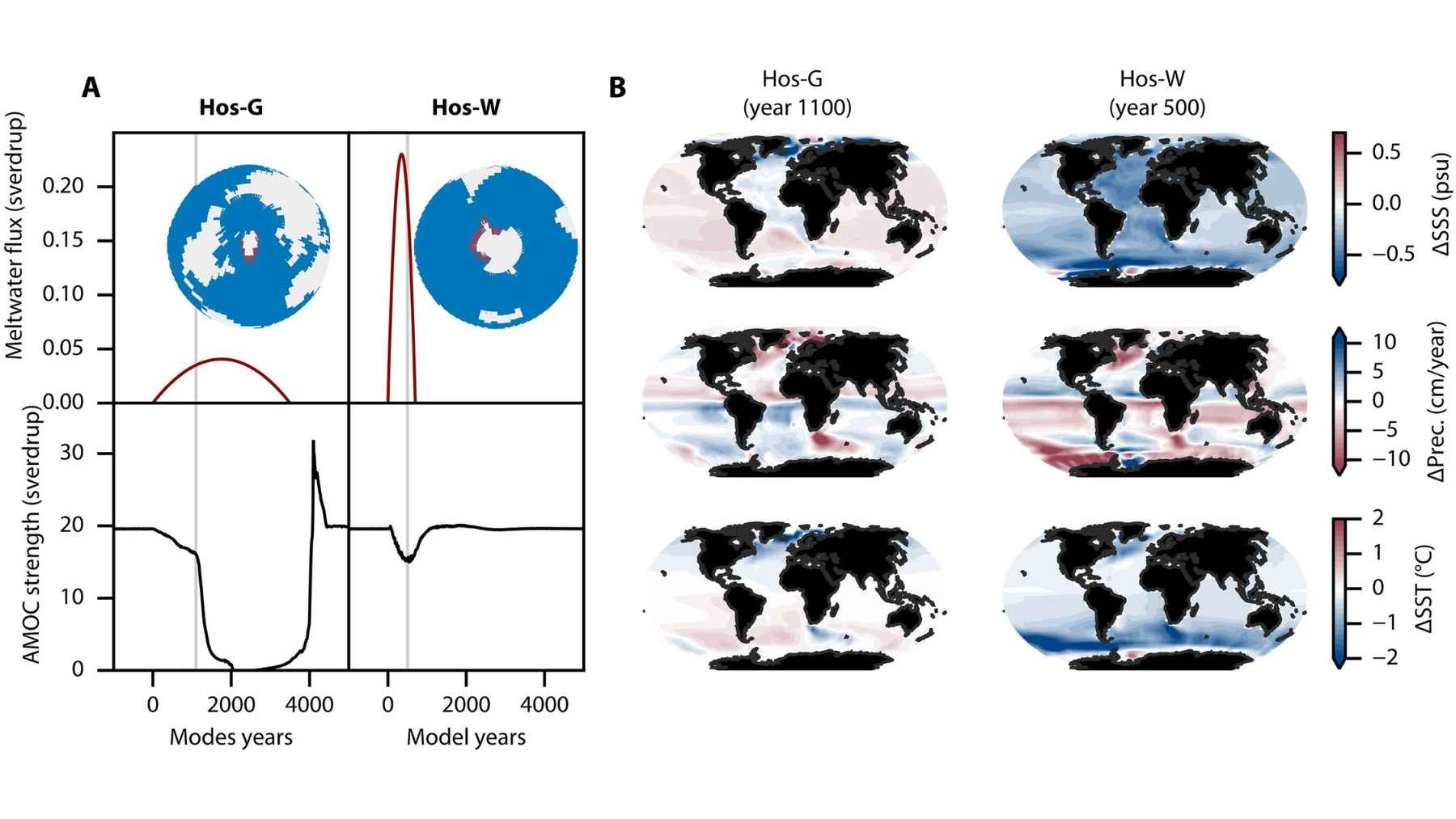
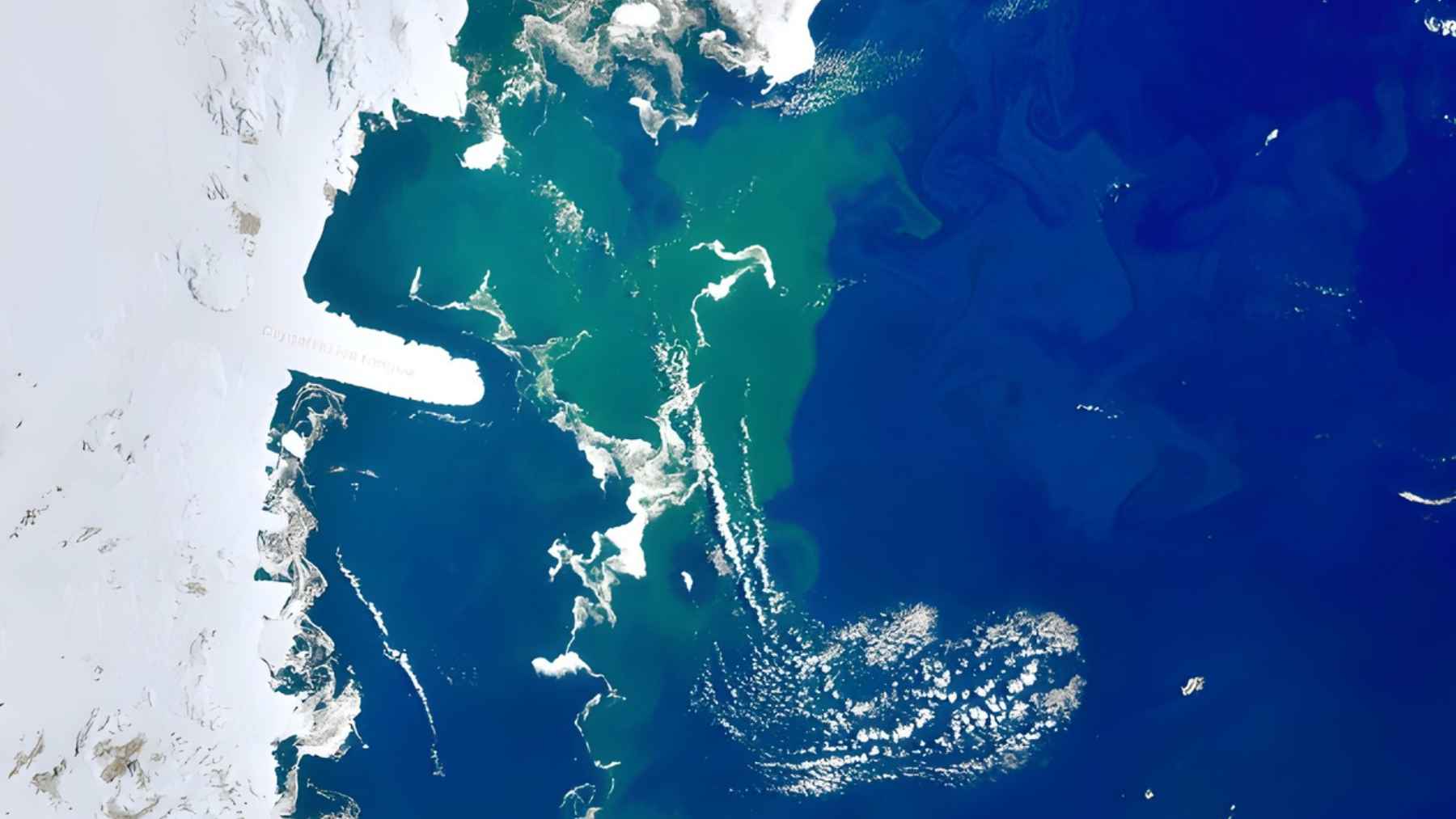
Climate simulations illustrate how meltwater from Greenland and West Antarctica can alter the strength of the Atlantic Meridional Overturning Circulation.
Greenland alone pushes the AMOC toward collapse
When the model added only Greenland meltwater into the North Atlantic, the AMOC eventually collapsed for a wide range of melt rates that lasted between about one and four thousand years.
That fresh water made surface waters in the North Atlantic less salty and therefore less dense, which choked off the sinking that normally drives the overturning circulation.
Once the AMOC collapsed in these experiments, the model produced a cooler Northern Hemisphere and a warmer Southern Hemisphere, along with a shift in tropical rainfall patterns. That kind of pattern would have big consequences for crops, fisheries, and everyday weather in regions that currently depend on a relatively stable Atlantic climate.
West Antarctica changes the story
The twist came when the team added meltwater from West Antarctica on top of the Greenland signal. West Antarctic melt alone did not tip the AMOC in the model, although it did weaken the circulation after a brief initial strengthening linked to changes in deep water formation around Antarctica.
When both ice sheets were allowed to “tip”, West Antarctic meltwater sometimes made things worse and sometimes better.
In some setups it sped up the AMOC collapse or delayed its recovery, but in others it nudged the system into a different, weaker, yet stable overturning pattern that never fully shut down, even while Greenland kept pouring freshwater into the North Atlantic.
How meltwater can both weaken and stabilize the AMOC
In the stabilizing experiments, the West Antarctic ice sheet collapsed relatively quickly, over at most about eleven hundred years, and its main melt pulse arrived several hundred years before the peak of Greenland melting.
That early Southern Hemisphere meltwater first helped weaken deep convection in the far north, then shifted where sinking occurred so that deep water formation continued farther south in the Atlantic.
Over time, less Antarctic freshwater reached the North Atlantic, while salty water from lower latitudes slowly increased the density of surface waters there. The model settled into a “weak but still active” AMOC that proved more resilient to Greenland melt than the stronger original state, preventing a total shutdown in those cases.
Why this is not a get out of jail free card
At the end of the day, this does not turn West Antarctic collapse into good news. The same ice sheet holds enough frozen water to raise global sea level by roughly four to five meters if it melts completely, which would redraw coastlines and expose many major cities to chronic flooding.
Earlier work has also shown that Antarctic meltwater can delay or reshape AMOC weakening, yet still drive major climate shifts in both hemispheres, including changes in storm tracks and rainfall that people would feel far from the poles.
For the most part, the new study reinforces two messages. First, the climate system contains networks of tipping elements that can interact in complex ways, sometimes pushing one another toward crisis and sometimes cushioning the blow.
Second, relying on a West Antarctic tipping event to “rescue” the AMOC would trade one huge risk for another even larger one, especially for low-lying coasts that already worry about each extra inch of sea level rise.
The main study has been published in the journal Science Advances.