Tea feels like one of the simplest daily rituals. You boil water, drop in a bag, wait a few minutes, and get something warm that smells familiar. But a recent scientific review is asking an uncomfortable question that most tea drinkers have never had to think about.
Are microplastics and even smaller nanoplastics ending up in the tea you sip?
The answer is not a clean yes or no. The review’s main takeaway is that tea can pick up plastic particles from several points along the way, and tea bags are often the biggest contributor, especially in hot tea. But the same review also underlines something many headlines skip.
The numbers can swing wildly depending on how scientists measure what is floating in the cup.
A tea bag can be the main source
In the Food Chemistry review, researchers describe microplastics and nanoplastics (often grouped together as “MNPs”) showing up across tea-based drinks, from hot brewed tea to other tea products.
They point to multiple potential sources, including production water, packaging, and even contaminated tea leaves.
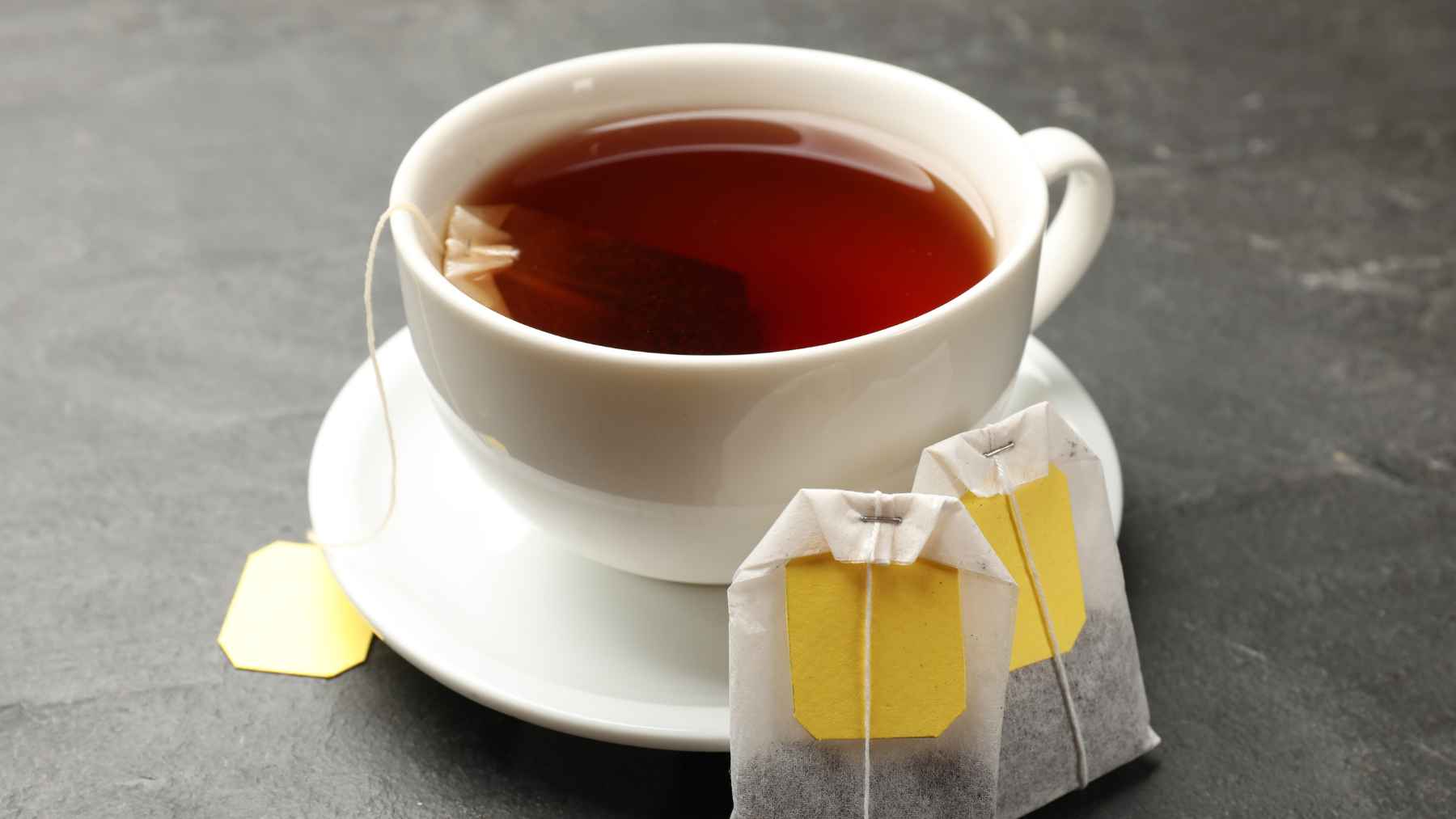
Still, one detail stands out. The authors say “the most important contributor overall is the teabag,” and they note that studies have reported releases exceeding one billion particles per plastic tea bag when steeped in near-boiling water.
That single sentence is why this topic is suddenly everywhere.
Tiny plastics, big measurement challenges
Microplastics are generally defined as pieces ranging from about 0.00004 inches (1 micrometer) up to about 0.2 inches (5 millimeters). Nanoplastics are even smaller than 0.00004 inches, so small that you cannot see them and many standard lab methods struggle to count them reliably.
That size issue is not a technical footnote. It’s the whole story. If one lab counts particles down to a smaller cutoff than another lab, the final totals can look dramatically different, even when both labs are studying similar tea bags.
Why some bags shed more than others
A lot of people assume tea bags are just paper. Some are mostly paper, but others can include plastics like nylon or polyethylene terephthalate (PET), and some “premium” pyramid-style bags use mesh-like materials that behave more like plastic packaging than old-fashioned paper.
The Food Chemistry review also flags that “biodegradable” or mixed-material bags are not automatically a free pass. Significant quantities of these particles have been reported from plastic-cellulosic composites and from some biodegradable bags as well.
In other words, switching labels does not always mean switching exposure.
And then there’s the everyday reality. Even if the tea bag itself is the main culprit, the tea’s “plastic journey” can start earlier, with processing and packaging, and continue later with cups, lids, and contact with plastics along the way.
If you’ve ever carried tea in a disposable to-go cup, you know how quickly those contact points add up.
Billions make headlines, but methods matter
Some of the most eye-catching figures come from a widely cited 2019 study that reported steeping a single plastic tea bag at about 203°F (95°C) released roughly 11.6 billion microplastic particles and 3.1 billion nanoplastic particles into one cup. Put together, that is about 14.7 billion tiny plastic pieces, at least under that study’s brewing and measurement conditions.
Other work has reported lower but still startling totals, including estimates around 1.3 billion particles per bag in at least one approach using different imaging and identification methods. So, which number should you believe when you see it shared online? A good first question is “What was the size cutoff, and what exactly counted as plastic in that lab?”
There is also scientific pushback worth knowing about. In an official assessment, Germany’s Federal Institute for Risk Assessment (BfR) argued that parts of the 2019 counting method could misidentify dried residues as microplastics, and that some of what was counted may have been soluble oligomers (short-chain by-products) rather than solid plastic particles.
BfR’s own work cited much lower counts for particles larger than 0.00004 inches (1 micrometer), in the range of thousands to tens of thousands per bag, not millions.
Additives and residues add another layer
The Food Chemistry review highlights another concern that is easier to miss than particle counts. Plastics are not chemically “pure,” and they often contain additives or manufacturing residues that can potentially leach out in hot water. The authors note that additive leaching is a concern, even if it is “not well understood”.
This is where the science still feels unsettled. Researchers are still trying to separate what might come from intact bag material versus what might ride along on particles that break off, and what might simply come from contamination during processing, storage, or brewing.
If it sounds messy, it is.
What the science says about risk so far
Here’s the part many readers actually want to know. Does this automatically mean your tea is dangerous? The review itself does not present human clinical trials proving harm from tea-bag-derived particles.
Instead, it argues that the concentrations reported in tea can be high relative to many other foods and beverages, which is why health and environmental impacts “require further study”.
Laboratory findings can be unsettling, but they are still early-stage. The 2019 study, for example, included an acute invertebrate toxicity assessment and reported dose-dependent behavioral and developmental effects in small organisms exposed to particles released from tea bags.
That kind of result raises legitimate questions, but it is not the same as showing real-world health outcomes in people who drink tea.
Regulators also tend to urge caution in interpretation. In its communication, BfR summarized its position as “no health impairments expected based on current knowledge,” while also stressing that there are still data gaps and that a full assessment is not yet possible.
BfR also noted that only very small particles are considered likely to cross the intestinal barrier, which is one reason risk assessments remain cautious rather than alarmist.
A few practical takeaways for your next cup
So what should a normal person do with all this, standing in front of the kettle on a weekday morning? First, treat big numbers as a prompt to ask better questions, not as an instruction to panic. What kind of tea bag was tested, at what temperature, and what counted as a particle in the lab?
Second, if you want to reduce one likely source without giving up tea, the most straightforward option is to remove the bag from the equation. Loose-leaf tea brewed in a stainless-steel infuser avoids plastic mesh bags entirely, and it also nudges the market toward products that rely less on mixed-material packaging. Small change, familiar comfort, fewer unknowns.
The study was published on ScienceDirect.