Today the Gobi Desert is shorthand for dust, rocks and brutal dryness. In the early Holocene it looked very different.
A new geoarchaeological study of a site called FV92 on the shore of a now-vanished lake named Luulityn Toirom shows that more than 8,000 years ago mobile hunter-gatherers camped beside seasonal watercourses, butchered animals and used wild plants in what is now desert steppe that receives less than 100 millimeters of rain in a typical year.
By combining lake sediment cores, advanced luminescence dating and microscopic analysis of hundreds of stone tools, an international team reconstructed both the local environment and the way people adjusted as the region dried.
A lake in the middle of today’s desert
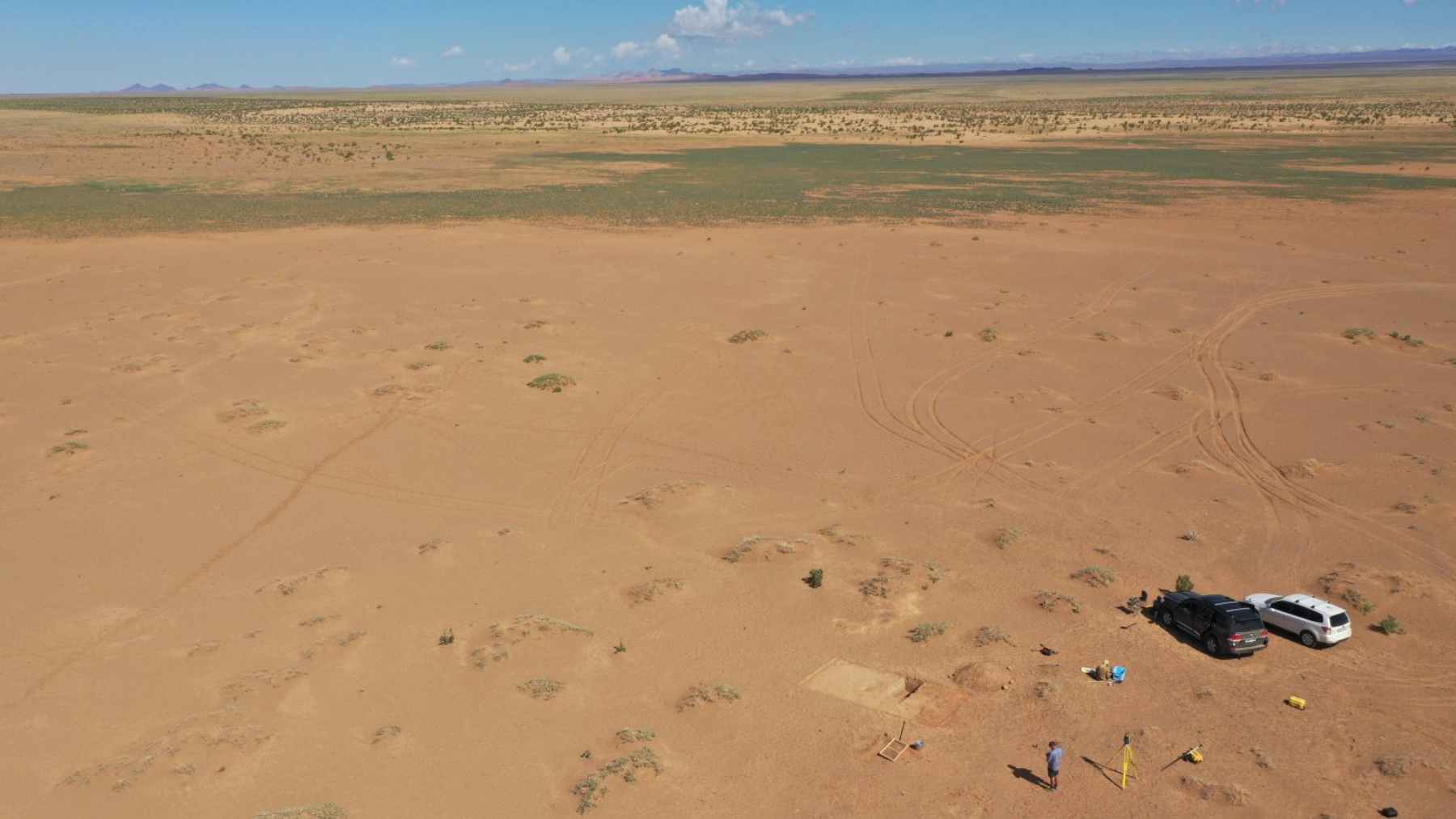
Luulityn Toirom lies on the Mongolian Plateau near the Arts Bogd massif in the Gobi Altai Mountains. If you visit today you see a dry basin, scattered dunes and the stony desert pavement that forms when wind strips away finer grains.
The new research shows that this basin once held an endorheic lake about 3.5 kilometers long and covering roughly 1.8 square kilometers. Sediments in eleven hand-drilled cores reveal alternating layers laid down by rivers, standing water and wind.
Optically stimulated luminescence dating indicates that the lake was present during humid phases of the early Holocene and that sandy wind-blown deposits began to bury the archaeological remains a little more than eight thousand years ago.
Stone tools on a shifting shoreline
Right on this shifting shoreline archaeologists opened an 18-square-meter trench where stone artifacts were visible on the surface. They uncovered a dense scatter of more than 2,700 pieces of chipped stone, from tiny chips to carefully shaped tools.
Most were made of jasper and chalcedony, materials that do not crop out nearby. Geological work in the same region shows that the nearest known sources lie in the Flint Valley about 16 kilometers away and in a newly documented Jasper Valley almost 36 kilometers away in the surrounding mountains.
That medium range transport suggests highly mobile groups who were willing to walk a full day to bring back suitable raw material.
At first glance many of the pieces look like slivers. So why do they matter so much? Detailed technological analysis shows that FV92 belongs to a long tradition of microblade production that began in Mongolia during the Upper Paleolithic and continued into the early Holocene.
Eight of the ten cores at the site are small rounded blocks that were carefully prepared to produce parallel bladelets. Microscopic study of the scars and platforms indicates that stoneworkers used sophisticated pressure techniques rather than only hitting cores with a hammerstone.
When the team refitted flakes and blades they could follow a consistent operational chain from raw nodule to finished tool.
What the tools say about daily life
Use wear experiments helped turn those technical details into traces of daily life. Under high magnification the edges of 22 artifacts carried polishes and tiny nicks that match experimental tools used to scrape hides, cut meat, work wood and slice herbaceous plants and reeds.
A bifacial adze shows intensive contact with wood, probably while shaping handles or other implements. Endscrapers were used more lightly to treat hides and bone, and several blades and bladelets were hafted in wooden handles.
The picture that emerges is a small camp near a seasonal stream where people butchered animals, processed skins and made or repaired gear between moves. The authors describe FV92 as a “short-lasting encampment” rather than a settled village.
The team is careful about reading too much into the exact layout of that camp. Floods and slope wash during wetter years nudged artifacts downslope, and later wind action abraded surfaces and spread lighter pieces.
Even so, the combination of sediment studies and tool analysis points to repeated themes across the wider region. Early Holocene layers in the Luulityn Toirom basin and in other Gobi paleolakes record higher lake levels and greater influence of the East Asian monsoon system.
Later deposits show that water became more seasonal, dunes advanced and desert conditions similar to today were in place by the late Holocene.
Climate lessons from an ancient lake
In chronological terms FV92 fits what archaeologists working in Mongolia call the Oasis 1 Mesolithic phase, which spans roughly 13,500 to 8,000 calibrated years before present. Communities still relied on hunting and gathering, pottery was absent or rare and microblade technology dominated.
The Luulityn Toirom camp seems to match a pattern of short stays by highly mobile groups who shifted between mountain raw material zones and lowland wetlands as resources changed. It was not a permanent home. It was one stop in a larger seasonal round.
Viewed from an environmental angle the study is a reminder that even places we now think of as barren have long histories of water, vegetation and human use.
The Gobi region today faces land degradation and frequent dust storms as climate change and local pressures interact, something herders and town dwellers feel whenever spring winds pick up. Long records such as the Luulityn Toirom cores help scientists separate natural swings in humidity from newer human-driven trends.
For communities living in drylands and watching their own lakes shrink, that kind of baseline matters. It shows that deserts are dynamic landscapes and that survival has always depended on knowing when and where the water will return.
The full study was published in the journal PLOS ONE.