
Turning CO2 from air into car parts may help carbon capture pay
· 2 min de lectura
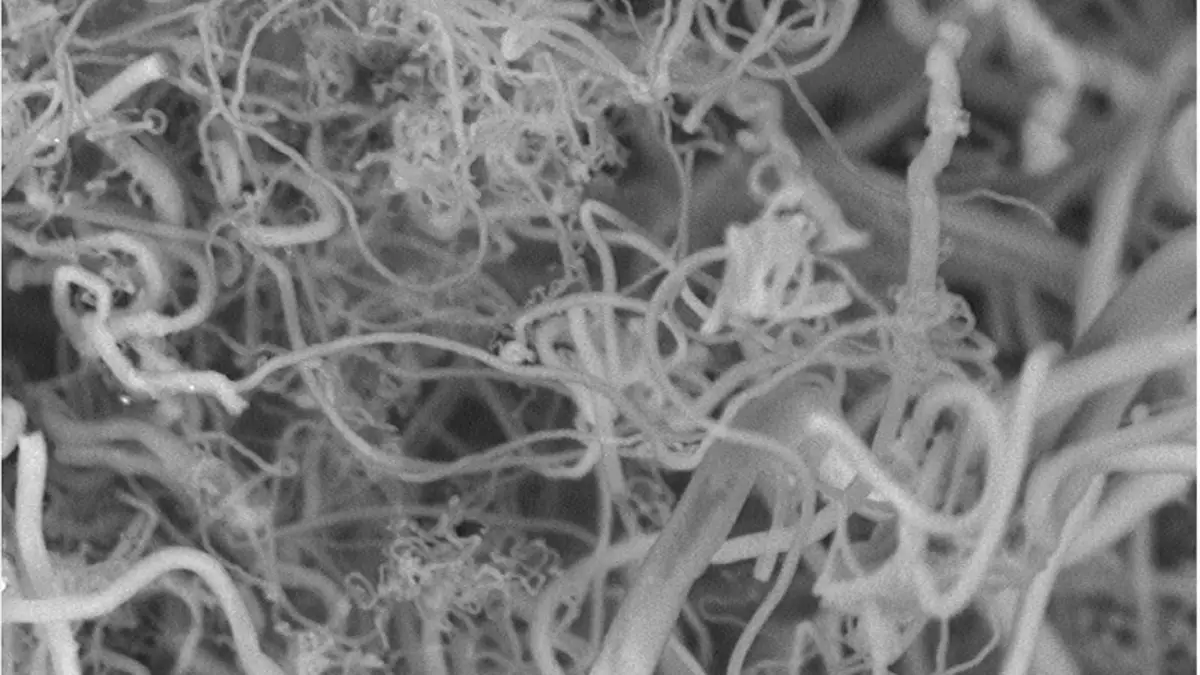
All that extra carbon dioxide clogging our atmosphere might be useful for something new. In a process described at this week’s American Chemical Society meeting in Boston, Massachusetts, the carbon from piped-in air was spun into tiny nanofibres – a raw material used to build strong composites such as those used in aircraft, fitness equipment and sports cars.
A team led by Stuart Licht, of George Washington University in Washington DC, has designed a process that actively strips carbon from the air and turns it into a product that Licht claims can be sold for much more than the cost to produce it.
Carbon nanofibres sell for about $25,000 per ton, but making a ton of them using this process would cost only about $1000, according to the team’s calculations. “We’re transforming the C02 into something useful,” says Licht. “We hope there will be significant demand.”
The technique works in an electrolytic cell, in which atmospheric carbon is dissolved into a vat of lithium carbonate, a common industrial chemical.
Nanofibres grow in threads that look like steel wool from electrodes made of steel, sprouting from tiny amounts of nickel, cobalt or copper. “These little islands provide the take-off point for the carbon nanofibres and they grow from there,” Licht says.
So far, the team’s efforts to scale up from one amp of current for growing nanofibres to 100 have revealed no unexpected snags.

The electric current could come from conventional sources – which might offset the technique’s carbon-sucking potency – but Licht has also successfully run it on solar power.
If extrapolated to very large scales, the process could in theory have an enormous impact on fighting climate change. “We calculate that with a physical area less than 10 per cent the size of the Sahara desert, our process could remove enough CO2 to decrease atmospheric levels to those of the pre-industrial revolution within 10 years,” Licht says.
Bold outlook
That’s a bold projection – and not everyone believes it.
“I am extremely sceptical of these claims,” says Ken Caldeira of the Carnegie Institution for Science in Stanford, California. Caldeira doubts that this kind of solar-to-chemical conversion is near being economically viable. “I would be highly surprised if these people have cracked this nut,” he says.
Nate Lewis of the California Institute of Technology in Pasadena says one limiting factor in the large-scale deployment of Licht’s method might be that carbon dioxide would be depleted from the air where the equipment is set up.
Stripping CO2 from the atmosphere above a concentrated area with high efficiency would mean that more would have to blow in from elsewhere after only a few hours. “It will require much longer times than they calculate,” Lewis says.
Licht says his unpublished research shows that just the hint of a breeze could provide enough influx of new CO2 to allow his process to keep running.
But his team doesn’t have plans to adapt their method for large-scale commercial ends. Licht stresses that his lab is interested only in pioneering the fundamental science involved.
To scale up, he says, we need the global community to work together to generate the resources needed. “This would require a lot of money,” he adds.
Comentarios · 0
Normas ›Todavía no hay comentarios. Sé el primero en opinar.