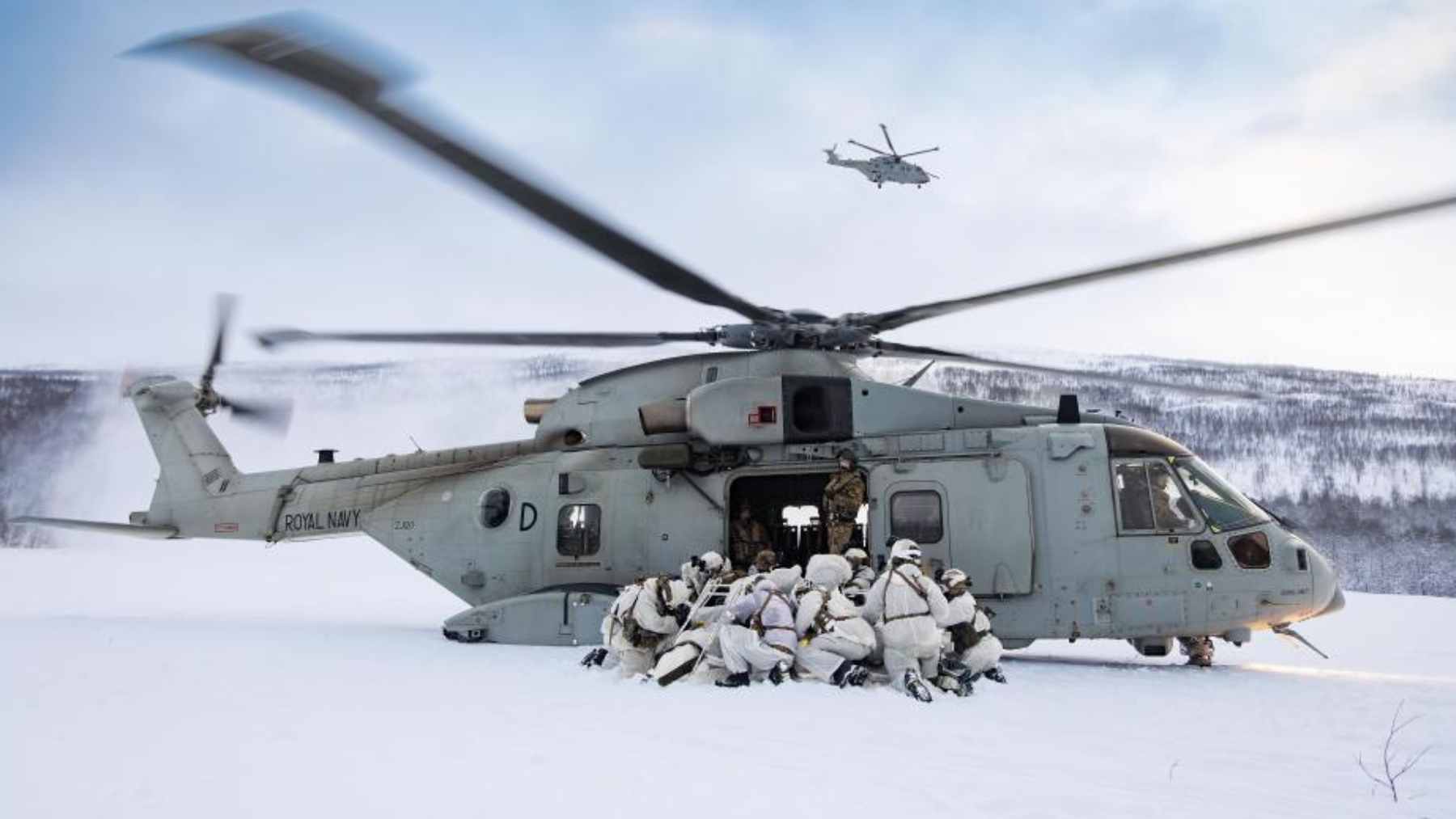
The United Kingdom and Norway have quietly opened a new chapter in the Arctic. Under the Lunna House defense agreement, British Royal Marines will now operate in northern Norway all year instead of just in winter, deepening joint defenses on NATO’s northern flank at the very moment the region is warming faster than almost anywhere else on Earth.
For London and Oslo, this is about hard security. The Lunna House deal links the two navies through an interchangeable fleet of at least thirteen British built Type 26 frigates and a shared focus on protecting undersea cables, pipelines, and other critical infrastructure in the North Atlantic and Barents Sea.
It also commits the UK to Norwegian-led programs on uncrewed mine hunting and undersea warfare systems, and to year-round training of Royal Marines in Norway.
On the ground, that pledge is already taking shape. Camp Viking, a British operations hub opened in 2023 in Øverbygd about sixty five kilometers south of Tromsø, now anchors the UK Commando Force in the High North.
Around 1,500 personnel, plus all-terrain vehicles and Commando Helicopter Force aircraft, are rotating through the base this winter to exercise along Norway’s fjords and mountains and prepare for Exercise Cold Response, the country’s largest military drill in 2026 with an expected 20,000 to 25,000 participants from more than ten nations.
As Lieutenant Colonel Chris Armstrong of 30 Commando put it, the UK Commando Force is “stepping up its readiness to fight alongside allies in the High North.”
Norwegian defense minister Tore O. Sandvik underlined that the Marines, long used to winter training in Inner Troms, will now practice in other seasons as well so they can “come to our aid quickly if a crisis or war situation should arise.”
So far, this sounds like classic defense news. But the backdrop is anything but routine. According to the 2024 NOAA Arctic Report Card, average surface air temperatures in the Arctic are now rising about three times faster than the global mean, part of a pattern known as Arctic amplification. That acceleration is driving dramatic loss of sea ice, shrinking glaciers, and more frequent extreme events.
Between late 2024 and 2025, the Arctic logged its hottest year in at least 125 years of records, with long-term declines in the oldest and thickest sea ice and growing rainfall where snow once dominated. Scientists warn that these changes are already reshaping ecosystems and sending ripples through weather systems far to the south.
More troops are now training on this thinner, more fragile ice. Research reviewed by the Arctic Institute finds that military exercises can compact soil, strip vegetation, and contaminate training areas, while aircraft and naval activity add powerful noise that can disturb wildlife above and below the waterline.
At the same time, analysts point out that the Norwegian Armed Forces have introduced stricter environmental rules, including designated exercise corridors, off-limit zones to shield sensitive habitats, and reimbursement schemes when damage occurs.
NATO itself has begun to treat environmental protection as part of its core work. The alliance’s environment and climate programs focus on cutting the footprint of armed forces, improving energy efficiency, and reducing harm from large exercises, even as members rely on those same activities to practice rapid reinforcement in places like northern Norway and Finland.
In practical terms, that creates a tension that is hard to ignore. On one hand, more capable Arctic forces can better respond to oil spills, search and rescue calls, and accidents along busy sea lanes, all of which are becoming more likely as sea ice retreats and traffic increases.
On the other hand, every extra convoy, low-flying helicopter, and live fire drill adds noise, pollution, and stress to ecosystems where species are already scrambling to adapt to a rapidly changing climate.
For people far from Tromsø or Bardufoss, this can feel distant, like something happening on another planet of snow and ice. Yet the same warming that is opening the High North to more military traffic is also nudging up sea levels that threaten coastal homes, shifting storm tracks that batter power lines, and influencing the energy infrastructure that eventually shows up on the monthly electric bill.
In a way, the Royal Marines training on skis and snowshoes are operating on the front line of a climate story that touches everyone.
As year round British deployments settle in alongside Norway’s own forces, the real test will be whether security planners and environmental authorities can keep pace with the speed of Arctic change.
That means not only rehearsing for conflict but also investing in careful monitoring, strict environmental standards, and honest reporting of impacts, so the High North does not pay twice, once for climate disruption and again for the way we choose to defend it.
The official statement was published on GOV.UK.