Astronomers have just uncovered something astonishing at the heart of one of the sky’s most familiar objects.
Inside the Ring Nebula, a textbook target for backyard telescopes, they have found a narrow bar of super-hot iron gas that seems to cut straight across the nebula’s glowing interior. It is a feature no one had ever seen before, even after decades of study.
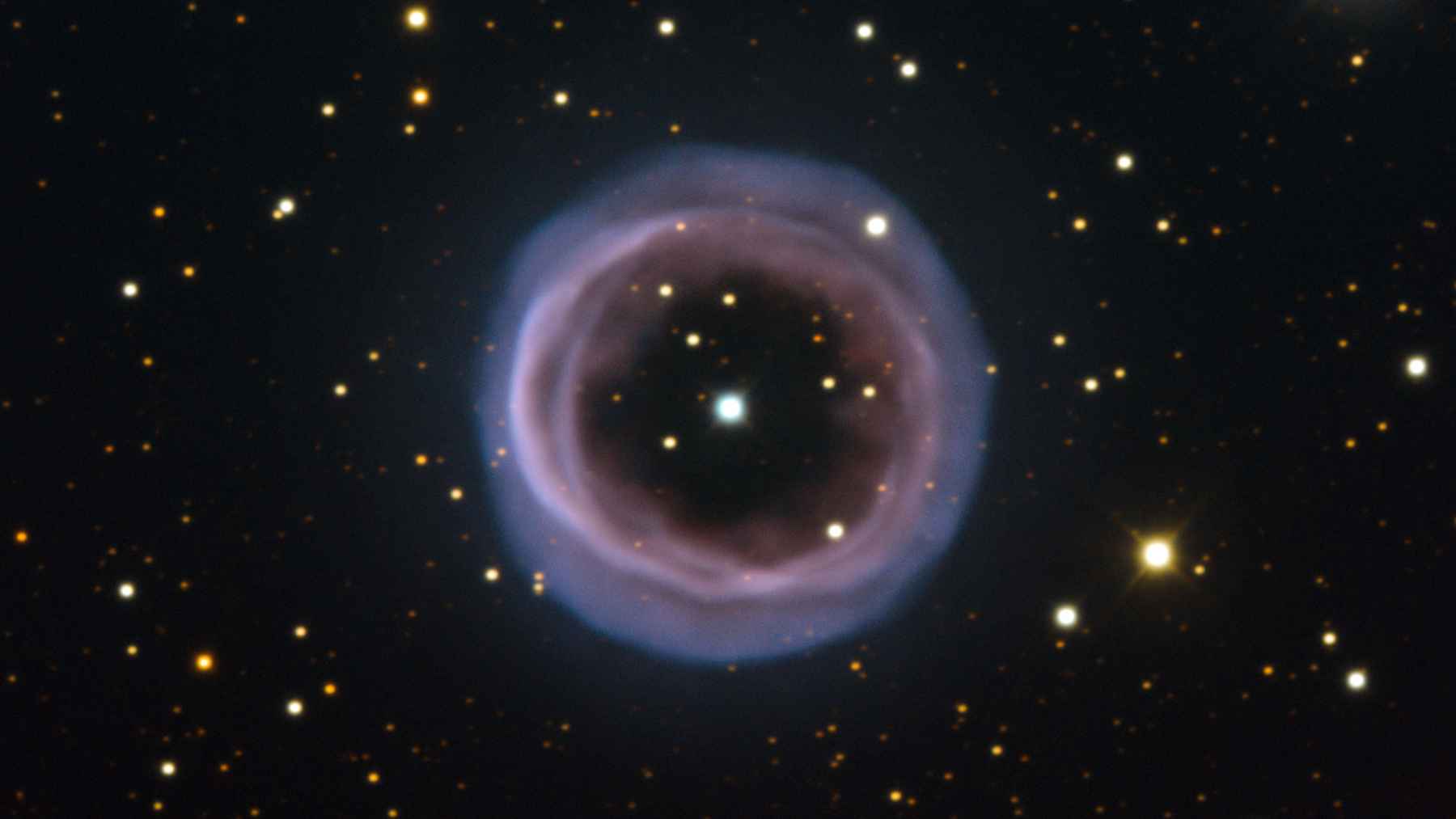
The Ring Nebula is the colorful shell of gas left behind when a Sun-like star ran out of fuel and shed its outer layers around four thousand years ago. It sits roughly 2,000 to 2,600 light years away in the constellation Lyra and has been imaged by many observatories, including the James Webb Space Telescope. So how did everyone miss a structure this dramatic?
A bar of iron the size of a mini solar system
The surprise came from new observations with the 4.2 meter William Herschel Telescope on La Palma in the Canary Islands. Astronomers used the new WEAVE spectrograph instrument in a mode that collects a spectrum at hundreds of points across the entire nebula, instead of just along a single slit. That gave them something like an MRI scan of the gas.
When the team mapped the light from highly-ionized iron atoms, a thin bar suddenly appeared in the data, running across the central cavity. The press material describes its length as roughly 500 times the size of Pluto’s orbit and the amount of iron as comparable to the mass of Mars.
The scientific paper goes further and estimates about 8.5 × 10²⁶ grams of iron in the bar, around 0.14 of Earth’s mass, mostly in very highly charged states of Fe⁴⁺ and Fe⁵⁺. For a region that looks almost empty in ordinary images, that is a huge stash of metal.
Crucially, the iron does not move like the rest of the nebular gas. Its emission lines are shifted in a different way, which tells astronomers it is not simply part of the normal expanding shell. Something separate is going on in there.
Two big ideas and one stubborn mystery
Right now, scientists are considering two main possibilities. One idea is that the bar records a previously unseen phase in the dying star’s mass loss, perhaps a focused outflow or a change in the wind that briefly concentrated iron in a narrow region.
The more speculative scenario is even more evocative. The iron might be what is left of a rocky planet that spiraled into the star during its giant phase, was torn apart and vaporized, and then stretched into a long arc of plasma. Co-author Professor Janet Drew at University College London urges caution and notes that researchers “definitely need to know more” about which other elements, if any, share the same structure.
At the moment, the team cannot cleanly detect lines from other elements with the same velocity as the iron, because those signals are drowned out by brighter gas in front of and behind the bar. Their next step is to use WEAVE at higher spectral resolution to separate these components, and to search for similar iron features in other nebulae.
In other words, this is not a closed case. It is the first clue.
A lesson in cosmic recycling
For an outlet like ECONEWS, there is another angle that matters. Planetary nebulae such as the Ring Nebula are one of the main ways that stars like our Sun return material to the galaxy. The IAC press release points out that this kind of ejection supplies much of the Universe’s carbon and nitrogen, key ingredients for life on Earth.
Iron is just as important in its own way. It builds the cores of rocky planets, strengthens the rocks in Earth’s crust, and sits at the heart of the hemoglobin in our blood. That strange bar of iron in the Ring Nebula is part of the same grand recycling system.
Over millions of years, that gas will drift into interstellar space, mix with other clouds, and eventually help to form new stars, planets, and maybe future biospheres.
Seen from that perspective, this discovery is not just about a pretty nebula. It is a reminder that the atoms in our cities, our cars, and even our bodies once passed through violent evolutionary stages of stars. The cosmos has its own circular economy, and planetary nebulae are among its key recycling hubs.
What sky watchers can look for
If you have a small telescope and have ever scanned past Lyra on a warm summer night, you might have already looked at the Ring Nebula without realizing it. Observers find it about 40% of the way between the stars Beta and Gamma Lyrae, where it appears as a tiny smoke ring.
The new iron bar will not show up in amateur instruments. It only reveals itself when you dissect the nebula’s light by wavelength, the way WEAVE does from its perch on La Palma. Still, the next time you see that faint ring, you will know there is a colossal and puzzling structure hiding in the glow.
At the end of the day, that is the most humbling part. Even in one of the most studied objects in the night sky, nature has kept a major secret tucked away until we built the right tools to look.
The study was published in Monthly Notices of the Royal Astronomical Society.