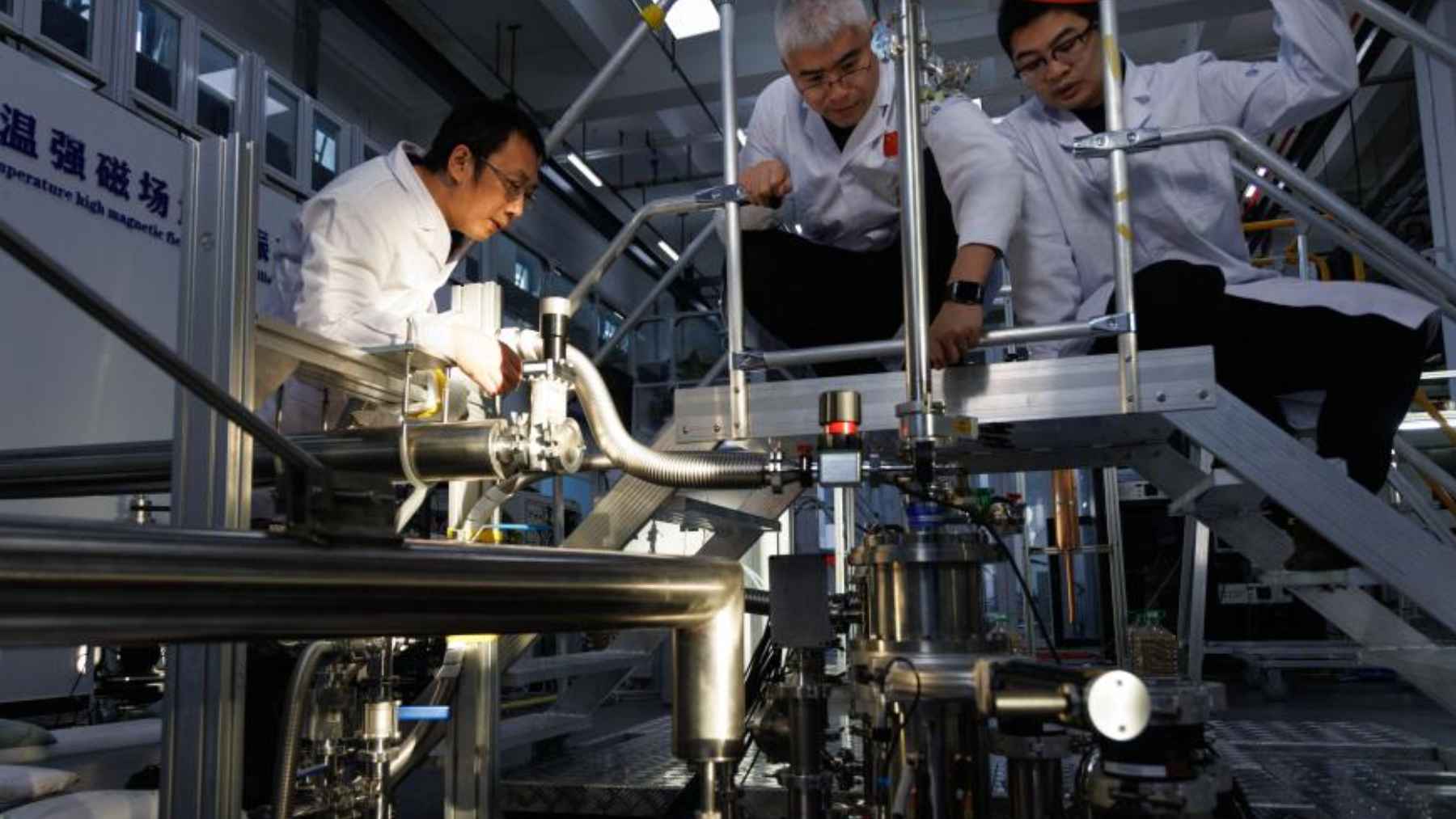
China has announced a new world record in high magnetic fields with an all‑superconducting magnet that reaches 35.6 tesla, more than 700,000 times stronger than Earth’s magnetic field at the surface.
The system, created by the Chinese Academy of Sciences, is designed as a shared tool so research teams can study matter under conditions that are close to those found in deep space or inside giant planets.
Unlike many record magnets that can run only for short bursts, this one is built to hold its maximum field for more than 200 hours while keeping energy use relatively low. That combination of strength, stability, and efficiency could reshape how scientists probe quantum materials, advanced superconductors, and even biological molecules.
What makes this magnet so extreme
Magnetic field strength is measured in tesla. Earth’s field at the surface is only a few tens of microtesla, which is a tiny fraction of one tesla, so a 35.6 tesla magnet really is in a different league.
Official reports describe the new system as more than 700,000 times stronger than our planet’s natural field, a figure that lines up with basic physics.
For a sense of scale, a typical hospital MRI scanner runs at about 1.5 to 3 tesla. That already needs huge coils, careful shielding, and safety warnings that sound almost scary when you first hear them in the waiting room. The new Chinese magnet operates at a field roughly ten times higher than those medical machines.
The record magnet has a usable opening, or bore, of 35 millimeters, wide enough to slide in crystals, small devices, or tiny biological samples. Researchers can put their samples right into the heart of the strongest part of the field, which is essential if you want clean, precise measurements instead of noisy data.
That simple detail makes the system far more practical than a record number on paper.
A shared superconducting system that sips power
The magnet is described as all superconducting, which means every coil is made from materials that carry electrical current with zero resistance when cooled to very low temperatures.
In everyday terms, a normal high field magnet is like an appliance that runs with the heater on full blast all day, while a superconducting one behaves more like an efficient fridge that barely nudges the electric bill.
At the end of the day, according to official explanations, this design gives high stability and very low operating costs compared with traditional resistive magnets that consume megawatts of power.
Inside the system, a high temperature superconducting insert magnet is combined with a lower temperature outer magnet, a configuration that lets engineers push the field higher without the coils breaking or losing their superconducting state.
The research team kept the 35 millimeter bore while raising the field from an earlier 30 tesla result to 35.6 tesla, which is a significant jump at this level. That steady operation for more than 200 hours gives scientists enough time to run complex, multi-day experiments rather than quick snapshots.
Extreme conditions under one roof in Beijing
The new magnet sits inside the Synergetic Extreme Condition User Facility on the outskirts of Beijing. This national facility combines very low temperatures, very high pressures, intense magnetic fields, and ultrafast laser systems in a single complex. It is set up as an open user lab so teams from China and abroad can apply for time and bring their own experiments.
In practical terms, that means a scientist can cool a material close to absolute zero, squeeze it with gigantic pressure, shine ultrafast light on it, and expose it to the 35.6 tesla field all in one place.
Those extreme combinations are hard to imagine in a typical university lab. At the end of the day, this facility acts like a kind of physics playground for pushing materials far outside the conditions we ever see in daily life.
Why scientists want such powerful fields
Strong, steady fields let researchers track very small changes in how electrons move inside solids, which is crucial for studying quantum materials and unconventional superconductors.
Techniques such as nuclear magnetic resonance, specific heat measurements, and magnetostriction become much more sensitive as the field increases, so a higher limit means new pieces of information about how matter really behaves.
One official summary notes that the magnet is aimed at frontier work in materials science, life sciences, and even areas linked to nuclear fusion.
Biophysicists also hope to use strong but stable fields to probe the structure of complex biomolecules, the building blocks behind proteins and other components of living cells.
While this magnet will not be sitting in a hospital any time soon, the technology behind it could eventually influence the design of future medical imaging systems that work faster or use less power. For patients, that kind of downstream progress matters more than the record number itself.
What comes next after 35.6 tesla
Engineers from the Institute of Electrical Engineering and the Institute of Physics say they are already planning upgrades. They aim to push the field beyond 40 tesla, widen the bore so more types of experiments can fit inside, and strengthen the cooling system to cut long-term costs even further.
Researcher Luo Jianlin has highlighted that the magnet can hold its peak field for more than 200 hours while working smoothly with ultra-low temperatures and high pressures, which he says greatly meets the needs of the user community.
That kind of reliability means international teams are more likely to book time, travel to Beijing, and build demanding experiments around this machine instead of treating it as a one-off stunt. The real test, over the next few years, will be the discoveries that come out of those experiments.
The main scientific study describing the magnet has been published in the journal Superconductivity.