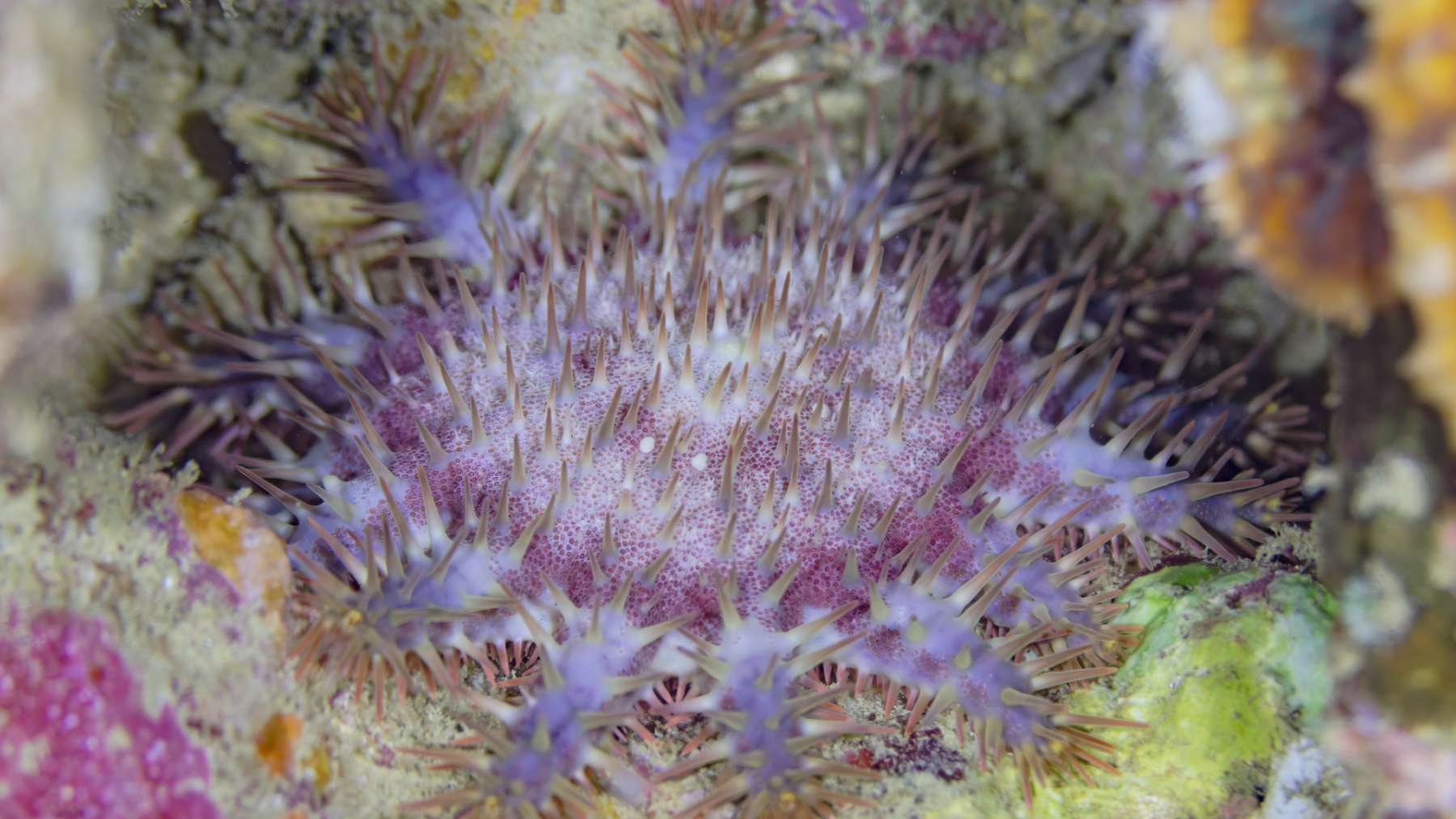
For decades, the crown-of-thorns starfish has been cast as the Great Barrier Reef’s number one villain. It’s spiny, venomous and able to strip whole reefs bare during its infamous population explosions. So what if the very same animal, in small numbers, is actually doing the reef a favor?
That’s the surprising conclusion of a new study from the University of Sydney, published on September 24, 2026. On a protected reef where fish keep the starfish in check, living coral tissue survived after almost 75 percent of the feeding events the team examined, and the starfish’s picky appetite appears to help keep the coral community more diverse.
A predator that takes a bite and moves on
The research was led by Dr. Shawna Foo, a Horizon Fellow at the university’s School of Life and Environmental Sciences. Her team surveyed coral feeding scars, and the tissue left alive around them, at One Tree Reef between 2022 and 2024.
What they saw didn’t match the usual picture of total destruction. “At One Tree Reef, COTS appear to consume a relatively consistent amount of coral during each meal and move on, rather than demolishing the entire coral colony,” Foo said. (COTS is the short name scientists use for crown-of-thorns starfish.)
In other words, many corals lost a patch, not their lives. Think of it as a diner who orders one slice rather than the whole pie.
What the numbers show
According to details of the study reported by Earth.com, the average feeding scar measured about 15 square inches. In one survey month, 188 of the 260 colonies that had been fed upon still had living tissue, while 72 were eaten completely.
The team also followed 71 scars over 22 weeks. Of the 46 that kept a rim of living tissue, about a quarter showed coral growing back by the end of that period. That regrowth turned up in Montipora, Porites and Isopora corals, but not in branching corals such as Acropora.
It’s a small sample from a single reef, so the figures shouldn’t be stretched to the whole Great Barrier Reef. Still, they show that a starfish meal isn’t always a death sentence.
How a coral eater can boost diversity
Here’s where it gets interesting. Crown-of-thorns starfish tend to go for fast-growing corals like Acropora, which can crowd out their slower neighbors if nothing holds them back.
“By feeding on fast-growing corals such as Acropora, low-density COTS populations create space for slower-growing coral species to persist, helping to increase coral diversity,” Foo explained. Slower growers like Montipora and Porites get a bit more room and light as a result.
Co-author Professor Maria Byrne says the results fit with “the intermediate disturbance hypothesis, an important framework in ecology and conservation.” The basic idea is simple. A little disruption now and then stops a few dominant species from taking over, so more kinds of life can stick around.
Why One Tree Reef is special
The surveys took place around the university’s One Tree Island Research Station, in a marine reserve on the Great Barrier Reef. Because it is protected, healthy fish populations naturally keep the starfish from booming.
That matters a lot. The study describes starfish acting as ordinary predators, not the plague-like swarms that make headlines. Elsewhere on the reef, the story can look very different.
Outbreaks are still a real threat
None of this means the starfish is harmless. Individual animals can grow up to about 31 inches across and eat up to roughly 108 square feet of coral a year, and outbreaks “can kill up to 90 per cent of the corals on affected reefs,” according to the Australian Institute of Marine Science.
The Great Barrier Reef has recorded four major outbreaks since the 1960s, roughly one every 15 years. Fewer natural predators, including tritons and several reef fishes, have left the reef more exposed to them.
Foo is clear that her findings “do not diminish the significance of devastating COTS outbreaks which coral populations struggle to recover from.” As she put it, “It’s important to distinguish between COTS populations performing their natural role as coral predators and outbreaks causing sustained reef decline.”
What this could mean for culling
Australia already runs a large crown-of-thorns starfish control program, set up in 2012, in which trained divers inject starfish with bile salts or household vinegar. During the 2025-26 financial year alone, crews removed 64,879 starfish across roughly 32,600 acres of reef habitat, according to the Great Barrier Reef Marine Park Authority.
The new study doesn’t question that work. But it suggests a different finish line. “Once an outbreak is suppressed, the goal should not necessarily be to eliminate COTS entirely,” Foo said.
“Culling needs to be complemented by strong marine management to protect COTS predators and keep COTS populations in check,” she added. In practical terms, that means protecting the fish and snails that eat the starfish, not just hunting the starfish themselves.
A villain with a job to do
It’s tempting to sort nature into good guys and bad guys. Reefs, it turns out, are messier than that.
At low numbers, the crown-of-thorns starfish seems to act a bit like a gardener, trimming back the fastest growers so others can share the space. The problem only starts when the balance tips and there are far too many of them.
The study was published on Ecology and Evolution.
Photo: Diego Delso.