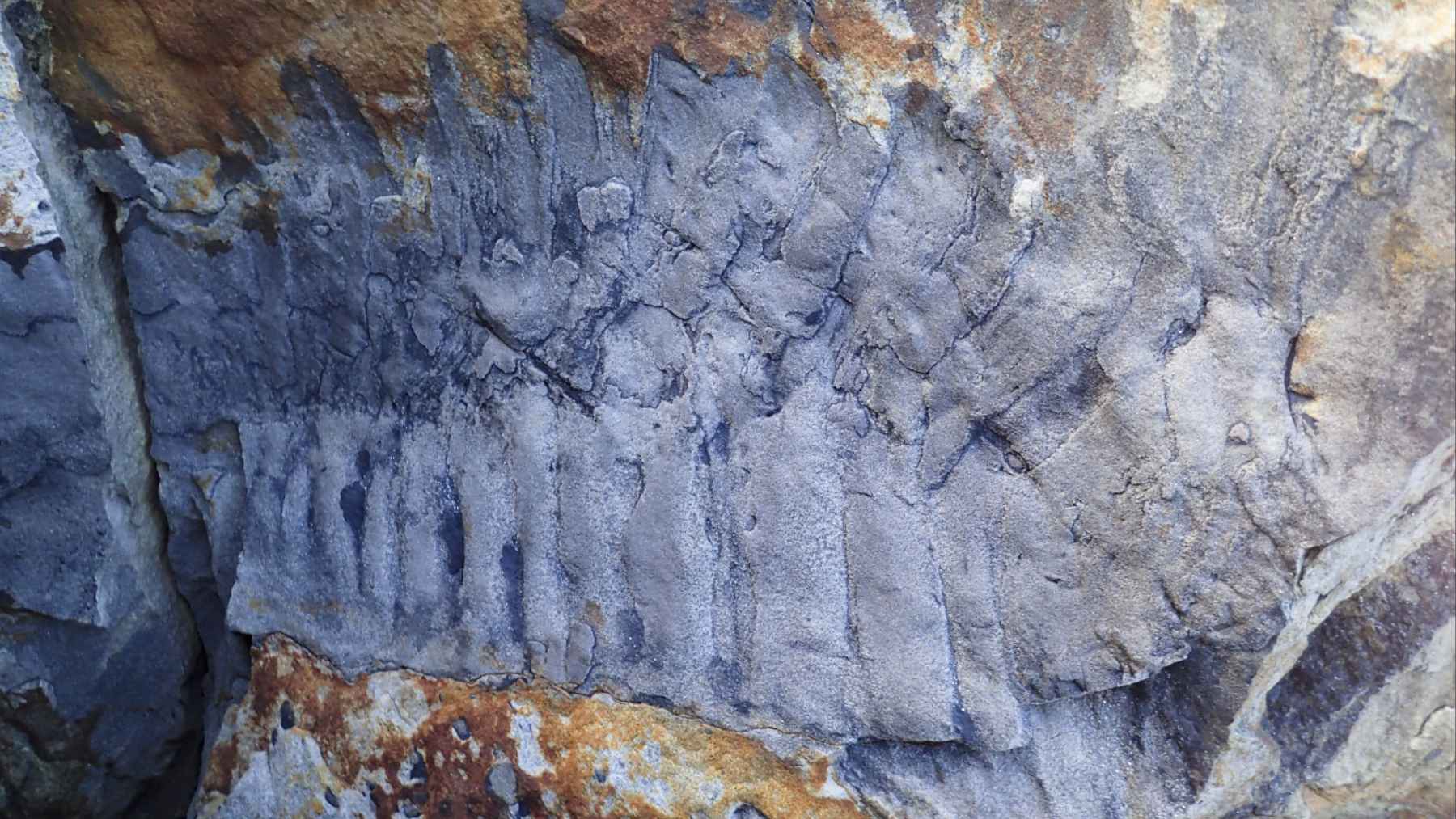
On a quiet stretch of beach in northern England, a fallen cliff has exposed one of the most spectacular creatures ever to walk on land. Inside a split sandstone boulder, researchers found the remains of Arthropleura, a millipede-like arthropod that once stretched close to nine-feet long and weighed around 50 kilograms, the size of a compact car and the heft of a large dog. Scientists now regard it as the largest land invertebrate in Earth’s history.
The fossil dates to about 326 million years ago, in the Carboniferous period, more than 100 million years before the first dinosaurs. It was discovered in 2018 at Howick Bay in Northumberland after a block of sandstone crashed to the shore and cracked neatly in two. Dr Neil Davies of the University of Cambridge called the find “a complete fluke” and noted that one of his former students happened to spot the exposed segments during a routine walk along the coast.
Only 75 centimeters of the animal are preserved, but the proportions match other specimens enough for scientists to estimate a full length of around 2.6 to 2.7 meters and a width of 55 centimeters. The preserved piece appears to be a shed exoskeleton rather than a carcass, which explains why articulated fossils of such large animals are so rare. Once these giants died, their bodies probably fell apart quickly in the humid forests that surrounded ancient river channels.
A giant of tropical river woodlands
Today Northumberland is cool and windswept. During the late Carboniferous, the same region sat near the equator and was warm and lush. Evidence in the rock shows scattered vegetation, seeds, and amphibian tracks preserved alongside the Arthropleura remains. That combination suggests open woodland along a river rather than the dense coal swamps where these animals were traditionally placed.
Read More: {{post_title link:post}}
Trackways from similar creatures, some up to 50 centimeters wide, have been found in other parts of Europe and North America. They show a slow-moving animal with many closely-spaced legs shuffling across the forest floor and sometimes along the margins of ancient streams.
For everyday comparison, imagine following a line of deep parallel footprints across damp soil on a modern riverbank, only each trackway is wider than your kitchen table. That is the sort of mark Arthropleura left behind.
Cracking the oxygen puzzle
For years, textbooks explained Paleozoic “monster bugs” with one simple idea. Higher oxygen in the Carboniferous atmosphere supposedly allowed arthropods to grow far larger than anything alive today. Some reconstructions even suggested oxygen levels above 26%, compared with about 21% today.
The Northumberland fossil complicates that story. Geological evidence indicates that this individual lived before the late Carboniferous oxygen peak, when air may have been only slightly richer in oxygen than now. That implies other factors helped Arthropleura reach its record size. Scientists point to a mix of abundant plant litter in equatorial forests, few large land predators, and stable humid climates that favored big detritivores.
In practical terms, this colossal millipede grew large not just because it could breathe more easily, but because the ecosystem around it was generous and relatively safe.
At last, a face for the biggest “bug”
Until recently, almost all Arthropleura fossils lacked the head, which left scientists guessing how it sensed and fed. That changed with a 2024 study using CT scans on tiny juvenile specimens from Montceau les Mines in France. The scans revealed short antennae, stalked compound eyes, and enclosed mandibles, blending traits seen in both centipedes and millipedes.
By combining those anatomical details with genetic data from living relatives, researchers concluded that Arthropleura belonged to a now extinct group that links modern millipedes and centipedes more closely than previously thought. In other words, the giant from Northumberland was not simply an oversized version of today’s forest millipedes. It sat on a separate branch of the arthropod tree that has no direct modern counterpart.
Why giants like Arthropleura vanished
Arthropleura thrived for roughly 50 million years, from the early Carboniferous into the early Permian, before disappearing around 292 million years ago. Current research suggests that increasing aridity and the collapse of equatorial rainforests fragmented its humid habitat. As the supercontinent Pangaea dried, conditions for moisture-dependent giants deteriorated.
Large body size also made molting risky. Shedding and regrowing a multi-meter exoskeleton likely required stable, moist shelters that became harder to find in a drying climate. At the same time, early reptiles and other tetrapods were diversifying, competing for space and food in the same landscapes. Arthropleura seems to have lost that ecological contest.
A deep time warning about changing climates
Seen from today’s world of traffic jams and LED-lit evenings, a car-sized millipede roaming a tropical England feels almost unreal. Yet its story ties directly into themes that still matter. Arthropleura depended on dense, productive forests, generous leaf litter, and stable humidity. When climate and vegetation shifted, the giant invertebrates vanished while more adaptable vertebrates took over.
Read More: {{post_title link:post}}
Scientists often point out that Earth’s atmosphere and ecosystems have never been static. This fossil is a vivid reminder that rapid environmental change can redraw the map of which creatures succeed on land. The same combination of climate, oxygen balance, and habitat that once allowed a millipede to grow to the length of a small car is not guaranteed to last forever for today’s species either.
The study was published on the Journal of the Geological Society website.