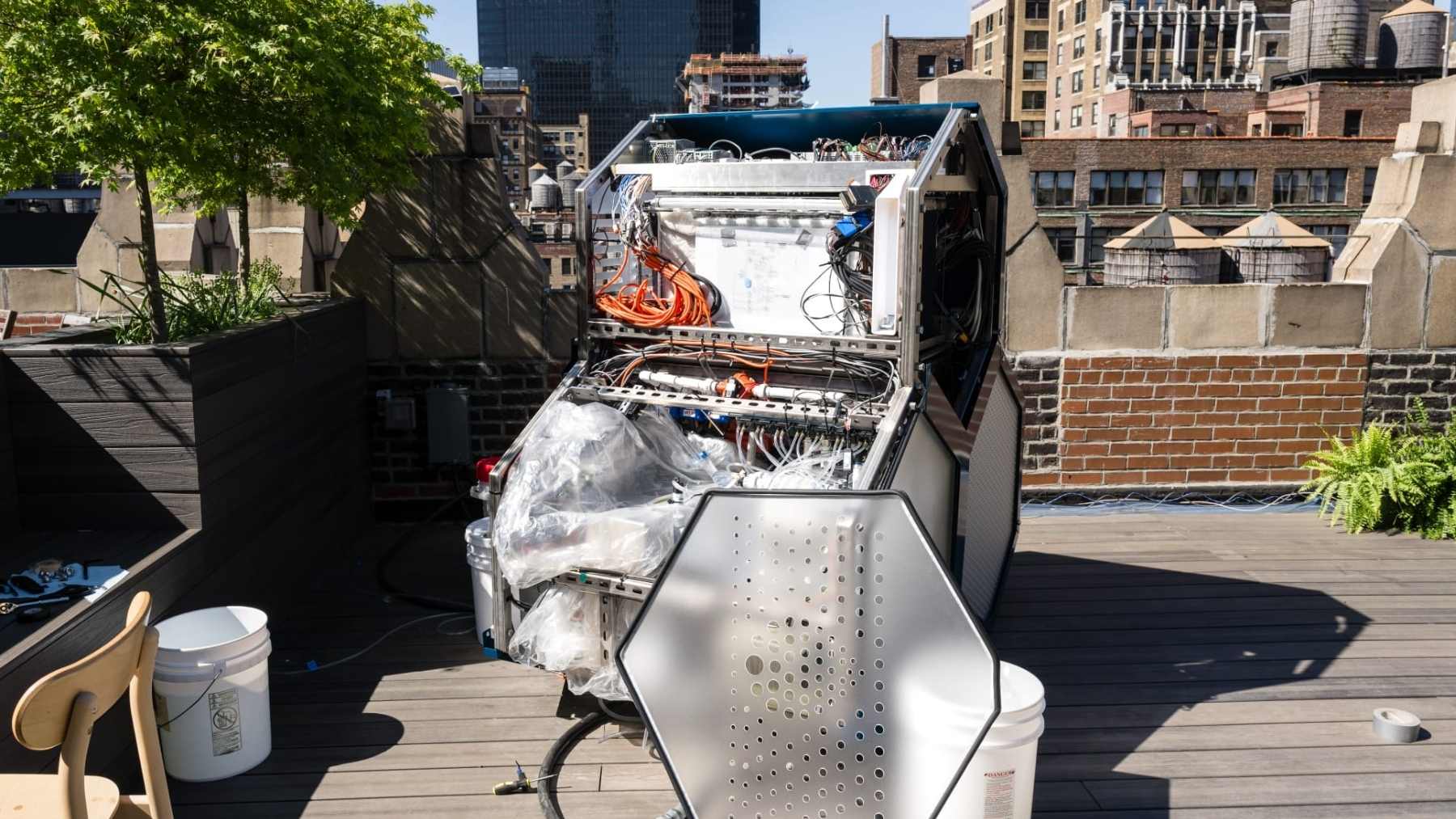
On May 22, 2025, a New York startup called Aircela showed something that sounds like science fiction but looked very real in the moment. In a rooftop demonstration in Manhattan’s Garment District, the company ran a compact machine that captured carbon dioxide from the air and produced “drop-in” gasoline on site.
The claim is simple and provocative. If you can make usable fuel without pumping crude oil, you could cut emissions without waiting for every car, truck, and generator to be replaced. But can a rooftop demo turn into a real-world solution at scale? That is the question hanging in the air.
How turning air into gasoline actually works
Aircela’s system combines two steps that are usually discussed separately. First, it uses “direct air capture”, which means pulling carbon dioxide out of normal outdoor air, even though that gas is present in tiny amounts.
Next comes the fuel-making step. Using electricity, the machine turns water into hydrogen and then chemically builds liquid fuel from that hydrogen and the captured carbon. Aircela’s system says the result is chemically the same as conventional gasoline and can be used in today’s engines without modifications.
Why “drop-in” fuel gets people’s attention
Most climate conversations about cars revolve around electric vehicles, charging, and batteries. That matters, but it can feel far away if your family’s car is older, or if your town has one charger that is always broken. So the idea of fueling up the same way you do now, just with a cleaner supply chain, is naturally appealing.
At the rooftop event, the company demonstrated the machine producing gasoline in real time, filling a container in front of invited guests that included New York City Councilmember Erik Bottcher and New York State Energy Chairman Richard Kauffman. Eric Dahlgren, one of the company’s co-founders, handled the fuel during the demo.
The toughest part is the energy math
There is a catch, and it is not a small one. Capturing carbon dioxide from the open air takes work because the gas is so diluted, and making hydrogen from water takes even more electricity. That is why many experts say direct air capture can be technically feasible but expensive, mainly because separating carbon dioxide from air is harder than capturing it from a smokestack.
Aircela’s climate promise depends on clean power. If the machine runs on renewable electricity, the carbon released when the gasoline is burned can be largely offset by the carbon that was taken from the air in the first place. If the electricity is fossil-based, the benefit shrinks fast, and that is where real-world deployment choices start to matter.
Investors are looking beyond cars
One reason this story is not just about drivers is that some industries cannot easily electrify. Long-distance shipping, certain industrial uses, and parts of aviation still rely heavily on energy-dense liquid fuels, and batteries often do not fit the job.
Aircela has attracted backing that reflects that reality, including Maersk Growth, plus investors Chris Larsen and Jeff Ubben. In a statement tied to the company’s announcement, Morten Bo Christiansen said, “We invested in Aircela because of their innovative approach to production of low-emission fuels based on direct air capture.”
Where this fits in a world that is going electric anyway
Electric cars are growing quickly, but they are still a minority of what is on the road. The International Energy Agency estimated about 40 million electric cars worldwide as of 2023, which helps explain why gasoline demand and debates about alternatives are not disappearing overnight.
Policy is also moving faster in some places than others. In Europe, rules like ReFuelEU Aviation are pushing fuel suppliers toward more low-carbon options, including synthetic “e-fuels” made with captured carbon. In the United States, the policy landscape is more fragmented, which could shape how quickly machines like this move from rooftops to real markets.
The main press release has been published in Aircela’s announcement distributed by GlobeNewswire.