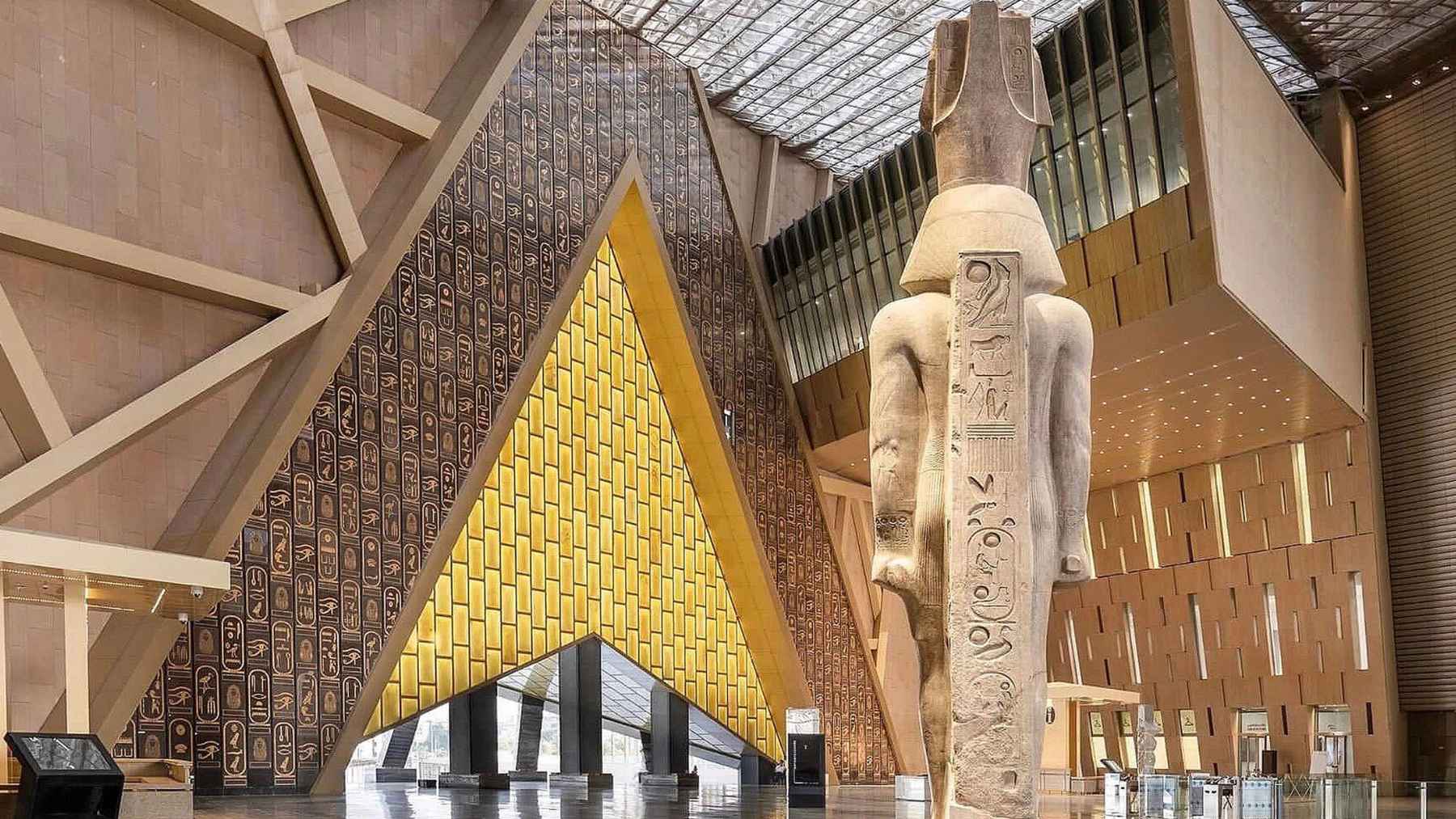
With lasers painting the night sky and a symphony echoing beside the Pyramids of Giza, Egypt officially opened the Grand Egyptian Museum on November 1, 2025 near Cairo. After roughly two decades of work and a price tag above one billion dollars, the complex now anchors the Giza plateau as the largest museum on Earth devoted to a single civilization.
Inside, more than 100,000 artifacts trace ancient Egyptian history, including the complete treasure of Tutankhamun displayed together for the first time in one place. A colossal statue of Ramses II greets visitors in the atrium, while a grand stairway lined with statues leads toward galleries that also showcase the 4,500-year-old solar boat of Khufu.
World leaders and royal families joined the opening ceremony, which featured drone formations that sketched Tutankhamun’s mask in light above the site.
A flagship for green architecture
For an eco-minded visitor, the building itself is the real headline. In 2024 the International Finance Corporation awarded the museum its EDGE Advanced Green Building Certification, calling it the first museum in Africa and the Middle East to reach that standard.
By IFC’s own calculations, the design cuts energy use by more than 60 percent and reduces water consumption by about one third compared with a typical building of similar size, which translates into fewer emissions and less pressure on already stressed Nile water resources.
How does a glass and stone giant in the desert pull that off in practice? The museum uses a reflective roof, deep external shading and highly-efficient lighting and cooling systems, supported by smart meters that constantly track consumption.
A one megawatt solar plant already covers around a tenth of the museum’s electricity demand, with plans to scale to ten megawatts so the complex can approach full self sufficiency. A large reservoir collects and filters rare Cairo rain so gardens can be irrigated without drawing as much on municipal supplies.
Officials report cuts in electricity use, water consumption and operational emissions, and say the museum is working toward carbon neutrality.
In a city where summer heat pushes air conditioners and household electric bills to their limits, those numbers matter.
The same thick concrete masses and precise climate controls that keep energy use in check also protect fragile wood, pigments and textiles inside the conservation center, which houses nineteen laboratories focused on preventive conservation and environmental monitoring. In practical terms, the green design is not only about saving kilowatt hours, it is also about giving 4,000-year-old artifacts a stable home in a warming world.
Tourism, climate goals and heritage protection
Tourism remains the other big piece of the puzzle. The government hopes the museum will help drive a major rebound in visitor numbers, while access to the nearby plateau has shifted toward electric shuttles rather than a stream of private vehicles, trimming noise and exhaust around the pyramids.
Estimates suggest the museum can host tens of thousands of visitors a day, so lowering the footprint per visitor through energy savings, water reuse and on site recycling will be key if this cultural boom is to stay compatible with climate goals.
At the end of the day, the Grand Egyptian Museum is more than a new backdrop for selfies in front of ancient statues. It is a real-time test of whether mega-scale cultural projects in hot, water-scarce regions can respect both heritage and planetary limits.