Have you ever stopped to imagine a future where solar panels not only generate clean energy but also make cities more beautiful? Well, eco-solar cells are on the way. Yes, it sounds like fiction, but it isn’t anymore. That’s because scientists in Europe, specifically at the AMOLF Institute in the Netherlands, are leading a quiet revolution in the world of solar energy: they’ve created the world’s first eco-solar cell.
Would you put a standard solar panel on your home?
Surprisingly, the appearance of solar panels rarely makes it into the agenda of technological innovation. After all, they work, they’re efficient, and that’s it, right? Actually, wrong. This is because one of the biggest obstacles to the widespread adoption of solar energy in urban areas is, precisely, aesthetics. Many people end up not installing panels on their roofs because they find them “ugly,” dark, or visually incompatible with their home’s design.
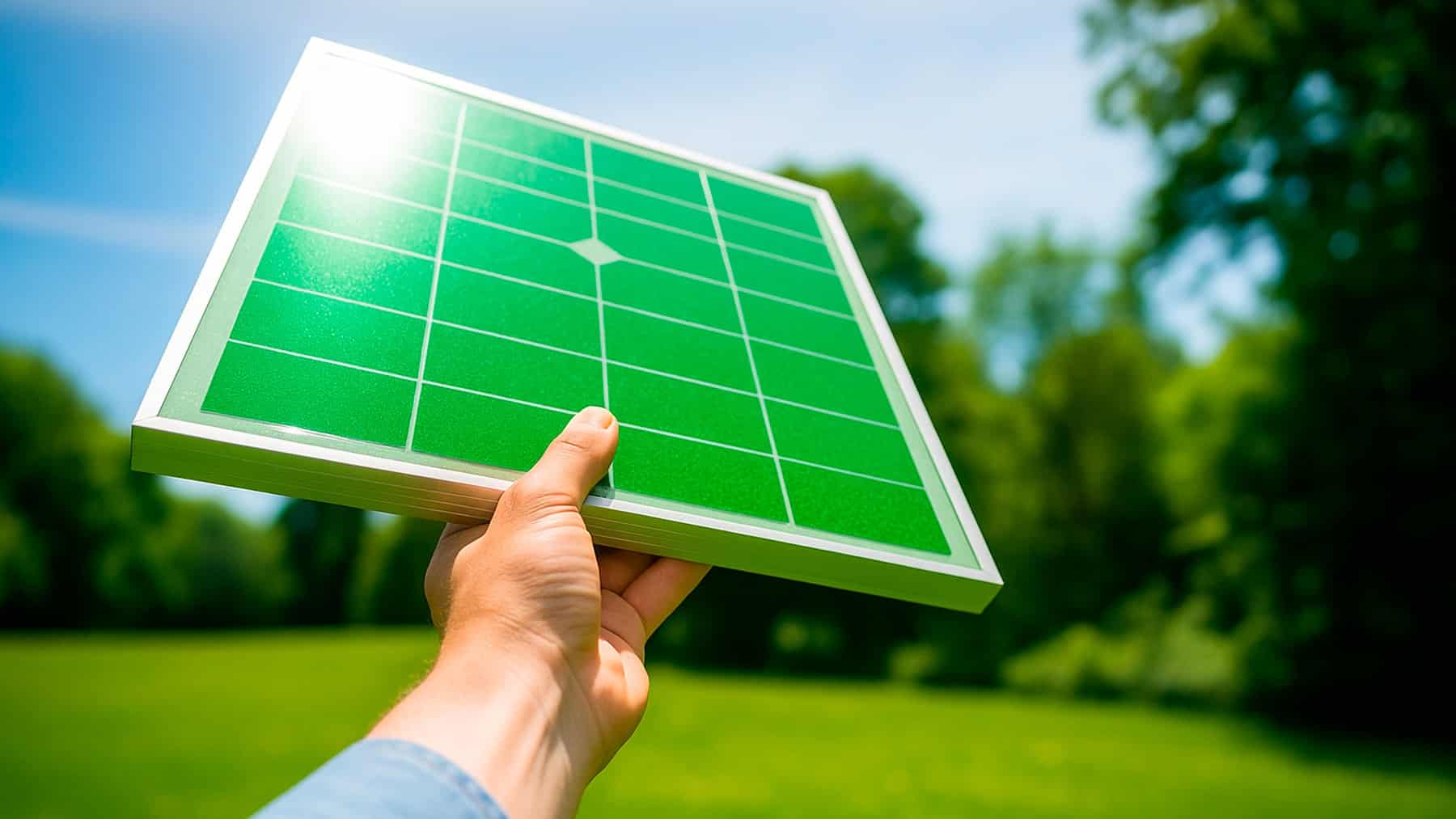
With this in mind, the solution found by AMOLF researchers was ingenious in its simplicity: they used nanotechnology to manipulate the color of solar panels without significantly affecting their performance. Using a process called soft-print lithography, they applied a network of silicon nanotubes to the solar cells. Each nanotube is shaped to emit a specific color of light — in this initial case, green.
They didn’t just build solar panels; they gave them personality. By using eco-solar cells, the team created panels that still do the job of capturing sunlight, but now they can also be part of a building’s visual identity. Picture this: a home, a museum, or even a city monument with solar panels that look like they belong there, not just slapped on top.
The eco-solar cell in various colors
So far, everything was great, but it raises the question: wouldn’t painting a solar panel affect its efficiency? And, practically speaking, it might, but the impact is surprisingly small — the new technology reduces efficiency by about 10%. However, this loss is even considered acceptable if we stop to consider the potential for popularizing solar energy in places where aesthetics are a critical factor.
And this story doesn’t stop with green, you know? Scientists are already working on printing to generate blue and red colors (in fact, some colored panels have already been seen in America). The goal, in fact, is to achieve the full spectrum, including white (something much more complex from a physical standpoint, but not impossible). White, by the way, will require highly refined nanoparticle engineering, where different particles must be extremely close together without negatively interfering with each other.
And best of all, this technology can be used in layered solar panels, where different layers absorb different wavelengths of light. This breakthrough could increase overall efficiency by up to 30%, a truly impressive leap compared to the 20% of the most popular current cells.
It’s not just performance and cost that’s driving the energy revolution
We need to stop and think that perhaps we’re too accustomed to thinking about energy revolutions solely in terms of performance or cost. However, this innovation from AMOLF shows that design is also a force for transformation. By making solar panels more beautiful, they also make them more visible and desirable.
Now, we need to consider the impact of this new technology on historic areas, urban centers, and planned communities. After all, where installation was previously avoided for visual reasons, architects and urban planners will now be able to integrate solar energy into facades, green roofs, and modern or restored structures. Imagine combining these eco-solar cells with a domestic wind turbine that generates 5,550 kWh per year; your home will have free energy and, as a bonus, will be visually pleasing.