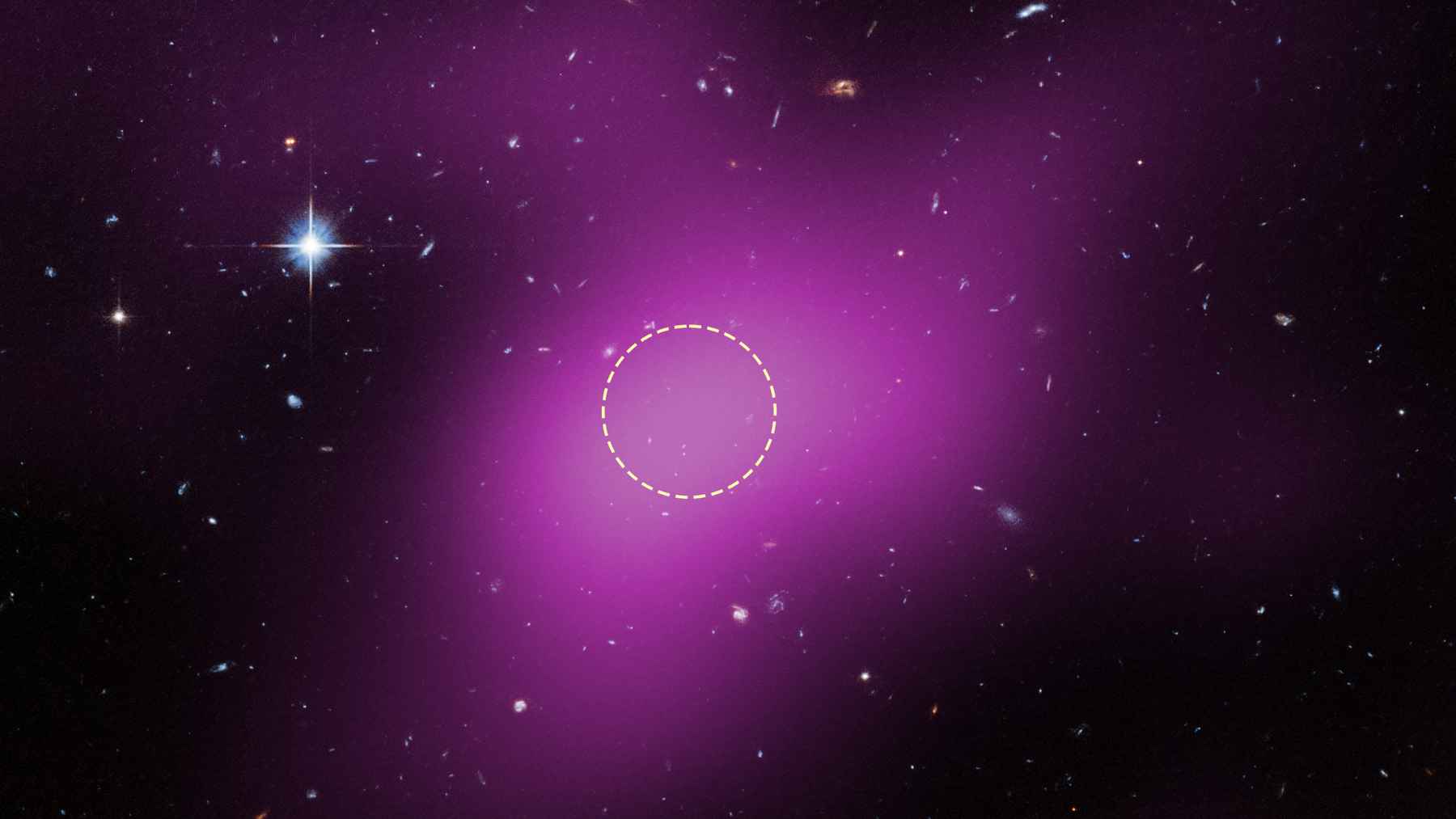
Astronomers have confirmed a strange new kind of cosmic object. It is a compact cloud of gas and dark matter called Cloud 9, parked on the outskirts of the spiral galaxy Messier 94 about 14 million light years from Earth.
Using the Hubble Space Telescope, researchers find that this cloud contains no stars at all, yet it holds roughly one million solar masses of hydrogen gas and an estimated five billion solar masses of dark matter.
For cosmology, that combination is pure gold. Dark matter is the invisible material that shapes the large-scale structure of the universe and likely accounts for about 85% of all its matter. It does not emit or reflect light, so astronomers usually infer it indirectly from how galaxies move and bend space.
A nearby system where dark matter dominates and stars are absent gives an unusually clean test of those ideas.
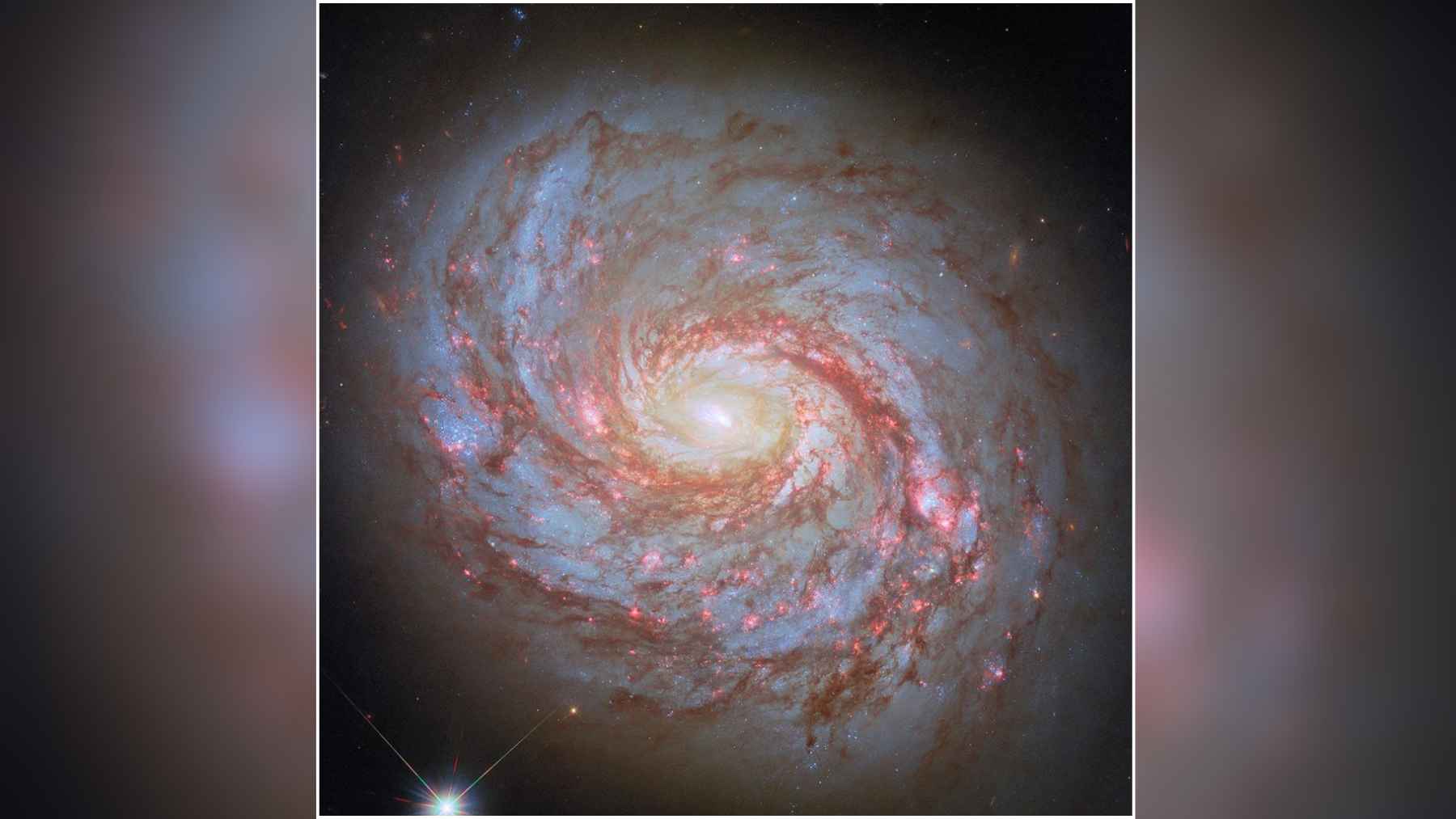
A failed galaxy frozen in time
The team classifies Cloud 9 as a Reionization Limited HI Cloud, or RELHIC, essentially a dark matter halo filled with neutral hydrogen that never managed to form stars. Principal investigator Alejandro Benítez Llambay describes it as “a tale of a failed galaxy.”
In this picture, the cloud sits at a delicate threshold. Its dark matter gravity is strong enough to hold on to gas but not quite strong enough to compress that gas so it collapses into stars.
Measurements show a nearly spherical core of neutral hydrogen about 4,900 light years across. Radio data indicate around one million solar masses of gas. To keep that gas bound, models require a surrounding dark matter halo weighing in at roughly five billion solar masses.
How astronomers caught a cosmic ghost
Cloud 9 first appeared three years ago in a survey with the 500-meter Aperture Spherical Telescope, which picked up its faint radio whisper from neutral hydrogen. Follow up observations with the Green Bank Telescope and the Very Large Array confirmed a compact, dynamically cold cloud sharing the same recession speed as its neighboring galaxy, so it sits at a similar distance.
The crucial test came when Hubble’s Advanced Camera for Surveys stared at the region where the radio emission peaks. Astronomers built a color magnitude diagram of every resolved point of light and showed that any hidden dwarf galaxy would have to contain less than about ten thousand solar masses of stars, a factor that makes Cloud 9 effectively starless.
Not everyone is ready to declare victory
Some researchers urge caution. Other gas clouds thought to be star free have later revealed ultra-faint stellar populations, and detailed radio maps show that Cloud 9 is not perfectly smooth but slightly distorted, as if ram pressure from its environment is tugging on one side.
That leaves a narrow possibility that an extremely dim galaxy still hides inside, below even Hubble’s limits.
Even so, most experts agree that Cloud 9 is now the strongest candidate for a genuine starless dark matter halo and a key test of the standard Lambda cold dark matter model. If similar objects turn up in future radio and space telescope surveys, they could map out how small dark matter structures really are and where galaxy formation simply stalls.
For anyone who has ever glanced up at the night sky between city lights or on the walk home from work, that is the quiet backdrop to every visible star. Dark matter clouds like Cloud 9 are part of the invisible framework that let galaxies, planets, and eventually life take shape.
The study was published in The Astrophysical Journal Letters.