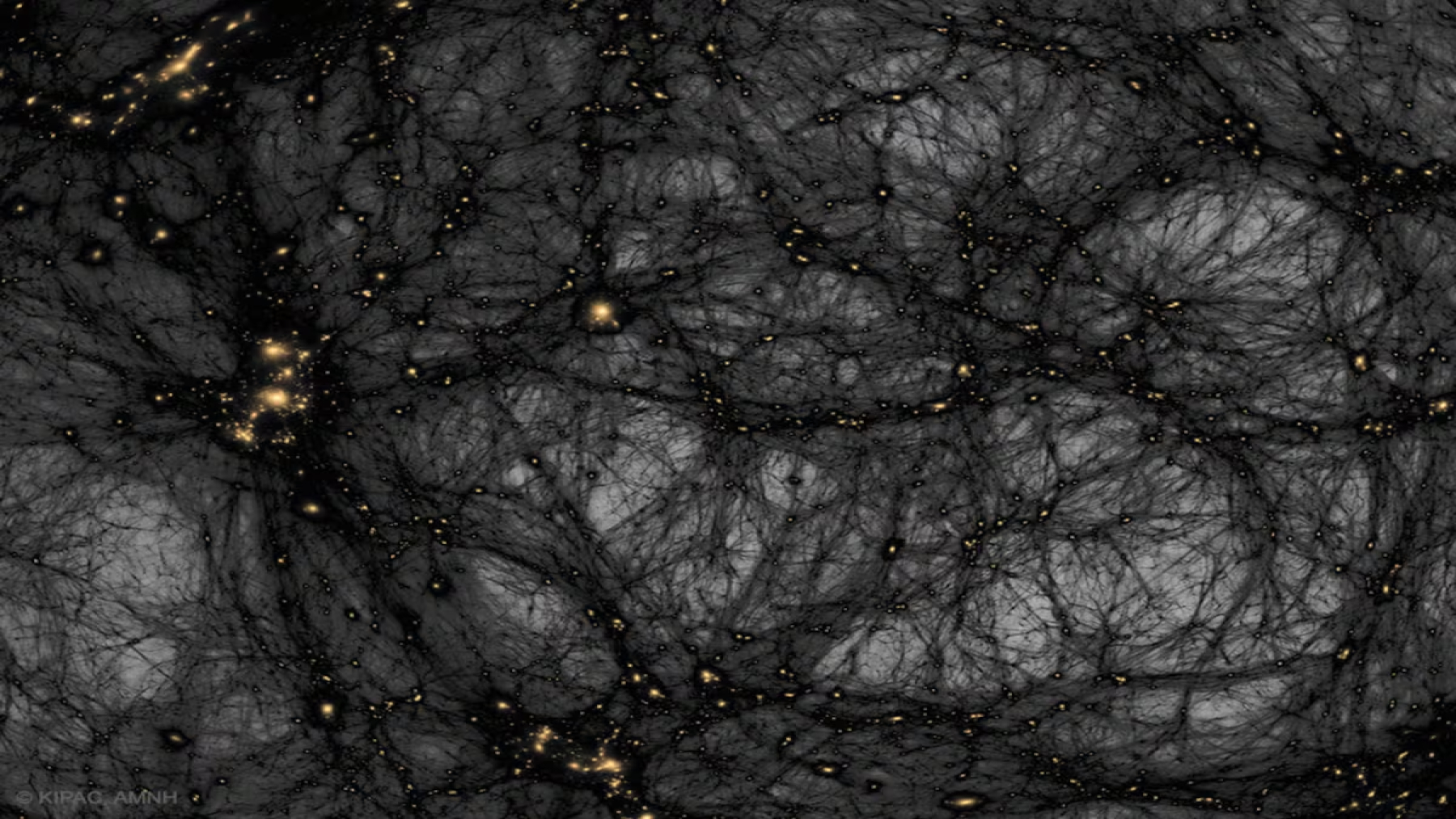
Only 5% of the universe’s visible matter is baryonic matter, while the remaining 95% consists of dark matter and dark energy. These mysterious forces shape and define cosmic reality, potentially revealing its fate.
What is dark matter? Unraveling the mystery of the universe
Dark matter makes up about 26% of the universe. It is a substance that neither emits, absorbs, nor reflects light; therefore, whatever it is cannot be detected through ordinary means. The existence of dark matter is inferred from gravitational effects, like those exhibited in galaxies and the bending and distortion of distant stars.
Dark matter is different from ordinary matter, which consists of planets and stars. Dark matter consists of unknown particles and interacts weakly with normal matter. X-ray telescopes are used to study the effects of dark matter in various cosmic environments, from active galaxies and galaxy-seeking nebulae to monster black holes.
Such observations enable the testing of many odd properties of dark matter. However, the true nature of dark matter falls into an increasingly compelling puzzle that modern astrophysics must solve. Dark matter (like this strange, undecipherable dark matter) acts like an invisible glue that binds together galaxies and larger matter groups in the universe. Without this glue, the universe would never have been in such a successful form.
The elusive nature of dark matter has made understanding it incredibly difficult. Theories suggest that dark matter may consist of exotic particles such as WIMPs (weakly interacting massive particles) or axions, but none have been proven. The search for clues that might provide insight into what dark matter is continues through space and experiments.
The cosmic secret: What is dark energy?
Dark energy, which makes up 69% of the universe, is, in fact, even more elusive than dark matter. One of its most controversial assertions (which revolutionized in the 20th century regarding cosmic evolution) is its role in accelerating the universe’s expansion.
This dark force works against gravity, pushing galaxies apart and shaping large-scale structures. Theories of dark energy range from Einstein’s cosmological constant, which implies that it is a property of space itself, to the mistaken notion of our theory of gravity.
Studying galaxy clusters through X-ray astronomy provides insights into the role of dark energy in the cosmos. These studies are vital because they could help determine whether the universe will continue to expand indefinitely or collapse under a cataclysmic reversal.
Some of the most valuable insights about dark energy evoke hints of its relationship with the universe’s fate. Will it stretch space to its breaking point and set the stage for the Big Rip scenario, or will it stabilize and permit a different evolution for the universe?
How do black holes and supernovas shape the universe we see?
Visible matter, such as stars and planets, makes up 5% of the universe, just a tiny part of the cosmos. Once thought to be complete, our knowledge of the universe grew steadily, with occasional discoveries, such as the existence of dark matter in the 1930s.
Black holes, previously confined to science fiction, are now beginning to shed light on quantum mechanics and general relativity. Their effective light-capturing gravity enhances our understanding of galaxy formation and the laws of physics.
When they die, supernovas produce a flurry of heavy elements necessary for forming new stars. The largest gravitationally bound objects, galaxy clusters, are crucial in determining where to look for dark matter and dark energy with X-ray tools.
The dark universe, consisting of dark matter and dark energy (like this strange dark energy that gives us life), is said to hold the secrets of the cosmos. Even with further elaboration, the dark universe events will always remain elusive. These forces speak of the universe’s beauty, complexity, and visibility. The quest to decipher the dark universe is marked by discovering cosmic mysteries and exploring reality.