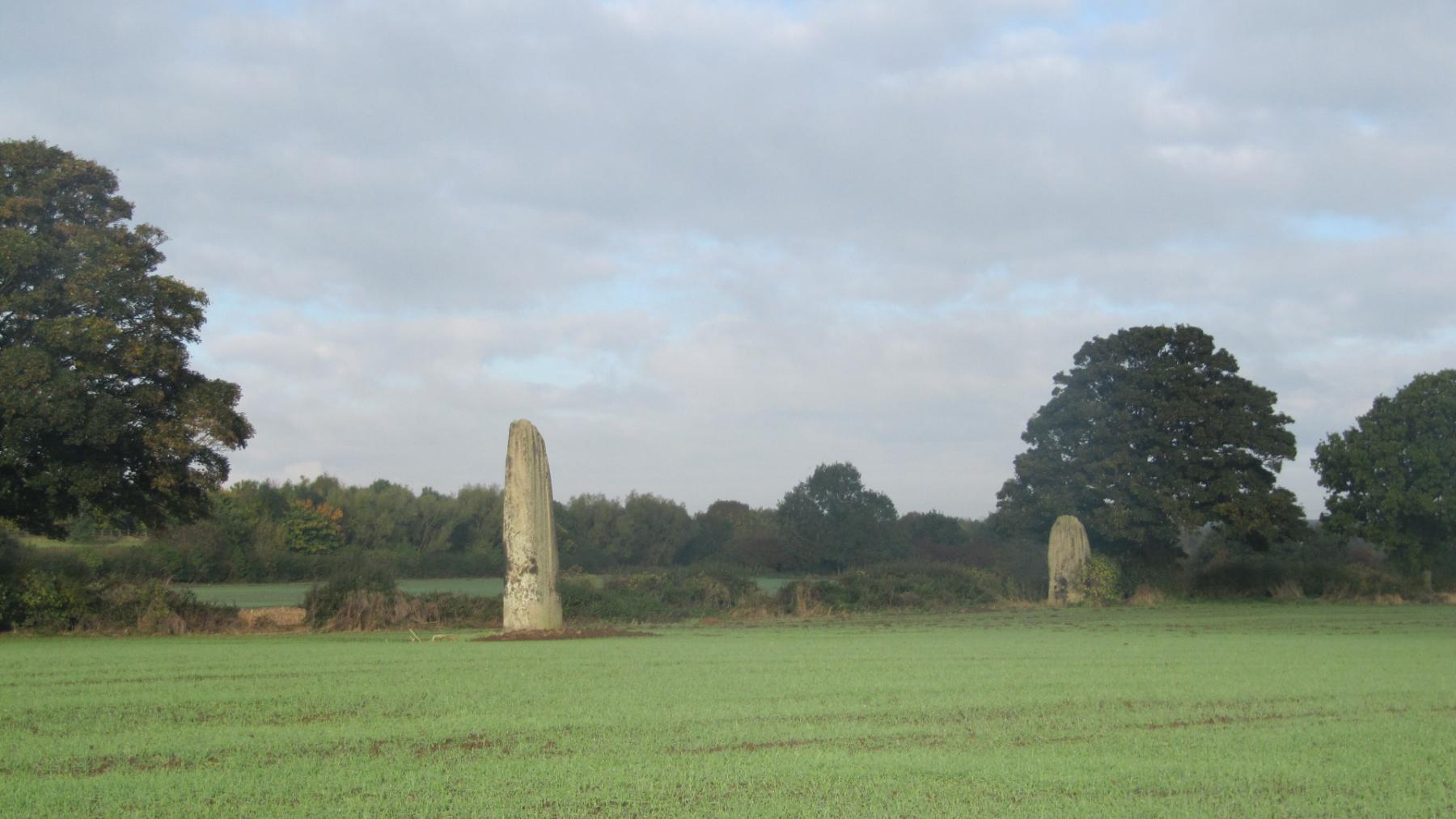
Moving a heavy couch is one thing. Moving a stone weighing roughly 55,000 pounds across 11 miles of Yorkshire is quite another, yet new research suggests prehistoric builders did exactly that to create the Devil’s Arrows near Boroughbridge in northern England.
Researchers from Curtin University and the University of York have traced the towering stones to Brimham Rocks, about 18 kilometers away, despite closer sources being available. Their findings also connect a medieval cross in nearby Aldborough to a missing Arrow, revealing how the same material served communities thousands of years apart.
A longer journey than expected
Three pillars survive at the Devil’s Arrows, with the tallest reaching nearly 23 feet. They form Britain’s tallest surviving prehistoric stone row, although the individual height record belongs to the Rudston Monolith elsewhere in Yorkshire.
The rocks beneath the monument offered an early clue that the pillars had traveled. The surrounding bedrock is Triassic Sherwood Sandstone, while the standing stones are Millstone Grit, a coarse sandstone deposited more than 300 million years ago.
Suitable gritstone outcrops occur only about three miles away, and Plumpton Rocks, roughly eight miles distant, had long been considered a likely source. The new findings instead point to Brimham Rocks, suggesting the builders chose their material for reasons beyond proximity.
Tiny grains carry the evidence
To investigate the stones’ origins, a team led by Curtin geochemist Anthony Clarke examined microscopic zircon and apatite minerals. Their isotopic signatures preserve information about geological history, allowing researchers to compare the stones with samples from possible source areas.
Think of it as comparing a collection of identifying marks rather than judging two rocks by color alone. The mineral profiles linked the Devil’s Arrows to Brimham Rocks, providing evidence that their appearance could not supply by itself.
The sampling method was surprisingly simple. According to Curtin University, researchers used adhesive tape to lift tiny grains from the stones without damaging the monument, an approach they hope to use at other sites.
What the discovery says about human effort
The researchers interpret the findings as evidence of deliberate human transport and argue against the idea that the stones were simply boulders left nearby by glaciers. That distinction changes the story from people using whatever lay at hand to communities organizing a substantial construction project.
Each stone weighs around 25 metric tons, equivalent to approximately 55,000 pounds. Getting such enormous blocks across the landscape and raising them upright would have required careful coordination, even though the evidence does not tell us precisely how the builders accomplished it.
Why go to all that trouble? The researchers suggest the source landscape carried cultural or spiritual meaning, but the mineral match cannot reveal what people believed or establish the exact route they followed.
The missing stone in a medieval cross
The discovery in Aldborough adds a second chapter to the stones’ journey. Its Battle Cross, about 18 feet tall, is described by the University of York as a 15th-century monument commemorating the Battle of Boroughbridge in 1322.
During the 19th century, antiquarian J. R. Walbran proposed that the cross had been carved from a fallen Devil’s Arrow. The university reports that the new mineral analysis confirms his interpretation, identifying the cross as a surviving piece of the prehistoric monument.
That means a missing stone did not disappear entirely. Its shape and purpose changed, while its minerals retained evidence of its earlier identity, a connection that written accounts alone had left uncertain.
Part of a much larger landscape
The remaining pillars stretch across approximately 571 feet, or 174 meters. Historic England places them at the southern edge of a wider prehistoric ceremonial landscape containing henges and burial mounds, so their setting matters alongside their size.
“These results show that ancient communities were making deliberate and meaningful choices about where their stones came from,” said University of York archaeologist Jim Leary. His interpretation draws attention to the relationship between people and particular places, beyond the engineering involved in moving heavy rock.
The questions still waiting underground
The construction date remains uncertain, with Curtin describing a possible origin around 2000 B.C., during the Late Neolithic or Early Bronze Age. The age of minerals inside the stones does not date the moment people erected them.
The team plans targeted excavations at the monument and its proposed source to investigate when and how the stones were moved. For now, the research links a dramatic natural landscape, a prehistoric building project, and a medieval village landmark through material that survived them all.
The paper is titled “Deliberate prehistoric sourcing of the Devil’s Arrows, Britain’s tallest stone row.” The study was published in Proceedings of the Royal Society A.
Photo: David Tyers / Wikimedia Commons (CC BY-SA 2.0)