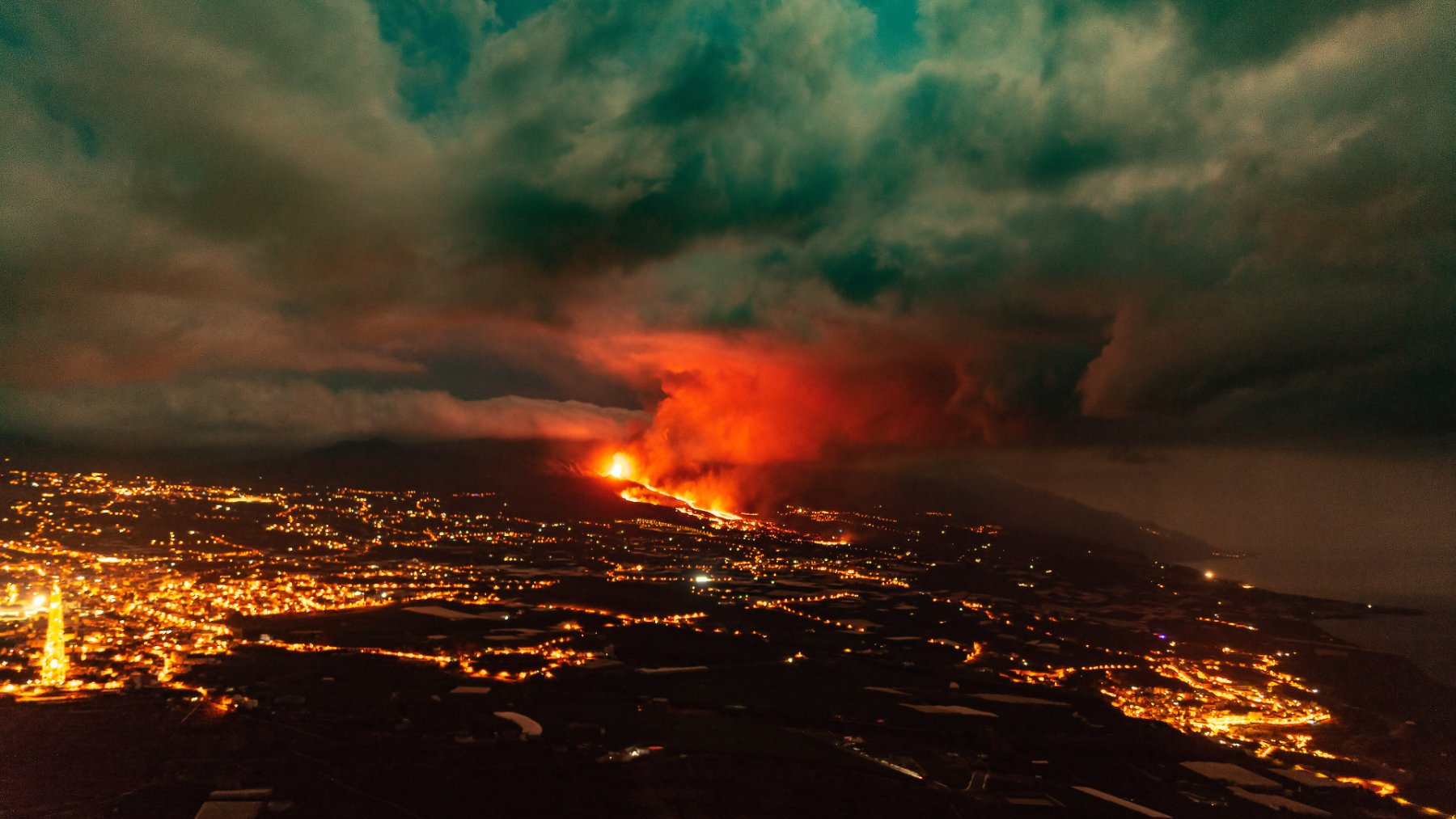
Scientists studying magma from the 2021 Tajogaite eruption on La Palma, Spain, have identified a heat-driven process that could help explain towering lava fountains. By delaying crystal formation, extreme heating can keep magma relatively fluid as it rises toward the surface.
The international team, led by the University of Manchester, found a striking contrast in laboratory experiments. Magma that had not been superheated began forming crystals after about 20 minutes, while strong superheating delayed crystallization for more than eight hours. The important clue may be not simply how hot magma is, but how hot it has been.
Why magma’s heat history matters
“Superheating” means more than being exceptionally hot. It occurs when magma exceeds the temperature at which crystals remain stable, allowing tiny existing crystal “seeds” to dissolve. Those microscopic starting points normally help new crystals begin growing.
Without those seeds, crystallization can remain delayed even after the magma returns to conditions that favor crystal growth. Superheating also makes the melt’s microscopic structure more uniform and less favorable for new crystals to form. In effect, an earlier burst of heat can influence what happens later, as magma continues its journey upward.
Scientists call the start of new crystal formation “nucleation.” Delaying that first step can postpone the buildup of solid material that changes how easily magma flows, linking a microscopic process to the behavior of an entire eruption.
Watching molten rock from the inside
To investigate, the researchers recreated volcanic conditions using material from Tajogaite. At Diamond Light Source, they combined a pressure vessel that allows X-rays to pass through with synchrotron X-ray microtomography, an imaging technique that let them watch crystal formation in real time.
Complementary experiments in Prague allowed the team to follow the process over longer periods. Together, the experiments provided a controlled way to observe how crystals developed under intense heat and pressure, and how prior heating changed that development. Controlling those conditions helped the team investigate processes that are difficult to isolate inside an active volcanic system.
“The history of crystal and bubble growth can dramatically control how a magma erupts,” said lead author Dr. Barbara Bonechi, a Manchester research associate. She explained that scientists had not fully understood crystal growth in magma that received an injection of excessive heat shortly before rising.
How tiny crystals can influence lava fountains
Why does the timing matter so much? As crystals accumulate, they can increase magma’s viscosity, meaning its resistance to flow. Think of the difference between pouring water and spooning thick honey, an everyday way to picture that resistance.
The researchers entered their measured crystallization delays into computer models of magma rising through Earth’s crust. The simulations indicated that longer delays could let magma remain relatively fluid and ascend rapidly. Under those modeled conditions, the fast-moving magma could favor dramatic lava fountains.
Earlier crystal formation pointed toward a different outcome. The magma became more viscous and rose more slowly, giving volcanic gases additional time to escape and favoring gentler, effusive activity. Rather than treating heat, crystals, and gas as separate ingredients, the results show why their interaction deserves attention.
What the experiments do not prove
The laboratory results and the eruption simulations answer different questions. Researchers directly observed delays in crystal formation, then used those measurements to explore possible consequences for magma ascent rather than directly watching every stage beneath an active volcano. That makes the modeling a test of an explanation, not an announcement of what a particular volcano will do next.
The Tajogaite magma may have experienced superheating before the eruption and during its ascent, according to the researchers. The findings therefore identify a plausible mechanism rather than establish that excessive heat alone explains everything that happened in 2021. It is an additional piece of the picture, not a replacement for other controls on eruptions.
A new clue for volcanic forecasting
For scientists interpreting monitoring signals, the potential value lies in considering a magma’s earlier history as well as its present condition. Coauthor Dr. Margherita Polacci, a University of Manchester volcanologist, noted that hazard models commonly emphasize magma chemistry, gas content, and pressure changes. The research suggests that pre-eruption heating and the timing of crystallization also deserve a place in that assessment.
For communities near volcanoes, the longer-term benefit could be a clearer picture of how an eruption might unfold, although the researchers present this as a potential improvement in forecasting. Their central message is that microscopic changes inside magma can help shape the much larger eruption seen at the surface.
The study was published in Nature Communications.