Earth did not always have blue oceans, green continents, or a crust firm enough to stand on. More than 4.4 billion years ago, much of the young planet may have been covered by a vast ocean of molten rock following the giant collision linked to the Moon’s formation.
Now, lava from Fani Maoré, a modern underwater volcano near Mayotte, France, appears to carry a faint chemical memory of that violent beginning. The finding does not mean scientists pulled an ancient crystal from fresh lava, but it suggests that material formed during Earth’s first 100 million years survived deep underground and later helped feed the eruption.
A young volcano with an ancient source
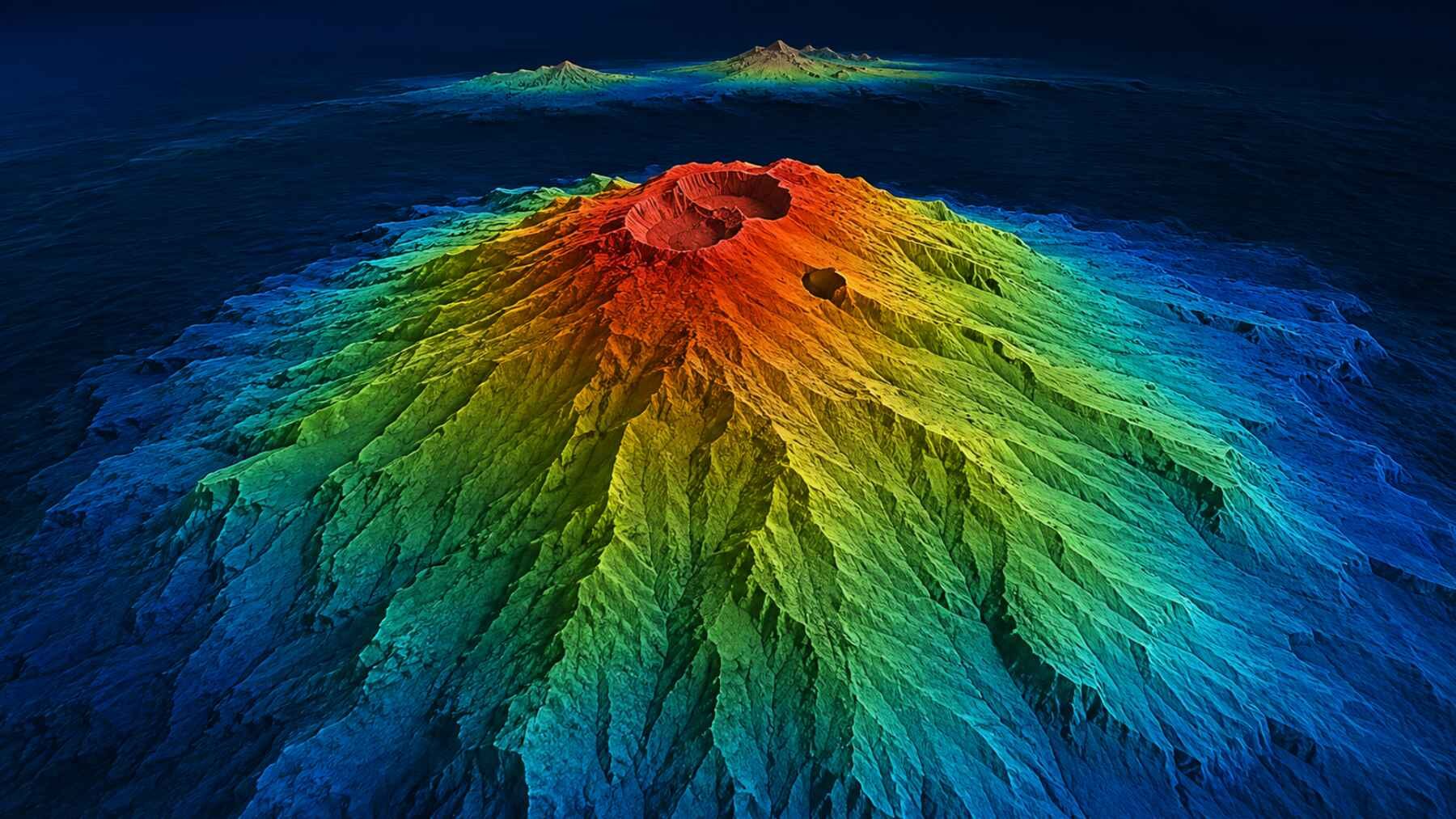
Fani Maoré formed during the earthquake and volcanic crisis that shook Mayotte from 2018 to 2021. The volcano erupted 34 miles east of the island, more than two miles below the ocean surface, and built an underwater structure about 2,600 ft. tall.
Researchers examined 13 lava samples from Fani Maoré and eight more from the eastern side of Mayotte. The work was led by Claudine Israel with Catherine Chauvel, Edward Inglis, Hui Chen, Cécile Hébert, and James Badro, bringing together the Institut de Physique du Globe de Paris, Université Paris Cité, CNRS, and École Polytechnique Fédérale de Lausanne.
A clue only a few parts per million wide
The key clue came from neodymium, a metallic element found in rocks. Neodymium has several isotopes, which are slightly different versions of the same element, and their proportions can preserve a record of processes that happened when Earth was very young.
Using an extremely precise laboratory method, the team detected a small excess of neodymium-142 in the Fani Maoré samples. The average difference was only about three parts per million, but statistical testing indicated that the pattern was real rather than ordinary measurement noise.
Why does such a tiny difference matter? The short-lived parent isotope that produced neodymium-142 disappeared early, so a surviving excess points to material that separated chemically while the planet was still in its first 100 million years.
What bridgmanite has to do with it
After the giant impact thought to have helped form the Moon, much of Earth’s mantle may have melted into a deep magma ocean. As that ocean cooled, minerals began to crystallize, and bridgmanite was likely one of the first major solids to form at great depth.
Bridgmanite is a high-pressure mineral and the most abundant mineral in Earth’s deep mantle. It cannot remain stable when carried to the surface, so the researchers did not find an intact primordial grain inside the lava. What survived, in their interpretation, was its chemical fingerprint.
“This Hadean bridgmanite may be more widespread in the present-day mantle than previously expected,” the authors wrote. In other words, material born while Earth was still taking shape may remain hidden in pockets far below our feet.
The mantle may not be fully mixed
Earth’s mantle moves very slowly through convection, with hotter material rising and cooler material sinking. Over billions of years, that motion was expected to blend most early chemical differences, much like a pot that has been stirred for a very long time.
The new result suggests the mixing was incomplete, though. The team’s preferred deep-source model can reproduce the isotope signal if roughly 9% to 11% of the magma source came from bridgmanite-rich material formed in the Hadean, the earliest chapter of Earth’s history.
The model also includes about half of one percent recycled sedimentary material to match the broader chemical pattern. A competing shallow-source explanation would require roughly 28% to 90% ancient material, an amount the researchers consider much harder to preserve for more than four billion years.
What the study does not prove
The fresh lava itself is not 4.4 billion years old. It erupted only a few years ago, while the unusual isotope pattern was inherited from material that may have remained isolated deep in the mantle before becoming mixed into the rising magma.
That distinction matters. The evidence is indirect and depends on isotope measurements, laboratory experiments, and models of how minerals and molten rock exchanged elements as the early magma ocean cooled.
Other explanations cannot be dismissed with absolute certainty, and the exact proportion of ancient material changes with assumptions about when the magma ocean crystallized. Still, the deep bridgmanite model explains the signal with far less Hadean material than the main shallow alternative.
A wider search for Earth’s earliest memory
Scientists have seen possible neodymium clues in modern volcanic rocks before. A 2018 study of Réunion Island reported isotope variations linked to very early mantle differentiation, while signals from Iceland and Pitcairn have also drawn attention.
The trouble was precision. Differences of only a few parts per million can disappear inside normal laboratory uncertainty, but the method used for Fani Maoré was designed to push past that limit. Testing more island volcanoes with the same approach could reveal whether this ancient component is rare or scattered widely through the mantle.
For geologists, the finding connects two scenes that seem worlds apart: a newborn planet covered in molten rock and a submarine eruption sampled in the modern ocean. Fani Maoré may be young, but the source feeding it could carry one of the oldest chemical echoes still detectable on Earth.
The full study was published in Nature.