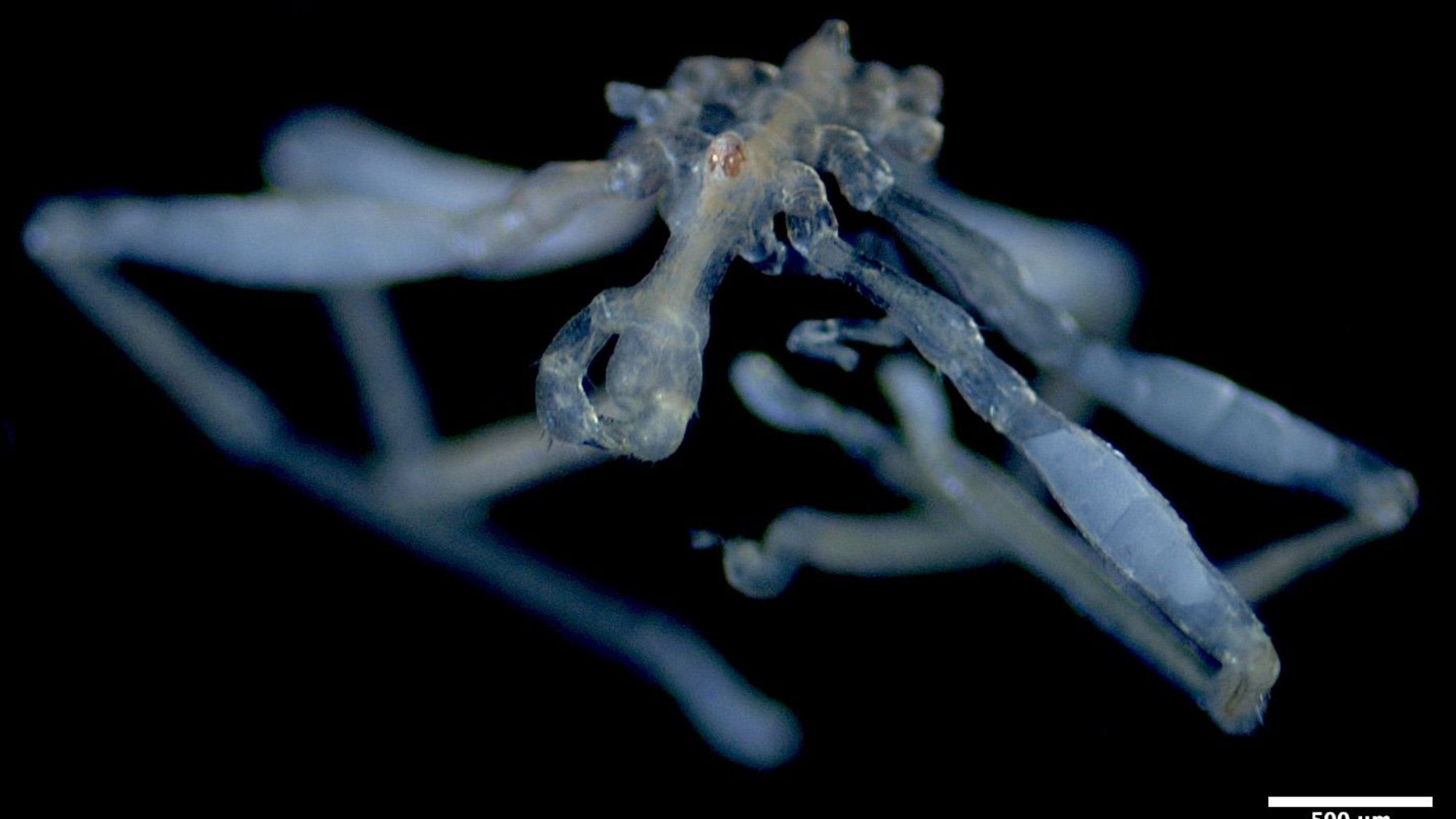
Two newly described sea spider species are bringing an overlooked corner of coastal wildlife into focus. Researchers at the University of British Columbia (UBC) identified the animals while investigating the Salish Sea region, marking what the university calls the area’s first descriptions of new sea spider species in almost a century. One has red eyes and curved spines that give its legs a distinctly hairy appearance.
The discovery also addresses a practical problem for marine conservation. Before scientists can track how these animals respond to changing environmental conditions, they need reliable ways to tell species apart. The research supplies detailed images, genetic information, and an identification guide to help establish that foundation.
A discovery hiding in coastal waters
The specimens came from fieldwork conducted between September 2023 and August 2024, with dives reaching about 59 feet (18 meters). Collection areas included Quadra Island, Vancouver, Victoria, and Bamfield, spanning waters in the Salish Sea region and along Vancouver Island’s outer coast.
Published on August 26, 2026, in Organisms Diversity & Evolution, the study examined seven coastal sea spider species. Scientists described two as new to science and updated descriptions of five known species, using scanning electron microscopy and genetic analysis to examine their anatomy and evolutionary relationships.
Hairy feet and a built-in cleaning kit
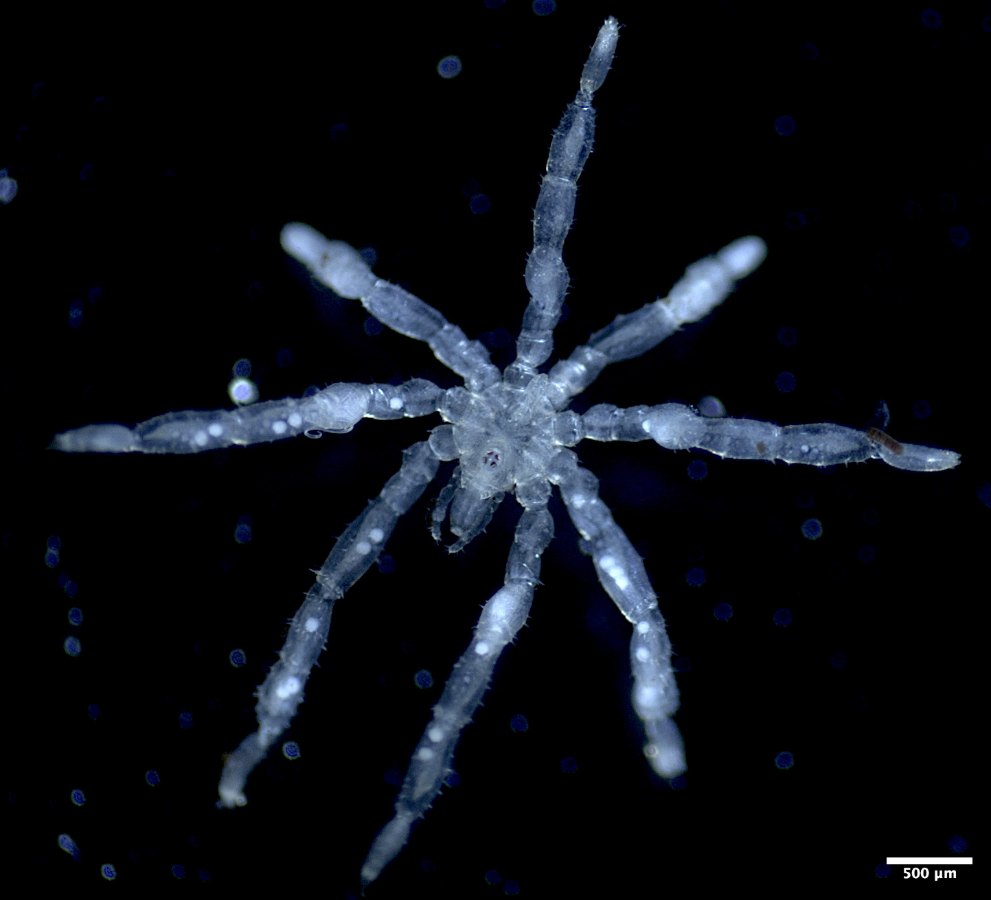
The name Callipallene pilosuspedes refers to the long, curved spines along its lower legs, drawing on Latin for “hairy feet.” Along with its red eyes, the animal has a short feeding structure called a proboscis and a triangular mouth with three lips and sensory structures.
Under the microscope, researchers also watched it perform a surprisingly familiar task. It wrapped specialized appendages called ovigers around its legs, using their comb-like spines to clean itself. Think of a tiny grooming kit attached to the body.
The team found just one specimen of this species during the project. That gives researchers an animal to describe, but it leaves basic questions about its abundance and full distribution open. Finding one individual cannot, by itself, establish how rare the species is.
A second species with passengers of its own
The other newcomer, Tanystylum kiixin, takes its name from an ancient Indigenous village site near where specimens were first collected. According to UBC, “kiixin” is pronounced “kee-hin” and refers to the sound of waves breaking below the village site.
Its ovigers are smaller and less nimble, making grooming less effective. Researchers frequently found tiny parasites among the debris on its body, prompting lead author Cormac Toler-Scott to describe “an ecosystem within an ecosystem within an ecosystem.” Even an animal this small can provide living space for something smaller.
Strange bodies and devoted fathers
What exactly is a sea spider? These marine arthropods belong to a group called Pycnogonida and are related to spiders, scorpions, and horseshoe crabs. Their jointed legs and compact bodies give them the spiderlike appearance behind their common name.
“They’ve retained some weird traits,” Toler-Scott said in the university’s announcement. Many small species feed on larger marine animals by drawing out fluids through a proboscis, a feeding tube that works somewhat like a straw. As the Monterey Bay Aquarium explains, sea spiders feed on soft-bodied animals, including sponges and other marine invertebrates.
Their family arrangements are unusual, too. Females have ovaries extending into their limbs, while males use ovigers to collect and carry eggs during development. Those appendages therefore help explain both the grooming behavior researchers observed and the group’s distinctive approach to parental care.
Why putting names to species matters
Toler-Scott began the work during his master’s research in zoology at UBC because he wanted to understand how climate change and human disturbance affect sea spiders. He encountered a more basic obstacle first, a shortage of information about which species live in the area and how they live. That knowledge gap shaped the project.
The immediate contribution is a clearer inventory of local biodiversity. The team’s identification guide covers the Salish Sea and Vancouver Island’s west coast, giving future researchers a more consistent way to recognize these animals. Its potential environmental value lies in making later comparisons possible, although the current findings do not establish how climate change affects these newly described species.
Toler-Scott expects further fieldwork to reveal additional diversity, so these two names may be only part of a much larger story. The latest official announcement about the research was published on September 23, 2026, on UBC News.
Photo: Cormac Toler-Scott / UBC