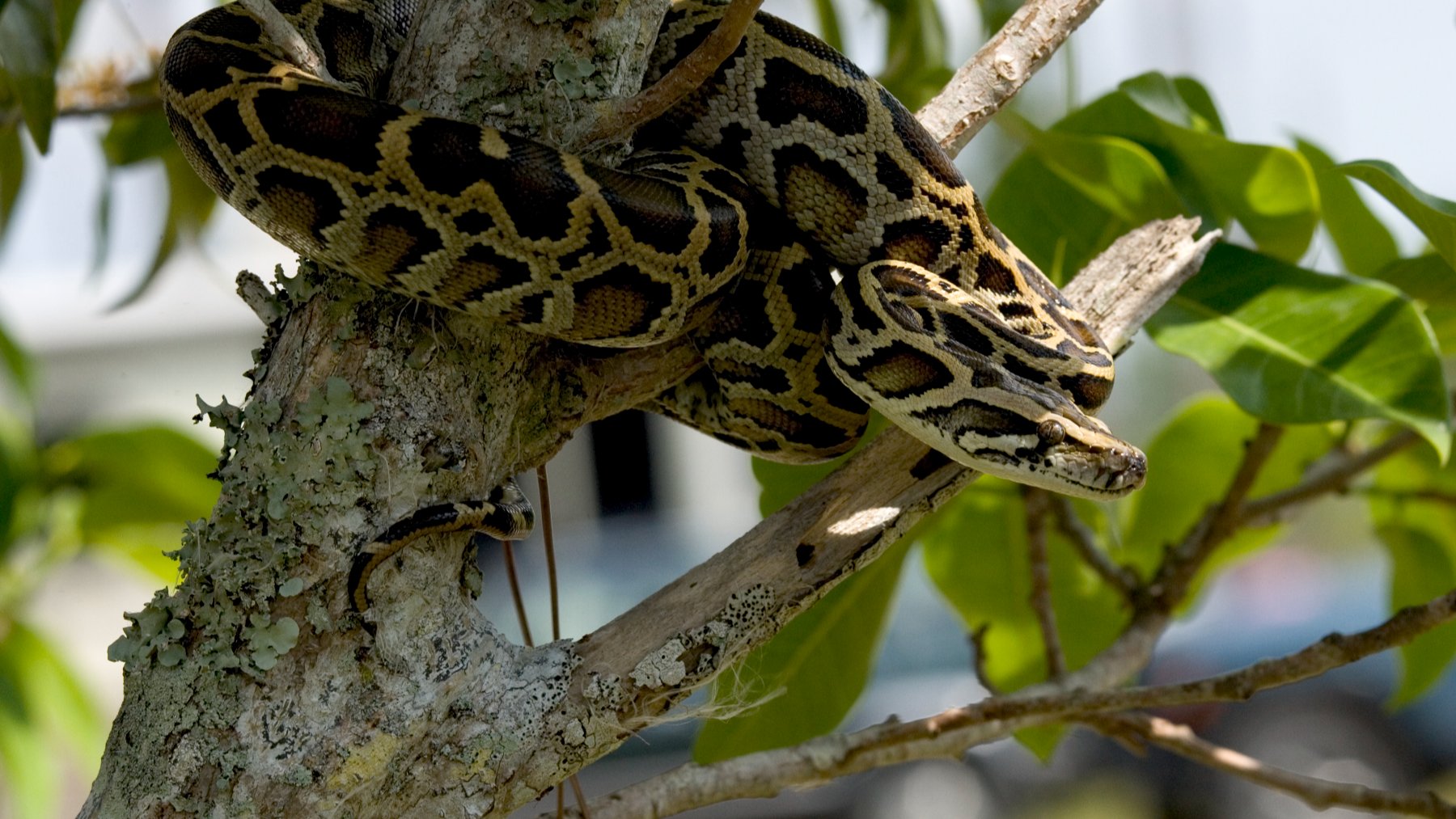
Biologists removed 177 invasive Burmese pythons weighing 8,080 pounds from a 200-square-mile area of Collier County, Florida, during the November 2025 to April 2026 breeding season. The Conservancy of Southwest Florida reported its largest seasonal haul by weight since launching the program in 2013.
But the more revealing number may be the approximately 4,100 python eggs also removed from the ecosystem. The strategy is not simply about catching enormous snakes, but interrupting reproduction before another generation begins hunting native wildlife.
The snakes leading biologists to other snakes
How do you find a predator that is so good at staying hidden? The team uses roughly 40 male “scout snakes” equipped with radio transmitters, following their signals as they seek breeding females. The males’ search for mates gives researchers a route to snakes they might otherwise miss.
The largest female captured that season weighed 153 pounds and measured 17 feet, while the removed females averaged about 95 pounds. Roughly one in four contained white-tailed deer remains, a reminder that these predators take much more than small rodents.
Here, size is only part of the story. Taking a breeding female out of the wild stops that animal from feeding on more wildlife and prevents future clutches, so the value of a capture extends beyond the snake on the scale.
What the missing mammals tell us
The ecological stakes became clearer in a 2012 study led by Davidson College biologist Michael Dorcas. Researchers compared nighttime road surveys before and after pythons became widespread in Everglades National Park, counting animals encountered along the roads.
Compared with surveys in 1996 and 1997, raccoon observation rates during 2003 through 2011 fell 99.3%, opossum rates declined 98.9%, and bobcat rates dropped 87.5%. No rabbits or foxes were recorded in the later surveys, despite their presence in earlier records.
These were changes in encounter rates, not a complete census of every animal in the park. Still, the timing and geography of the declines strongly implicated python predation, with mammals generally more common where the snakes had arrived more recently or were absent.
Key Largo’s hatchling warning dates to 2016
The concern extends beyond mainland wetlands, but the timeline matters. In August 2016, three hatchling-sized Burmese pythons were documented on Key Largo, according to the U.S. Geological Survey (USGS). Officials said the sightings suggested reproduction nearby, although no nests or eggs had been found in the area at that time.
“We worry about pythons becoming established in the Keys,” USGS biologist Bryan Falk said in that announcement. He highlighted vulnerable small mammals, including the Key Largo woodrat and Key Largo cotton mouse, as potential prey.
Florida’s wildlife commission now includes Key Largo within the species’ established range. That puts vulnerable island wildlife inside the management challenge, not safely beyond it.
Salt water is no simple defense
Could the water between islands keep the snakes out? A separate 2012 laboratory study gave 24 hatchling Burmese pythons either fresh water, brackish water, or full-strength seawater to drink. Those in the seawater treatment survived about a month, while those in brackish water survived about five months.
That does not mean pythons are immune to salt water or that the experiment proved they could colonize every island. The researchers concluded that saltwater barriers deserved reconsideration, especially because wild snakes may find fresh water from rainfall that the laboratory animals could not access.
A removal record is not a population count
The Conservancy’s June 2026 update reported cumulative removals of 1,750 pythons weighing more than 53,000 pounds since 2013. That is a substantial sustained effort, but removal totals alone cannot tell us whether the wider python population is shrinking.
USGS researchers say robust population estimates remain unavailable because the snakes are so difficult to detect. They are developing models using removal data to estimate abundance and assess control programs, which should help separate successful catches from measurable population reductions.
The practical takeaway is that removing breeding snakes and eggs cuts off specific opportunities for reproduction, without proving that native wildlife has recovered or the Keys are protected.
The official announcement was published on the Conservancy of Southwest Florida website on June 9, 2026.