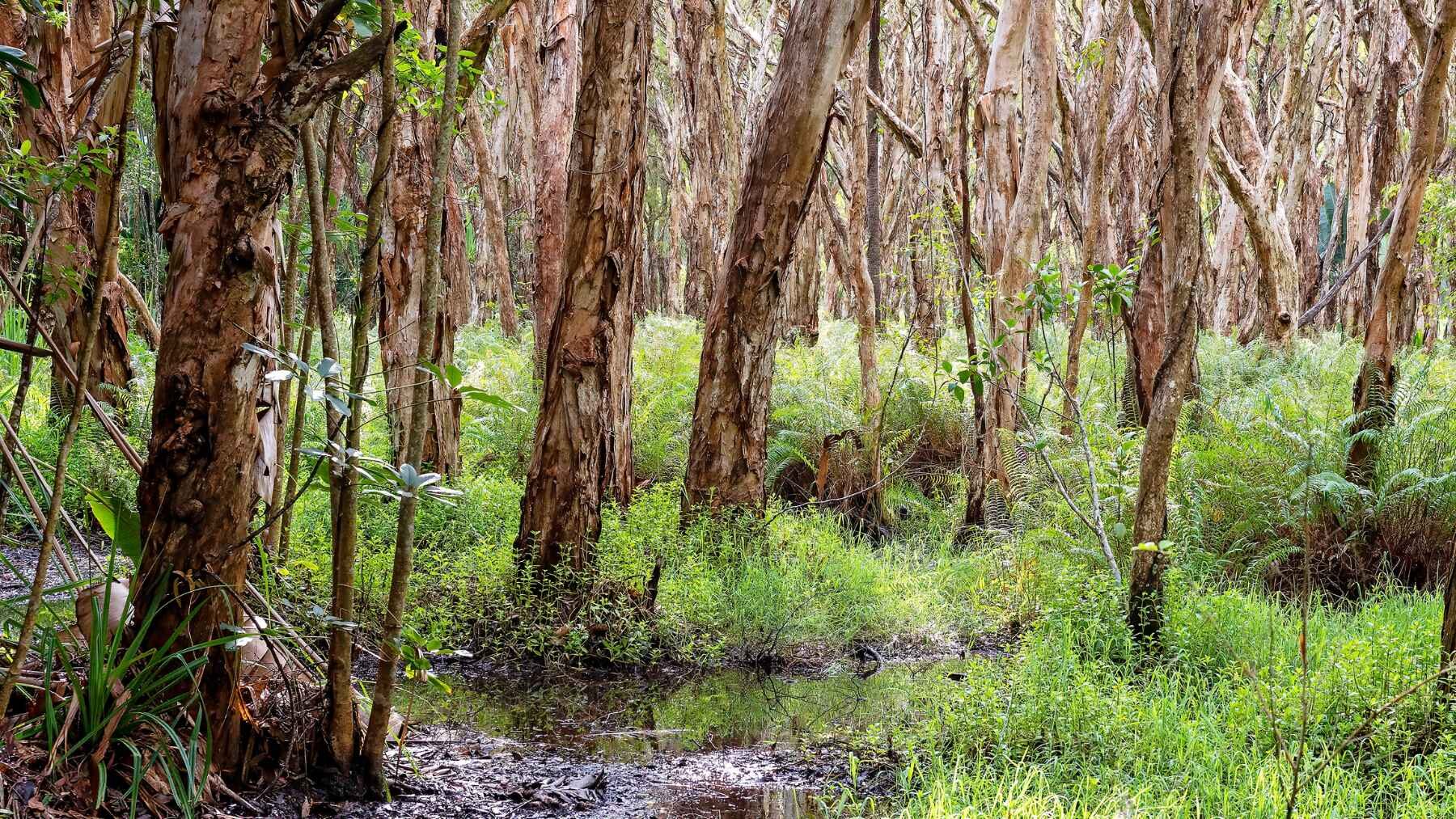
What happens when a tree chosen to tame a wetland decides the wetland suits it perfectly? Florida has spent decades living with the answer. Melaleuca quinquenervia, an Australian paperbark tree once promoted for timber, landscaping, levee stabilization, and drying swampy ground, spread through South Florida and converted open marsh into dense stands.
A UF/IFAS species overview updated in June 2026 says that by 1993, the tree was infesting about half a million acres. Integrated control has since cut dense land cover sharply, but the species remains distributed across more than 400,000 acres and still complicates Everglades restoration. The uncomfortable lesson is that a quick engineering fix can become a century-long ecological bill.
A takeover with many beginnings
The familiar story focuses on 1906, when melaleuca was promoted in Florida as potential commercial timber and later as an ornamental and windbreak. It was also planted to “dry up the Everglades,” reduce mosquitoes, and make development easier. In the 1930s, the U.S. Army Corps of Engineers used it to stabilize Lake Okeechobee levees, while seed was dispersed by airplane over the Everglades.
However, the scientific record is messier than one date. A Castanea study found more than a dozen introductions, with the earliest documented in Sarasota County in 1886, and said the tree became naturalized in southern Florida during the 1920s. Repeated human help gave the invasion several launchpads, not just one.
Why the Everglades fit so well
South Florida offered familiar wet, seasonally flooded conditions without the same natural enemies that kept the tree in check in its native range. Melaleuca can grow in wet or dry ground and add 3 to 6 ft. of height in a year. It also carries an enormous reproductive reserve, and an updated UF/IFAS overview says one tree can produce up to 20 million seeds in a year.
Fire, freezing weather, cutting, or other damage can open woody capsules and send a “seed shower” into the wind. Seeds can remain viable for up to 10 years, so clearing a stand without careful follow-up can turn one visible problem into thousands of seedlings. A chainsaw alone is not a restoration plan.
A marsh becomes a forest
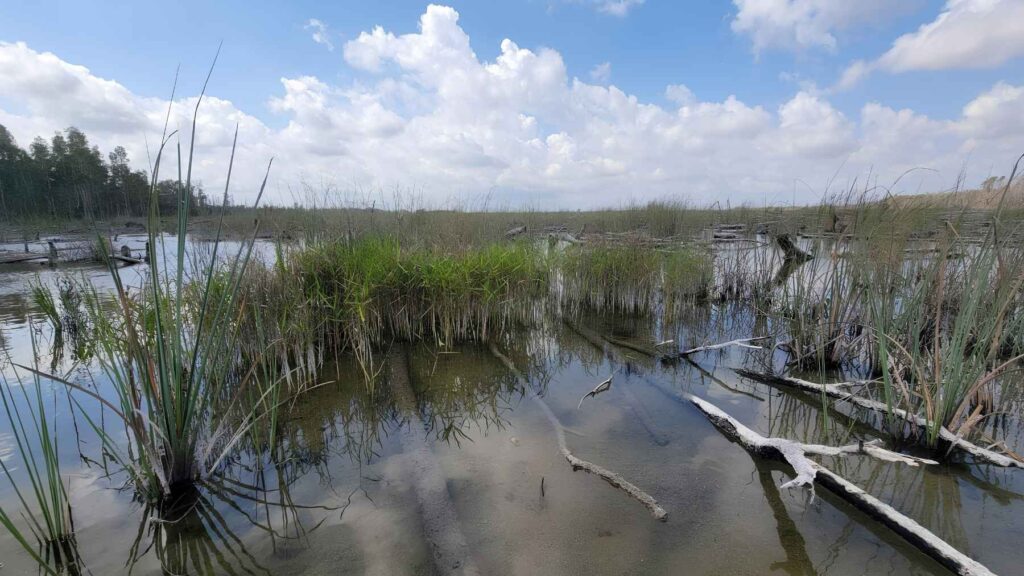
Sawgrass marshes are shaped by shallow water, seasonal flow, sunlight, and low vegetation. Melaleuca changes that setting by forming nearly single-species forests that shade out native plants, alter water movement, and reduce habitat and food sources for wildlife. Water may still be there, but the ecosystem is no longer the same.
The fire problem is just as serious. Oils in the leaves help dense stands support hot crown fires that can be more destructive than the lower fires native plant communities usually face. Smoke, flames, and falling embers can also threaten nearby roads and neighborhoods.
The insects fighting back
Florida eventually looked to Australia for help. After years of quarantine testing, scientists released the melaleuca weevil in 1997, a sap-feeding psyllid in 2002, and a gall-forming midge in 2008. These insects are not meant to eliminate every tree but to weaken growth and reproduction so other treatments work better.
The numbers are striking, though they are best read as maximum results from monitored sites rather than a statewide guarantee. USDA reports reductions of up to 99% in seed production, up to 84% in field density, and up to 77% in biomass. Native plant diversity increased as much as fourfold in some treated areas.
Why one treatment is never enough
Biological control buys time, yet it does not replace field crews. Managers still cut or girdle trees, apply herbicide to stumps, monitor regrowth, and return for repeated treatments. In practical terms, the work looks less like one dramatic cleanup and more like years of yard work on an ecosystem-sized property.
That persistence costs money. The South Florida Water Management District spent nearly $22 million on melaleuca control from 1991 through 2001, while the National Park Service says access, infestation density, and uncertain follow-up funding remain major obstacles. The electric bill arrives every month, and so does the ecological maintenance bill.
Progress without declaring victory
There has been real progress. USDA says integrated chemical, mechanical, and biological management reduced melaleuca’s occupied land cover to roughly 10 to 12% of its historical maximum. Yet Florida wildlife officials still place the species across more than 400,000 acres, showing how a plant can remain widely distributed even after its densest forests are knocked back.
Eradication across South Florida is no longer the practical benchmark. The work now centers on suppressing seed production, shrinking major stands, protecting restored wetlands, and stopping scattered trees from rebuilding the invasion. Pauses in follow-up can undo years of progress because surviving trees and long-lived seeds do not follow budget cycles.
The warning hidden in paperbark
Not every imported plant becomes invasive, yet melaleuca shows why introductions need risk screening and long-term monitoring. Florida did not simply plant a tree. Over decades, people repeatedly moved it, marketed it, scattered its seed, and placed it in a wetland almost perfectly matched to its biology.
Now insects, herbicides, mechanical removal, and follow-up crews are slowly pushing back. The original shortcut has become a multigenerational conservation project, and the Everglades will need steady attention long after the most visible forests are gone.
The official species overview was published on UF/IFAS Center for Aquatic and Invasive Plants.