You might not think much about what powers your phone or car until the electric bill jumps or a heatwave strains the grid. Behind the scenes, scientists are racing to reinvent how we store electricity, and China has just quietly crossed a new frontier.
A team there has built the first working hydrogen-based solid-state battery, turning a long-discussed idea into real hardware.
The prototype, described in the journal Nature by researchers at Dalian Institute of Chemical Physics, part of the Chinese Academy of Sciences, uses hydride ions instead of lithium to carry charge through a solid material.
For a field focused on safety, cost, and raw material supply, that shift could eventually change how we power electric vehicles and store solar or wind energy, even though the technology is still at a very early stage.
What makes a hydrogen battery special
Most batteries today move lithium ions between two electrodes through a liquid or gel electrolyte. In the new device, the charge is carried by hydride ions, which are hydrogen atoms with an extra electron and are often described as H minus.
That different carrier changes the chemistry and could let batteries store more energy in a lighter package in the long run.
The Chinese team also kept everything in a solid state, so both the electrodes and the electrolyte are solids instead of liquids. Solid-state designs are attractive because they aim to cut leakage and fire risks while packing more energy into the same volume.
In theory, using hydrogen in this way also helps prevent tiny metal filaments called dendrites from growing and shorting the cell, a serious safety concern in some lithium systems.
Inside the first Chinese hydride ion prototype
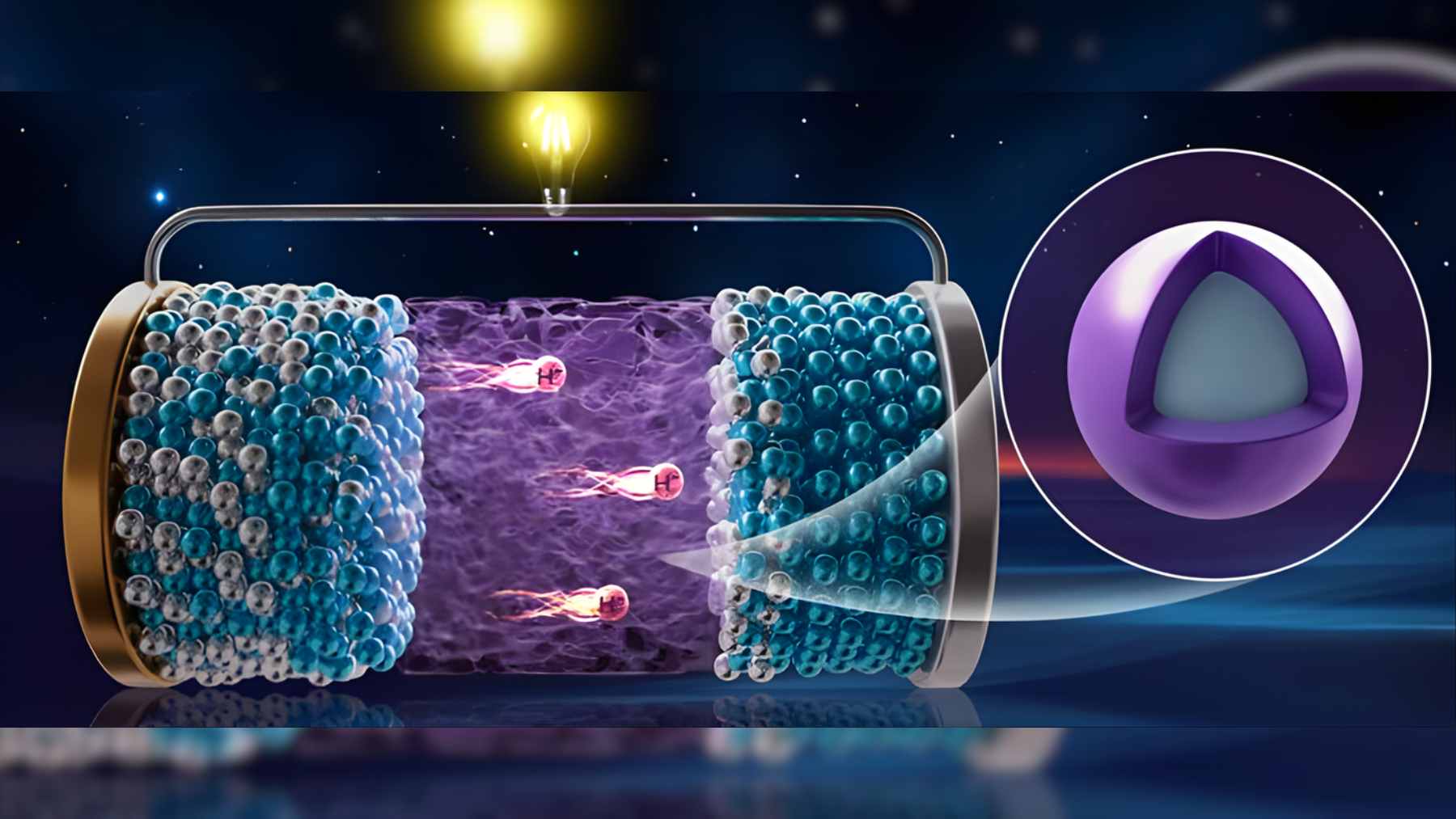
The prototype built by the group led by Ping Chen uses a positive electrode made from sodium and aluminum hydride, a well-known hydrogen storage material.
The negative electrode is a compound of cerium and hydrogen. Between them sits a specially engineered core-shell composite that combines a cerium hydride core with a thin barium hydride layer to guide hydride ions efficiently.
This core-shell material acts as a solid electrolyte that can move hydride ions at room temperature, which has been a major roadblock for the field. According to the study, it behaves as an exceptionally good ion conductor once it warms above about 60 degrees Celsius, while staying chemically stable against the surrounding materials.
In a statement, the team said that “using hydrogen as the charge carrier avoids the formation of dendrites and opens new paths for clean energy storage and conversion.”
Early performance numbers and a simple LED test
In early tests, the positive electrode delivered a specific discharge capacity close to 984 milliampere hours per gram at room temperature.
After 20 charge and discharge cycles, the cell still provided around 402 milliampere hours per gram, so performance dropped but did not collapse. For most experts, those figures signal a promising proof of concept rather than a ready-to-ship product.
In a stacked setup, the operating voltage reached about 1.9 volts. That is not much compared with the pack in an electric car, yet it is enough to power a small yellow LED lamp in the lab. Watching that tiny light turn on is a simple moment, but it confirms that the chemistry works outside computer simulations.
From lab bench to the energy transition
So what will it take to move from a shining lab demo to something that affects your monthly bill? For now, this hydrogen battery is a scientific milestone rather than a commercial device.
The cell has only been cycled a few dozen times, and engineers still need to prove that it can survive hundreds or thousands of cycles, scale up the materials, manage heat in larger packs, and connect many small cells in series to reach higher voltages.
Even so, researchers already describe hydride ion batteries as an emerging frontier in energy storage that could complement lithium rather than replace it overnight.
A recent overview in the journal The Innovation points to possible uses ranging from smartphones to electric vehicles and grid storage systems, especially where safety and material abundance matter.
At the end of the day, what this Chinese breakthrough shows is that ideas once trapped in theory can now be wired up to a real lamp.
If future work solves the durability and cost issues, hydrogen based batteries might one day help smooth out solar power after sunset and keep electric cars moving without such a heavy dependence on scarce metals.
The main study has been published in the journal Nature.