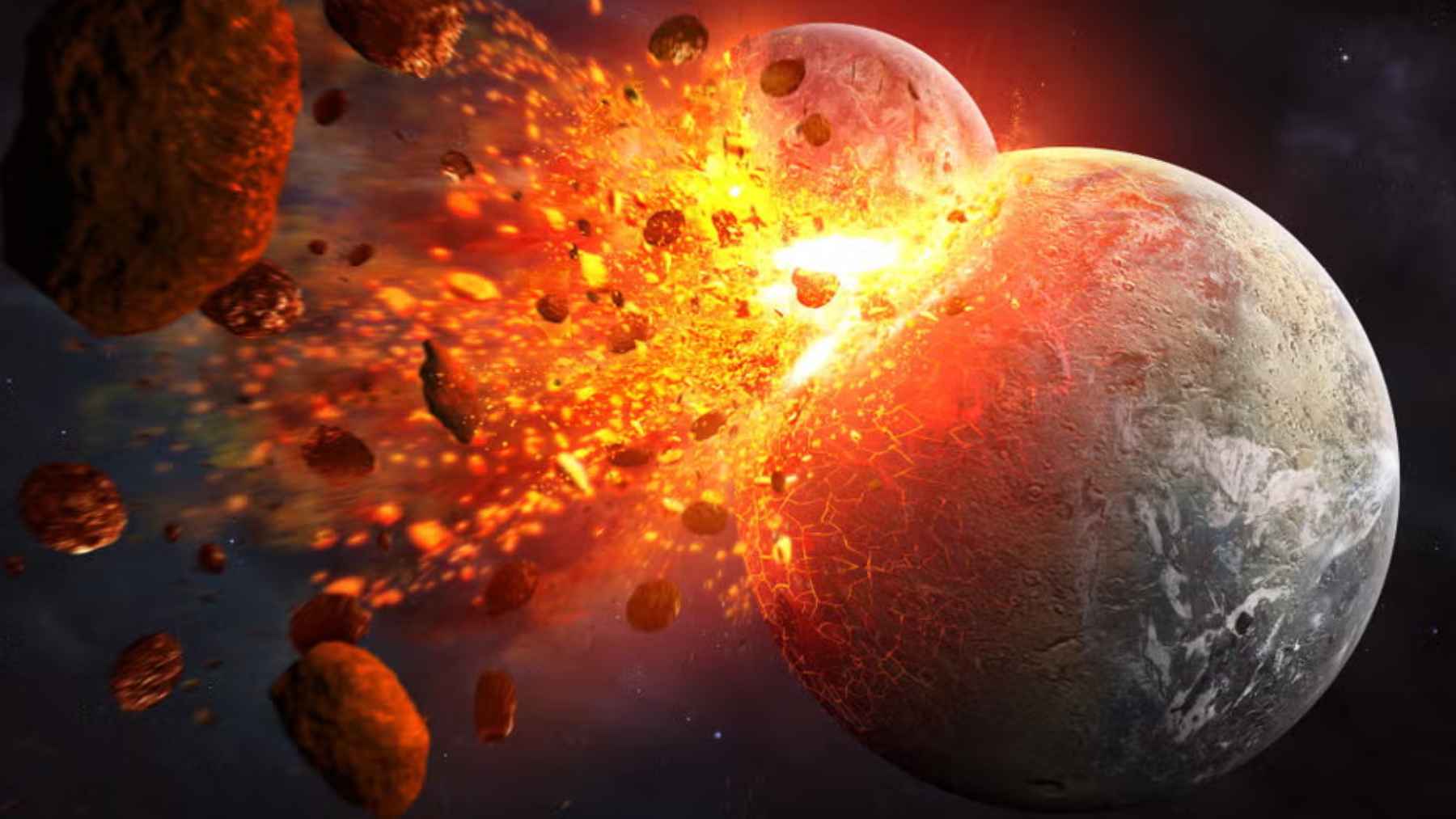
Two planets may have slammed into each other around a faraway star, and astronomers think they caught the fallout almost as it happened. In archived telescope data, the star Gaia20ehk suddenly started dimming in a way that looked less like a normal stellar change and more like something passing in front of it.
In a new analysis published on March 11, 2026, Anastasios (Andy) Tzanidakis and James Davenport at the University of Washington argue the best explanation is a catastrophic crash that filled the system with hot dust and rock. The lead author said, “Right around 2021, it went completely bonkers,” and the team says the work was supported by Breakthrough Initiatives.
The researchers also suggest next-generation sky surveys could spot on the order of a hundred similar impacts over the next decade.
A calm star that suddenly misbehaved
Gaia20ehk sits about 11,000 light-years away, which is on the order of 65 quadrillion miles from Earth, in the southern constellation Puppis. It is a main sequence star, meaning it should shine with a steady output for long stretches of time.
That’s what made the timeline jump out. The star’s brightness stayed flat for years, then showed three distinct dips starting in 2016, followed by wild, uneven flickering around 2021.
Astronomers track this kind of behavior with a light curve, which is basically a record of how bright something looks night after night. When the curve is smooth, the system is usually calm, but sudden drops often mean something is blocking the light.
Dust clouds did the dimming
The key twist is that the star itself does not appear to be the problem. The analysis points to huge clouds of dust and rocky debris orbiting the star and repeatedly drifting across our line of sight, like patchy smoke crossing a streetlight.
That kind of setup can make the star seem to flicker even if its surface stays stable. The dust acts like a moving curtain, dimming the star in different amounts depending on how thick the cloud is at that moment.
What could throw that much material into orbit so fast? The researchers argue the simplest answer is a high-energy event on a planetary scale, with two planets scraping each other a few times before a final, head-on collision.
Infrared heat tipped off the impact
Visible light was only half the story. When the team compared the star’s visible behavior with infrared observations, they found the curves moved in opposite directions.
Infrared is heat light, so a surge can mean fresh debris still holding on to the energy of an impact. In practical terms, the dust blocks some visible light while also glowing in infrared as it cools.
In the paper, Gaia20ehk is described as likely a young F-type star, meaning it is a bit hotter and more massive than the Sun. The dust is estimated to be hot enough to glow strongly in infrared, around 1,200 degrees Fahrenheit, and the infrared brightening persisted for more than four years.
A crash at Earthlike distances
One detail makes the comparison to our own history hard to ignore. The debris cloud appears to orbit at about the same distance Earth orbits the Sun, around 93 million miles, which astronomers call one astronomical unit.
It sits in the region where rocky planets form, collide, and sometimes get rebuilt. For context, NASA describes the leading Moon origin idea as a giant impact in which a Mars-sized body hit the young Earth about 4.5 billion years ago, launching debris that later clumped into the Moon.
Could Gaia20ehk eventually grow its own planet and moon out of this wreckage? The researchers say it is possible in principle, but it could take anywhere from a few years to millions of years for the dust to settle and cool enough to clump again.
Why this matters for worlds like ours
Planetary collisions are not just cosmic fireworks. They are part of how solar systems mature, as leftover bodies smash together until the chaos calms down.
The senior author links this kind of crash to astrobiology, the study of how life might arise elsewhere. He argues that moon-forming impacts could matter because moons can shape tides and long-term conditions on a planet.
Not every scientist would phrase it the same way, and the details are still debated. But the basic idea is easy to picture if you have ever watched the ocean rise and fall at a beach, or thought about how one big impact could change a planet’s future. Small causes, huge consequences.
The next decade could bring many more catches
If a planet collision really is behind Gaia20ehk, it raises a practical problem. These events are probably common in young systems, but they are hard to spot because the debris has to cross the star from our viewpoint and the changes can unfold over years.
So wide, fast sky surveys matter. The Legacy Survey of Space and Time at the Vera C. Rubin Observatory is designed to take hundreds of images a night for a decade, building the kind of time-lapse record that makes slow-motion events easier to catch.
A 2016 review of giant impacts argues that collisions should be a normal part of rocky planet formation, but the dusty aftermath may only be detectable for a limited window of time. That kind of work helps explain why catching Gaia20ehk’s debris at the right moment could be luck, not a once-in-the-universe event.
The main study has been published in The Astrophysical Journal Letters.