Most climate headlines talk about targets decades away. This time, the change is sitting inside a real engine that power plant operators can actually order, install, and hook up to their existing gas lines.
In late September 2025, Kawasaki Heavy Industries began selling what it calls the world’s first large gas engine that can run on natural gas mixed with up to 30% hydrogen by volume, backed by a full warranty and service program.
For anyone worrying about their electric bill while also hearing nonstop about carbon cuts, this is a very practical step. It does not solve climate change on its own. It does show how industry can lower emissions without ripping out pipelines or building brand new plants from scratch.
The first 30% hydrogen gas engine hits the market
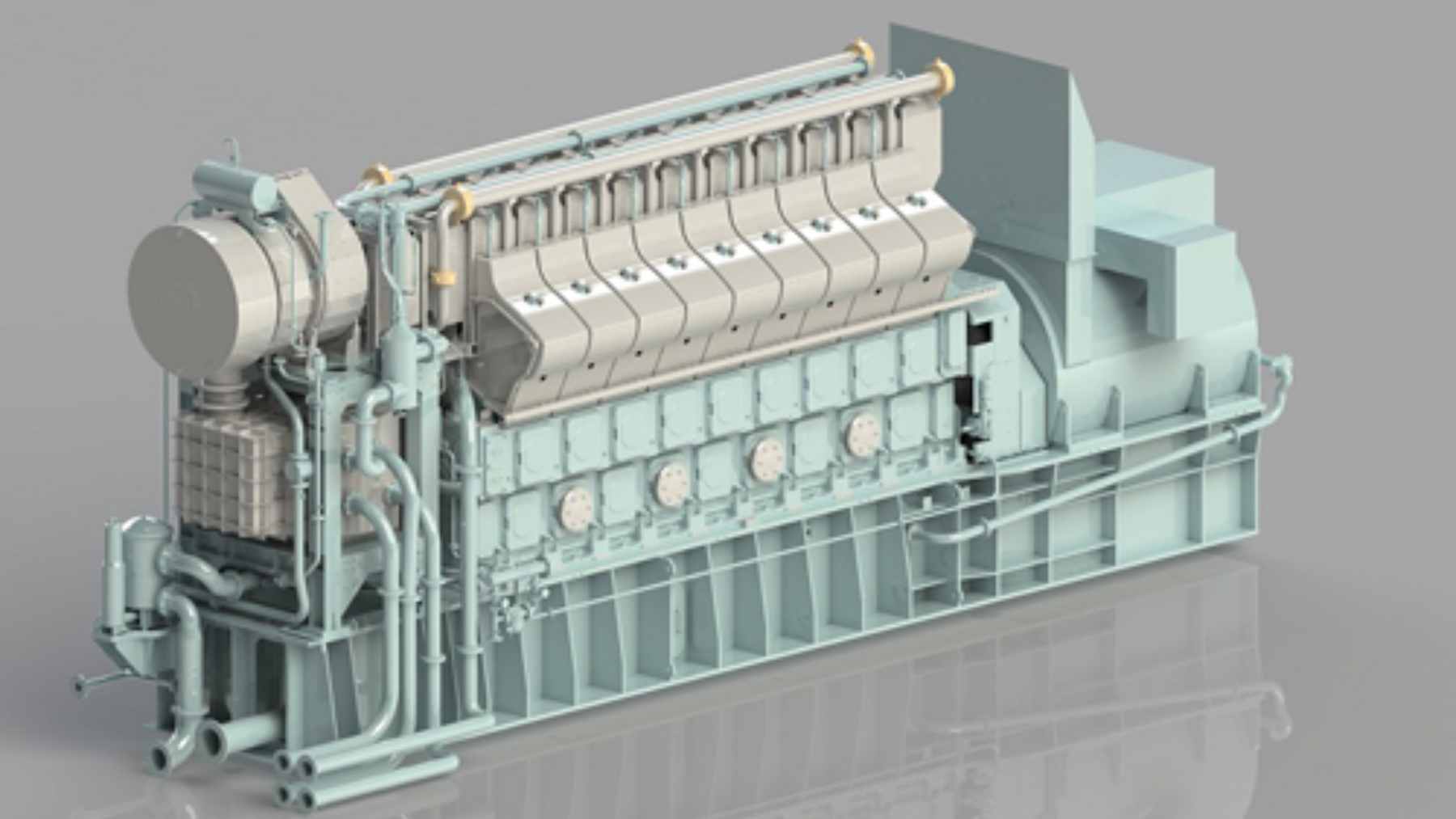
Kawasaki’s hydrogen co-firing unit is built on its existing Green Gas Engine platform, part of the KG Series that has logged more than 240 orders in the 5-to-8-megawatt range since 2011.
In tests at the company’s Kobe Works, an 8-megawatt class system ran for eleven months on natural gas enriched with up to 30 percent hydrogen by volume. Engineers focused not just on combustion, but on maintainability, integration with a hydrogen supply chain, and day-to-day safety procedures.
On September 30, 2025, after those trials wrapped up, the company officially moved the design from pilot to product.
The engine is marketed as a hydrogen-ready model that can burn city gas or natural gas on its own and gradually increase the hydrogen share as more fuel becomes available.
Retrofits instead of rebuilding
A key idea here is retrofit rather than replacement. Existing KG Series engines can be upgraded to the hydrogen co-firing specification with limited changes to the machine and surrounding equipment.
Kawasaki’s technical literature explains that stable operation is possible from hydrogen blends as low as 5% by volume and that output remains in the same range even at 30%.
For plant managers, that means a gas engine bought ten years ago does not instantly turn into a stranded asset.
A facility that already relies on pipeline natural gas can adopt the new unit without replacing underground distribution lines or storage tanks, because the 30% mix is compatible with current networks in many cases.
Safety has been a central concern, since hydrogen molecules are tiny, diffuse quickly, and ignite across a wider fuel-air range than methane. Kawasaki added hydrogen leak detectors around the fuel system, enclosed areas where gas might accumulate, and nitrogen purge systems that flush lines during startup, shutdown, or fault events.
The company also redesigned piping to cut down on flanged joints where gas could seep out.
Hydrogen at sea for cargo ships
The same transition mindset is now reaching the ocean. On October 28, 2025, a consortium including Kawasaki, Yanmar Power Solutions, and Japan Engine Corporation announced the world’s first land-based operation of marine hydrogen engines.
The demonstration, held at Japan Engine’s headquarters, used a newly built liquefied hydrogen fuel supply system to feed several classes of engines.
Two medium-speed four-stroke units from Kawasaki and Yanmar achieved stable hydrogen combustion at rated output. A low-speed two-stroke main engine, the workhorse type used on large container ships, is scheduled to begin operation in spring 2026.
All three designs share one feature that matters to shipowners who live with tight schedules and unpredictable fuel stops. They are dual-fuel, able to switch between hydrogen and conventional diesel, which lets crews cut greenhouse gas emissions when hydrogen is available while preserving redundancy when it is not.
This work is funded under the Green Innovation Fund, a program run by New Energy and Industrial Technology Development Organization (NEDO), which manages about two trillion yen in public money to support technologies that can help Japan reach carbon neutrality by 2050.
A race to build the fuel network
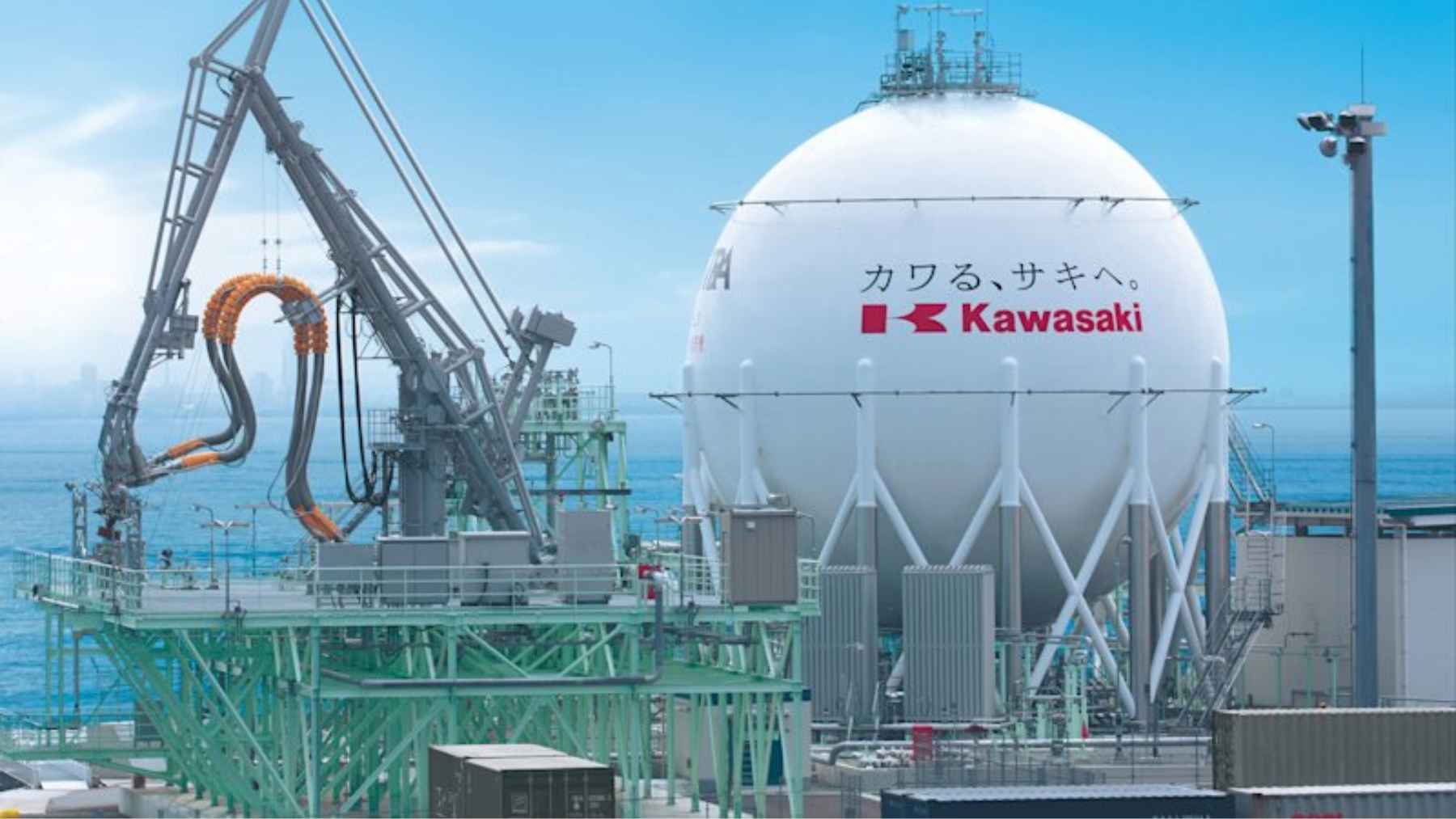
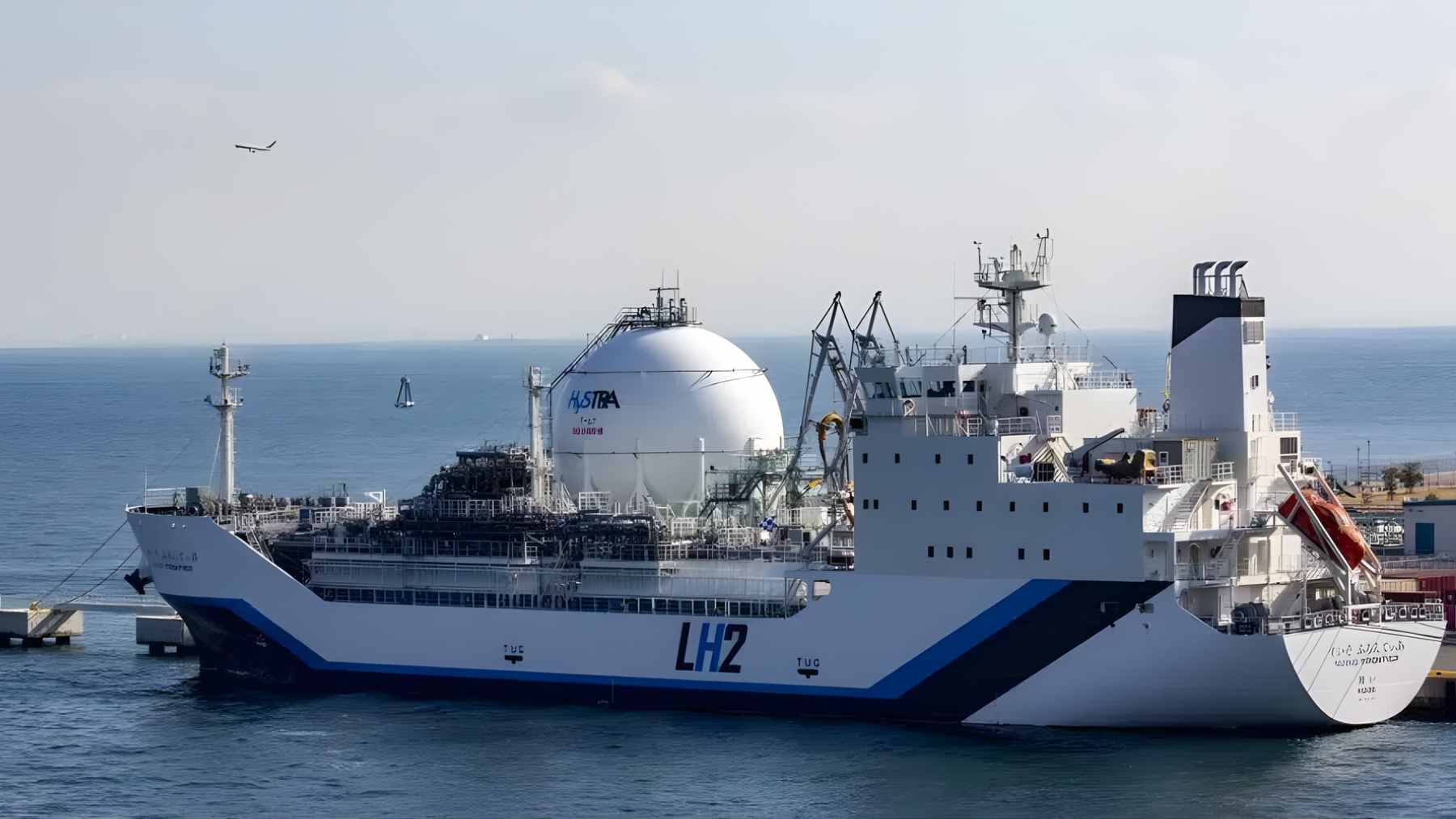
Engines are only one piece of the puzzle. The fuel has to arrive somewhere. On November 27, 2025, Japan Suiso Energy and Kawasaki held a groundbreaking ceremony for the Kawasaki LH2 Terminal in Ogishima, Kawasaki City.
The site is described as the world’s first commercial-scale terminal for liquefied hydrogen, anchored by a 50,000-cubic-meter storage tank, maritime loading and unloading facilities, liquefaction units, gas supply systems, and truck dispatch infrastructure. Operations are planned to start around fiscal year 2030.
The project includes a new liquefied hydrogen carrier with a capacity of about 40,000 cubic meters, far larger than the earlier Suiso Frontier vessel that carried pilot shipments from Australia. Together, the ship and terminal are meant to form a backbone for importing hydrogen produced overseas and supplying it to domestic industry.
Kei Nomura, who leads the Hydrogen Strategy Division at Kawasaki, has summed up the company’s view in simple terms, saying that “liquid hydrogen is a vital key to realizing a sustainable energy society” and that Kawasaki has spent years building the technology that underpins it.
What it means for the energy transition
Taken together, the new co-firing engine, the marine demonstrations, and the terminal in Ogishima show an energy transition that is messy and incremental rather than cinematic. In the short term, many buyers will likely run these engines mostly on natural gas or diesel, because hydrogen supplies at scale are still emerging.
Over time, the same hardware can shift toward higher hydrogen shares as fuel chains mature, without forcing factories or ports to start over from zero.
For households who mostly notice the grid when the lights flicker or the air conditioner drives up the summer bill, this may feel distant. Yet these are the kinds of nuts-and-bolts decisions that shape how clean that electricity is in the first place.
The press release was published on Kawasaki Heavy Industries’ website.